YGO Raises €8M Series A Led by Ventech to Connect Travel Suppliers With AI Agents
Top Picks
Submit PR
Stay Ahead of the Market
Get the latest startup funding, hiring trends and global opportunities delivered to your inbox every week.
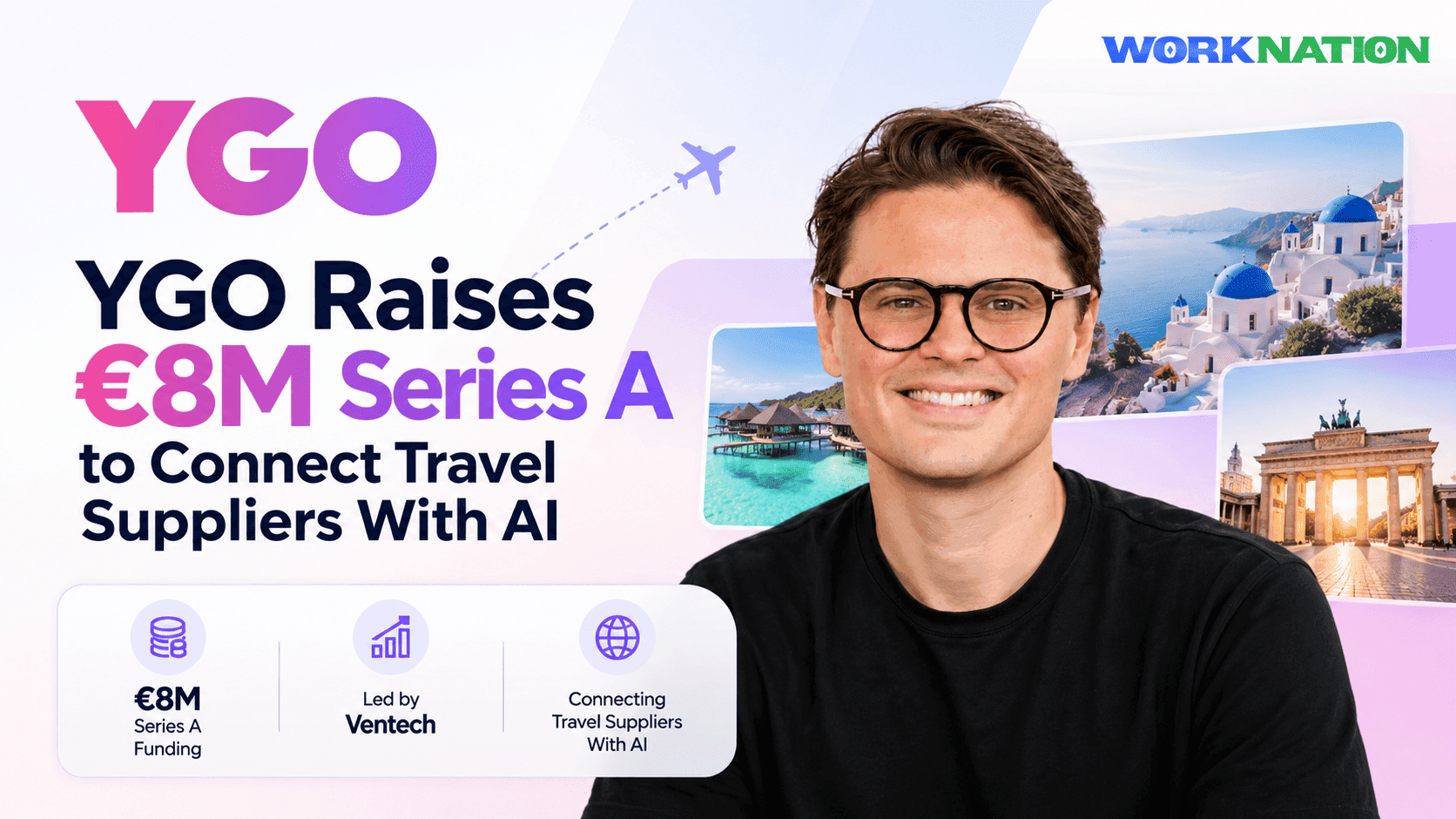
YGO, a Berlin-based travel technology startup, has raised €8 million in Series A funding led by Ventech to help travel suppliers make their inventory accessible to AI-powered assistants and booking platforms. The round also includes Sake Bosch, Caesar and several business angels.
Founded in 2023 by Julian Kögel, Willi Ibbeken and Sebastian Kreutzberger, YGO is building an AI infrastructure layer that connects hotel and travel product information with existing booking systems. Its platform helps travel companies organise fragmented data, offer personalised recommendations and enable bookings through their own websites or external AI assistants.
The company is shifting its focus from a consumer-facing travel planning app to infrastructure for travel suppliers. Its goal is to help hotels, tour operators and other travel businesses participate in a market where customers increasingly use conversational AI to research and plan trips.
YGO plans to use the new funding to expand its sales and go-to-market operations, improve its AI platform and convert its sales pipeline into new enterprise and mid-market customers across Europe and other international markets.
What Is YGO Building?
YGO provides technology that helps travel suppliers prepare their inventory and product information for AI-powered discovery and booking.
Traditional travel websites and booking systems were largely designed for people browsing pages, comparing options and entering search filters. AI assistants work differently. They need structured, detailed and context-rich information to understand a traveler's preferences and recommend relevant options.
For example, someone planning a holiday might ask an AI assistant to find a hotel with a heated swimming pool and a yoga studio within a 20-minute journey. Answering that request requires more than a hotel name, location and room price. The system needs reliable information about amenities, surroundings, availability and pricing.
YGO aims to organise this information and make it usable by AI assistants while connecting it to suppliers' existing booking infrastructure.
The platform supports several capabilities:
AI-powered semantic search that interprets travel requests expressed in natural language.
Personalised recommendations based on individual preferences and requirements.
Automated customer service for travel-related questions.
Integration with existing booking systems.
Distribution of travel inventory through suppliers' own platforms and external AI assistants.
The approach is designed to help travel businesses adopt AI without replacing their entire technology infrastructure.
Why Travel Suppliers Need AI Infrastructure
Travel suppliers have traditionally relied on online travel agencies and other distribution platforms to reach customers. These channels provide visibility and booking capabilities, but intermediaries can retain a meaningful share of each transaction.
The source article estimates that online travel agencies and metasearch platforms generally retain between 15% and 25% of each booking, although the economics vary by platform and arrangement.
YGO believes the shift toward AI-powered travel planning could change how customers discover and purchase travel products.
Instead of beginning a journey on a traditional booking website, a customer may ask an AI assistant to compare destinations, identify suitable hotels and help complete a reservation. Travel suppliers need their information to be discoverable and usable within these emerging experiences.
Without structured, reliable data, a hotel or tour operator may struggle to appear in recommendations that depend on detailed requirements.
YGO's strategy is to provide the underlying infrastructure rather than build another consumer-facing travel assistant. It wants suppliers to maintain control over their inventory and customer relationships while making their products accessible through multiple AI-powered channels.
However, the commercial benefits will depend on how AI assistants distribute recommendations, which booking integrations they support and whether travellers complete transactions through those channels.
How YGO Makes Hotel Data AI-Ready
A central part of YGO's platform is organising travel information into detailed, usable records.
The company says its platform contains more than 5,000 verified facts for each hotel listing. These details are intended to help AI systems understand a property's features and determine whether it meets a traveller's specific requirements.
For instance, an assistant responding to a request for a family-friendly hotel might need to assess available facilities, room options, location and other relevant attributes. A request for a wellness-focused stay could require information about pools, fitness facilities and nearby activities.
YGO makes this information available to AI assistants and models, including ChatGPT, Gemini, Claude and Perplexity, according to the source article.
The platform also connects travel content to existing booking systems. This is important because providing a recommendation is only part of the process. To make the experience useful, an AI-powered journey may also need access to current prices, availability and the ability to complete a reservation.
YGO's infrastructure is intended to bridge these requirements, allowing suppliers to make their products accessible through AI-powered experiences without completely rebuilding their technology stack.
The company has not disclosed a detailed technical breakdown of its integrations or independently verified the accuracy of its hotel-data coverage.
From Consumer Travel App to B2B AI Infrastructure
YGO's current business model follows a change in its original strategy.
The company initially launched as a consumer-facing travel application featuring an AI assistant named Athena, designed to help users plan short trips.
In August 2024, it raised €2.5 million in an earlier funding round led by GetAway Group. Other participants included HomeToGo co-founders Patrick Andrae and Wolfgang Heigl, Lucy Capital, Expedite Ventures and Usbeck. The FlixBus founders also invested at a later stage, according to the article.
YGO subsequently shifted its focus toward travel suppliers and the infrastructure required to connect their inventory with AI-driven discovery and booking.
The change reflects a different approach to the AI travel opportunity. Rather than competing directly for consumer attention with travel-planning applications, YGO aims to serve the companies whose products those applications recommend and sell.
The founding team brings experience in travel businesses and AI product development. CEO Julian Kögel has more than 12 years of experience in the travel industry, including work at a business-to-business-to-consumer tour operator that arranged flights and hotels across different channels.
The company says its team has grown to 20 people, with members from the United States, Africa and Europe, while its headquarters remain in Berlin.
Customer Traction and Commercial Progress
YGO reports that approximately 10 customers currently use its platform, including larger travel businesses such as Condor and Bentour.
Customers use the technology in different ways. Some incorporate its content into printed catalogues, while others distribute travel information through travel agencies and websites.
The company also reports that its platform has processed more than €15 million in bookings and reached seven-figure annual recurring revenue within six months, according to CEO Julian Kögel.
These figures suggest early commercial activity, although the article does not provide a detailed breakdown of booking volume, revenue sources, customer retention or the share of transactions directly attributable to AI assistants.
YGO is now targeting additional enterprise and mid-sized travel companies. Its immediate commercial priorities include converting its sales pipeline into signed customer accounts, expanding beyond the German-speaking DACH region and negotiating with travel brands internationally.
The new funding will support sales hiring, go-to-market activities and continued product development.
Competition Is Growing in AI-Powered Travel
YGO is entering a market where established travel companies and emerging startups are developing AI-powered consumer experiences.
Expedia acquired Berlin-based travel startup Layla, while Booking has been developing its own AI assistant, Vayo, according to the source article.
Other companies are also targeting AI travel planning. Odessia and Mindtrip are developing travel-focused AI experiences, while Omio has been exploring AI-powered multimodal travel. Entravel and Odynn are pursuing different approaches to travel distribution and booking infrastructure.
These companies do not all compete directly with YGO. Many focus on the traveller-facing experience, whereas YGO is concentrating on the supplier-side infrastructure that makes travel products accessible to AI systems.
This distinction is central to its strategy. If multiple AI assistants become important channels for travel discovery, suppliers may need infrastructure that allows them to distribute accurate information and connect booking capabilities across those experiences.
YGO's opportunity is to serve as a neutral technology layer across different platforms. Its challenge will be proving that suppliers are willing to pay for that infrastructure and that integrations can generate measurable improvements in bookings, customer relationships or distribution costs.
Why Ventech Invested in YGO
Ventech led the €8 million Series A, with Sake Bosch, Caesar and business angels also participating.
Ventech partner Nicolas Barthalon described the travel booking industry as undergoing a major structural change, arguing that much of its existing infrastructure was not designed for an AI-first environment.
He pointed to YGO's reported customer progress and its focus on providing neutral infrastructure rather than controlling the consumer interface.
The investment thesis is that travel suppliers will need new ways to make their products discoverable, understandable and bookable through AI-powered channels. Infrastructure providers could benefit if these channels become an important part of travel distribution.
YGO's funding will help it develop its platform and expand its commercial reach as travel companies evaluate how to adapt to this shift.
What Comes Next for YGO?
YGO's next stage will focus on commercial expansion and strengthening its AI infrastructure.
The company plans to increase sales and go-to-market activity, develop its platform further and turn its existing pipeline into confirmed customer accounts outside the DACH region.
Its long-term opportunity depends on whether AI assistants become meaningful booking channels and whether travel suppliers can maintain control over their inventory, pricing and customer relationships within those experiences.
There are also uncertainties. AI assistants will determine how travel products are presented, which suppliers are recommended and how bookings are completed. Established platforms such as Booking and Expedia have significant distribution capabilities and are developing their own AI experiences.
YGO is betting that suppliers will need an independent infrastructure layer to participate effectively in this evolving market.
With €8 million in new funding, approximately 10 reported customers and seven-figure annual recurring revenue, the startup has an early commercial base. The next test is whether it can scale beyond its initial customers and demonstrate that AI-ready travel data translates into sustained bookings and stronger supplier economics.
Have a Funding Round or Exciting Update to Share?
Submit your press release to get featured on WorkNation and reach founders, investors, and tech leaders.