Electric Plant Raises $11.2M to Build AI That Deciphers Electrical Signals in Plants
Top Picks
Submit PR
Stay Ahead of the Market
Get the latest startup funding, hiring trends and global opportunities delivered to your inbox every week.
Plants may not communicate with words, but they generate electrical signals that reflect their internal conditions. Startup Electric Plant wants to use artificial intelligence to interpret those signals, helping farmers and growers understand what their plants need in near real time.
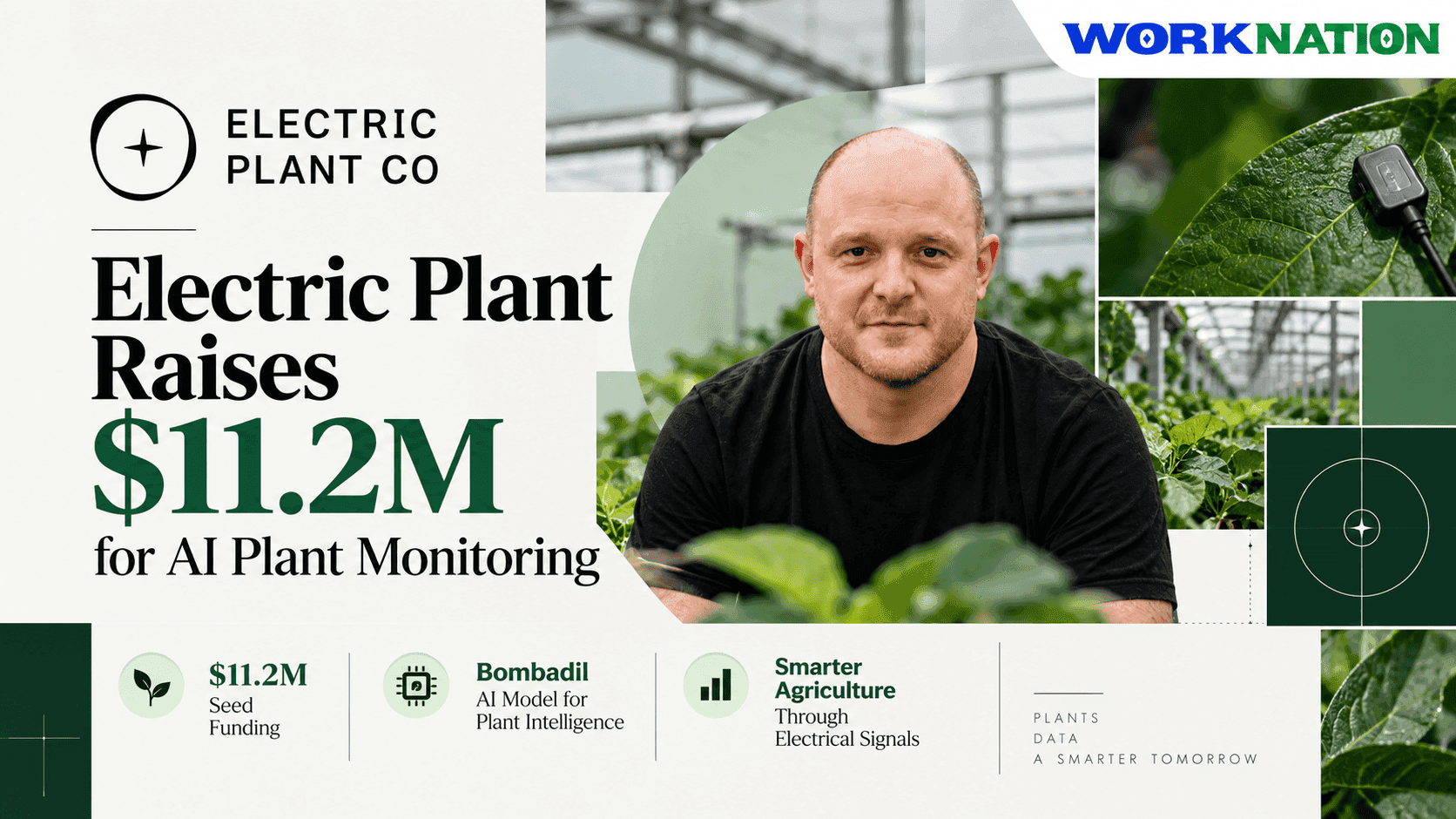
The company has raised $11.2 million in seed funding to develop its plant-monitoring technology and bring its AI model, Bombadil, and low-cost sensors to market. The round was led by Onto Ventures and Climactic, with participation from Ponderosa, Endeavor Catalyst, Ludlow, Michigan Rise, The Fund, Schox VC, and Dug Song.
Founded by Justin Mast and Lee von Kraus, Electric Plant has spent approximately three years collecting biological electrical-signal data to train a model designed to interpret plant conditions across different species. Its long-term vision is to help people understand plants through their electrical activity, potentially changing how agriculture and forestry monitor plant health.
How Electric Plant Started
Electric Plant's origins trace back to a scientific experiment that caught the attention of co-founder and CEO Justin Mast.
While reading scientific research, Mast came across a project involving a houseplant connected to a motorized stand. The system detected electrical signals associated with the plant's response to its environment and used those signals to move the plant toward a light source.
The experiment introduced Mast to the possibility of using electrical activity to understand what plants need.
He subsequently partnered with Lee von Kraus, a neuroscientist with experience working with the US Defense Advanced Research Projects Agency (DARPA), to explore whether machine learning could decode the signals generated by living plants.
Over the following three years, the team collected data to train Bombadil, an AI model designed to interpret electrical signals moving through plant tissues. Rather than relying exclusively on external observations, the approach seeks to obtain information from signals within the plant itself.
The founders ultimately hope to develop technology that makes plant communication more understandable to humans. For now, the emphasis is on listening to plants and translating their signals into useful information for growers.
What Is Bombadil, and How Does It Work?
Bombadil is Electric Plant's AI model for interpreting biological electrical signals. According to the company, it can interpret signals from approximately 125 plant species, covering a diverse range of plant types.
These include ferns, redwoods, tomatoes, and dahlias. The variety matters because a system designed to work across different species could have applications beyond a single crop or growing environment.
The technology combines physical sensors with wireless data transmission and cloud-based AI processing.
The sensors are approximately the size of an iPhone folded lengthwise. They attach to a plant using stainless steel screws that penetrate the cambium, the living tissue located just beneath the bark. This connection allows the sensors to detect microvolt-level electrical changes within the plant.
The collected data is transmitted to a base station through a low-power wireless network. Bombadil then processes the information in the cloud, with the resulting interpretation delivered to the customer.
Growers could use these insights to make decisions about irrigation, fertilizer application, and other growing conditions.
For example, instead of depending entirely on soil moisture readings or periodic visual inspections, a grower could use the system's interpretation of plant electrical activity as another source of information when adjusting watering schedules.
The company says only a couple of sensors per acre may be needed for accurate results. If that claim holds up across different environments and commercial applications, it could make plant-level monitoring more affordable and practical for large growing areas.
However, the article does not disclose independent validation results, detailed accuracy measurements, or customer-specific performance data.
Why Existing Plant-Monitoring Tools Leave a Gap
Farmers and growers already use various technologies to understand growing conditions. Soil probes, handheld spectroscopes, and satellite imagery can provide useful information about moisture, vegetation, and other environmental factors.
These tools have helped modernize agriculture, but Electric Plant argues that many primarily measure conditions around a plant or observe it externally rather than directly interpreting its internal electrical activity.
That distinction is central to the startup's approach.
Soil probes can provide information about conditions in the soil, while satellite imagery can help monitor vegetation across large areas. Yet these measurements do not necessarily provide a complete, real-time picture of a plant's changing needs.
Electric Plant wants to add another layer of information by interpreting electrical activity within living plant tissues.
Its technology could complement existing monitoring systems rather than immediately replace them. The practical value will depend on whether its readings reliably translate into better decisions under real agricultural and forestry conditions.
The startup also highlights the cost of conventional equipment as an obstacle. According to Mast, some existing tools cost thousands of dollars, while Electric Plant's sensors are expected to cost tens of dollars.
Combined with the company's estimate of a couple of sensors per acre, the proposed pricing could make continuous monitoring accessible to more growers if the hardware, connectivity, and ongoing service costs remain manageable.
Potential Benefits for Agriculture and Forestry
Electric Plant's technology could be relevant to agricultural producers, greenhouse operators, and forestry organisations that need to monitor plant conditions over time.
One potential application is irrigation management. If the system can reliably identify signals associated with a plant's water needs, growers may be able to adjust watering schedules more precisely.
Another application is fertilizer management. Better information about plant conditions could help growers evaluate when interventions may be necessary, although the source does not establish that Bombadil can already identify specific nutrient deficiencies with validated accuracy.
The technology may also be useful in forestry, where monitoring trees across large areas can be difficult and expensive. Electric Plant's reported ability to work across different species could support broader monitoring applications, subject to further testing.
Mast claims that the system could increase crop yields while reducing water use by 20% or more. These are company-reported expectations, not independently verified outcomes presented in the article. The actual results would likely depend on crop type, local conditions, existing agricultural practices, and how growers act on the information.
The company has not disclosed the identities of its initial customers, so the extent of its current commercial deployment remains unclear.
Electric Plant Raises $11.2M to Commercialise Its Technology
The $11.2 million seed round will support Electric Plant's efforts to bring its sensors and Bombadil model to market.
Onto Ventures and Climactic led the investment, joined by Ponderosa, Endeavor Catalyst, Ludlow, Michigan Rise, The Fund, Schox VC, and Dug Song.
The funding arrives as the startup works to turn several years of research and data collection into a commercial monitoring system. Its proposition combines relatively inexpensive hardware with an AI model intended to interpret biological signals across a wide range of plant species.
The article does not disclose the company's valuation, detailed allocation of the funding, revenue, or customer count. It also does not identify the first markets or crops the company will target commercially.
Those details will matter as Electric Plant moves from developing its technology to demonstrating its value in day-to-day operations.
What Comes Next for AI-Powered Plant Monitoring?
Electric Plant is pursuing a different approach to agricultural intelligence: using biological electrical signals as a source of information about plants' internal conditions.
Its long-term ambition is broader than simply building another agricultural sensor. The founders envision a future in which technology can help people understand plant responses and needs more directly.
For now, the immediate challenge is to show that Bombadil can interpret those signals consistently and that its insights lead to measurable improvements in crop management or forestry operations.
The startup's reported coverage of approximately 125 species and its proposed low-cost sensor design provide a starting point. Commercial adoption, however, will depend on accuracy, reliability, ease of installation, and demonstrated benefits for growers.
If Electric Plant can establish those results, its technology could become a useful addition to the tools farmers use to manage water, fertilizer, and growing conditions.
The company's $11.2 million seed funding gives it additional resources to pursue that goal. Whether plants' electrical signals can deliver practical, scalable insights remains the key question as the startup moves toward commercial deployment.
Have a Funding Round or Exciting Update to Share?
Submit your press release to get featured on WorkNation and reach founders, investors, and tech leaders.