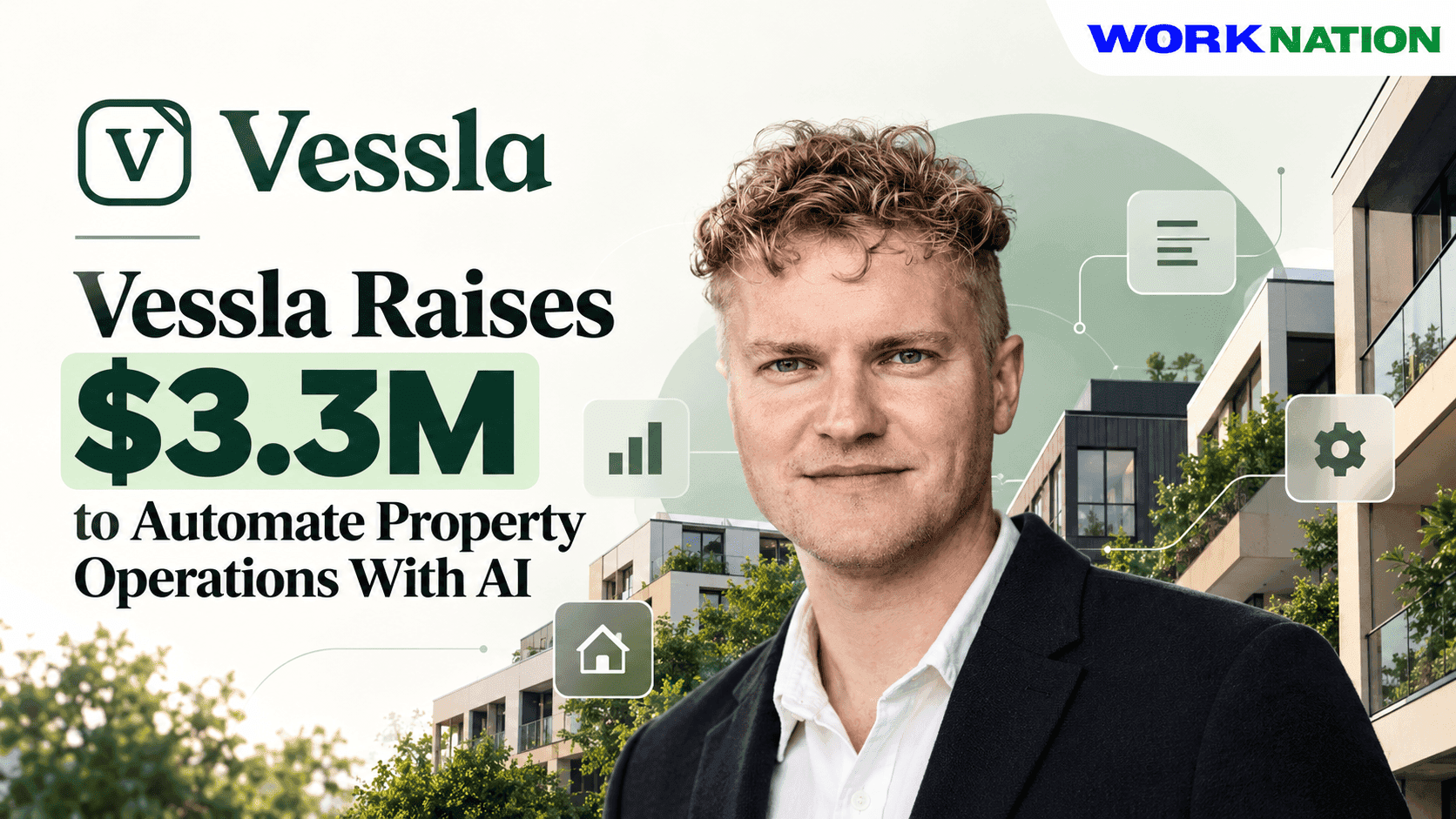
Vessla Raises $3.3M Pre-Seed to Automate Property Operations With AI Agents
Top Picks
Submit PR
Stay Ahead of the Market
Get the latest startup funding, hiring trends and global opportunities delivered to your inbox every week.
Vessla, a Stockholm-based property technology startup, has raised $3.3 million in an oversubscribed pre-seed funding round led by Seedcamp. The company is developing AI agents designed to automate property operations and coordinate work across the software systems that real estate businesses already use.
The round also attracted investment from Inception Fund, Tiny VC, operators from Lovable and OpenAI, Lukas Saari of Tandem Health, Fredrik Hjelm of Voi and Pit, and several angel investors.
Founded in 2026, Vessla aims to address a persistent challenge in property management: coordinating tenants, property managers, suppliers, and finance teams while ensuring information moves correctly between different systems and operational tasks are completed.
Rather than requiring property companies to replace their existing software, Vessla is building an AI layer that works alongside it. Its longer-term ambition is to develop an operating system for entire property portfolios, connecting leasing, building operations, and investment planning.
Vessla's $3.3M Pre-Seed Funding Round
Seedcamp led the oversubscribed $3.3 million pre-seed round. Other investors include Inception Fund, Tiny VC, operators from Lovable and OpenAI, and individual investors with experience across technology, healthcare, mobility, and enterprise software.
The funding will support Vessla as it develops its AI-powered property operations platform and works toward its broader vision of connecting activities across real estate portfolios.
The announcement does not disclose the company's valuation or provide a detailed breakdown of how the funding will be allocated.
The investor mix brings together early-stage venture capital firms and operators associated with companies building AI products and enterprise technology. For Vessla, the central opportunity is to apply advances in AI agents to the practical work involved in managing properties and coordinating business processes.
The round comes as AI companies increasingly move beyond tools that generate text or answer questions toward systems designed to carry out tasks within business workflows.
Why Property Operations Are Difficult to Automate
Property operations involve multiple parties and systems. Tenants raise requests, managers coordinate maintenance, suppliers provide services, and finance teams handle payments and related administrative work.
Completing a task often requires information to be collected from different sources, checked against organisational rules, transferred between software systems, and followed through until the next action is completed.
These processes can involve considerable coordination. Even when property companies already use software for individual functions, information and responsibilities may still need to move between systems and people.
Vessla is targeting this coordination layer with AI agents that can gather relevant information, follow company-specific rules, and assist with tasks through connected software.
The company says existing systems will remain in place. Its approach is intended to work with the tools property businesses already rely on instead of requiring them to replace their software infrastructure.
People will continue to make decisions that require judgment or approval. This distinction is important because property operations can involve exceptions, financial consequences, tenant relationships, and decisions that cannot be handled safely through routine automation alone.
Building an AI Operating System for Property Portfolios
Vessla's longer-term objective is to develop an operating system that connects leasing, building operations, and investment planning across entire property portfolios.
The platform is designed to help property teams set priorities while AI agents identify potential opportunities to increase income and reduce costs, then assist with the operational work required to pursue them.
For example, the company's stated approach could support coordination across existing property software and workflows. However, the supplied announcement does not provide specific customer case studies or independently verified savings figures demonstrating the platform's results.
The broader vision goes beyond automating isolated administrative tasks. By connecting information across multiple property functions, Vessla wants to help organisations coordinate operations across their portfolios rather than manage each process separately.
Achieving that goal will require reliable integrations, access to relevant business context, and clear boundaries around what AI agents can execute independently. The company itself identifies these requirements as central to making AI useful in complex enterprise environments.
A Founding Team With AI and Enterprise Experience
Vessla's founding team brings experience in AI development, consulting, enterprise software, and technology strategy.
Kasper Janehag began his career working in the space industry on NASA's Mars 2020 mission. He later led major AI projects at QuantumBlack, McKinsey's AI arm.
Chief scientist Arash Dabiri has developed and tested agentic AI applications at Andon Labs and QuantumBlack. CEO Orman Gazvini has advised major software companies at McKinsey and worked on strategy and mergers and acquisitions at Pophouse.
Other founding team members have experience at Legora, Stanford, and Netlight.
The team believes the main challenge in enterprise AI is not simply producing an impressive demonstration. It is making AI agents work reliably across existing systems, handle complicated business processes, and operate within appropriate limits.
Janehag has highlighted the importance of integrations, business context, rigorous evaluation, and clear restrictions on what agents can do.
Gazvini has similarly argued that AI could change how property companies manage maintenance, costs, leasing, and rental income, while human judgment and responsibility remain important.
Why Seedcamp and Inception Fund Are Backing Vessla
Seedcamp led the funding round, with partner Felix Martinez pointing to the team's experience building advanced AI applications and deploying them in high-stakes enterprise environments.
Inception Fund founder and partner Oliver Molander highlighted the speed of AI development and the challenge businesses face in keeping their technology current. He argued that vertical AI companies could create value by continuously translating new AI capabilities into practical applications for specific industries.
That thesis is relevant to property technology, where businesses must work across existing software, operational rules, and real-world processes.
For Vessla, the opportunity is to help property companies adopt new AI capabilities without rebuilding their entire technology stack every time the underlying models improve.
However, turning this vision into a sustainable business will depend on practical execution. The company will need to demonstrate reliable automation, meaningful customer outcomes, and the ability to work across varied property systems and workflows.
Competition in AI-Powered Property Technology
Vessla is entering a market where other companies are applying AI to real estate operations.
New York-based Uniti raised a $12 million Series A led by Pathlight to support AI agents handling leasing, maintenance, and collections for self-storage and multifamily housing operators.
ProptechOS offers an agentic software suite for real estate companies, while EliseAI has raised a $250 million Series E to expand its AI-powered offerings.
These companies operate in overlapping areas of property technology, but their precise products, target customers, and deployment models differ. They should not be treated as identical competitors.
The wider funding environment also suggests growing investor interest in AI-powered real estate technology. According to the source article, AI-native proptech companies raised approximately $4.5 billion in venture financing during 2025, while their share of total proptech venture financing increased by 42%, citing the Center for Real Estate Technology & Innovation.
AI agents are also spreading into other operationally complex sectors, including hospitality and financial administration. This broader movement provides context for Vessla's strategy of applying AI to repetitive coordination work inside a specific industry.
What Comes Next for Vessla?
Vessla's immediate challenge is to show that its agents can deliver dependable results across real property operations.
The company will need to demonstrate how its platform integrates with existing software, handles exceptions, and keeps people involved when decisions require approval or professional judgment.
It will also need to establish measurable customer value. The funding announcement does not disclose named property-company customers, revenue, valuation, or quantified cost savings, leaving important questions about its commercial traction unanswered.
Still, the company's strategy addresses a clear operational problem: property businesses depend on coordination across people, processes, and software, and AI agents could help reduce the manual work involved.
With $3.3 million in pre-seed funding led by Seedcamp, Vessla is positioning itself to build an AI layer for property operations, with the longer-term ambition of connecting leasing, building management, and investment planning in one system.
Its progress will depend on whether it can turn that ambition into reliable deployments and demonstrable results for property companies
Have a Funding Round or Exciting Update to Share?
Submit your press release to get featured on WorkNation and reach founders, investors, and tech leaders.