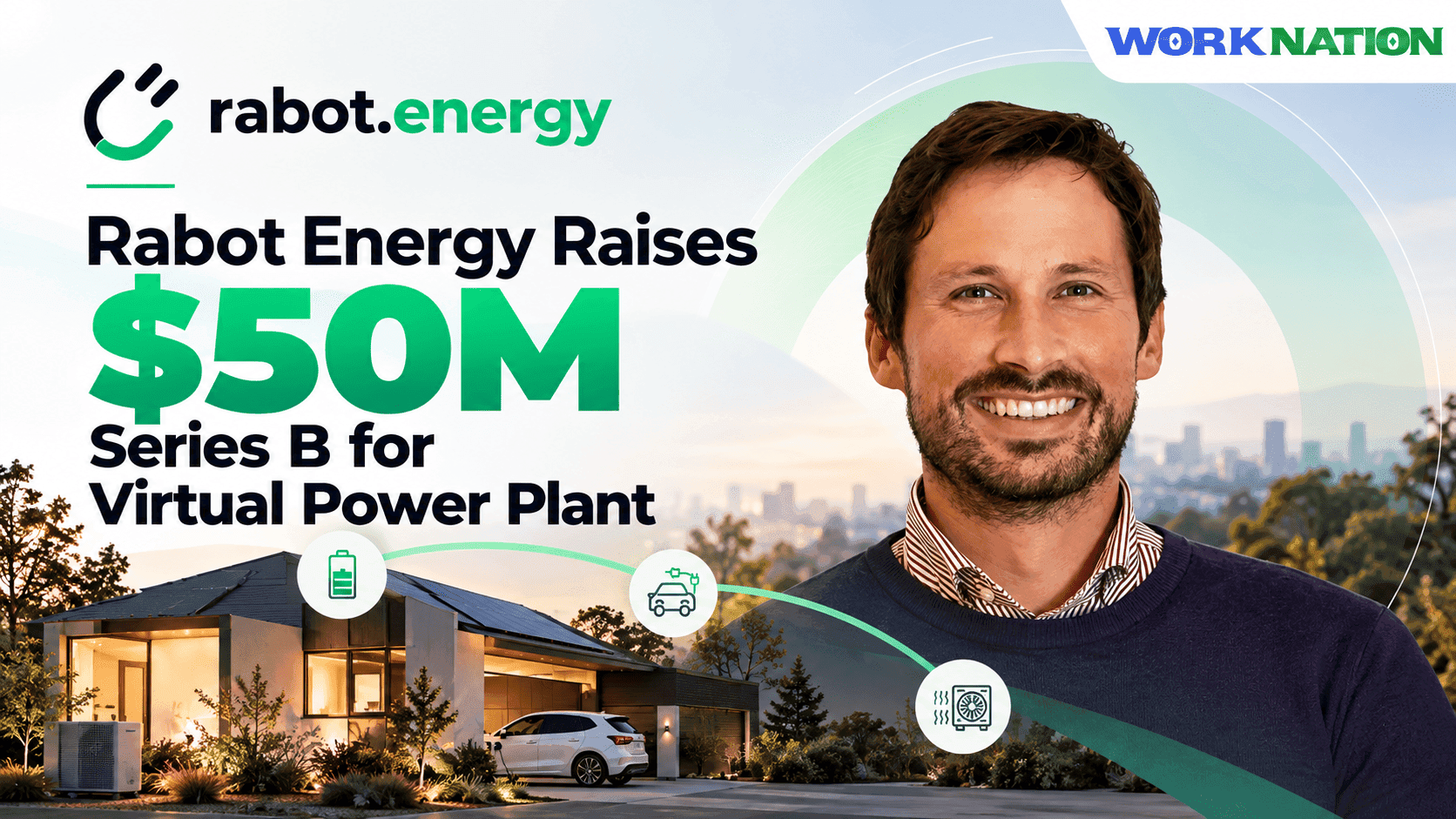
Rabot Energy Raises $50M Series B to Build a Virtual Power Plant
Top Picks
Submit PR
Stay Ahead of the Market
Get the latest startup funding, hiring trends and global opportunities delivered to your inbox every week.
Rabot Energy, a Hamburg-based climate technology startup, has raised $50 million in Series B funding led by Endeit Capital to expand its energy services and connect more household batteries and other devices into a virtual power plant.
The round also included Germany's DeepTech & Climate Fonds and existing investors HV Capital, High-Tech Gründerfonds, Bosch Ventures, CNI, Acurio Ventures, and vent.io.
Rabot Energy aims to make households active participants in the electricity system rather than simply consumers. Its platform coordinates energy consumption and storage, allowing connected batteries to charge when renewable electricity is plentiful and discharge when supply is tighter.
The company plans to use the new funding to work toward one million customers, expand services for residential and business users in Germany, and connect more devices, including home batteries, electric vehicle chargers, and heat pumps.
Rabot Energy reports that its customer base has grown from more than 35,000 in January 2024 to over 200,000. It also says it has supplied more than 600 million kilowatt-hours of renewable electricity and generates approximately €200 million in revenue.
From Energy Tariff Switching to a Digital Energy Supplier
Rabot Energy was founded by Jan Rabe and Maximilian Both, whose earlier work in the energy sector helped shape the company's business model.
Rabe studied physics in Munich before working in finance and energy trading in Switzerland. He later completed a master's degree in sustainable development in Madrid.
The founders initially launched Wechselpilot, a service designed to help customers switch electricity tariffs. The business faced difficulties when energy prices surged in late 2021.
Rabot Energy, initially known as Rabot Charge, became their next energy venture. According to the report, the founders initially financed the business themselves, while Both continues to manage Wechselpilot as a sister company.
The company subsequently attracted external investment to expand its energy supply business and develop technology that helps customers respond to changing electricity prices.
By April 2023, Rabot had secured €4.5 million across its pre-seed and seed rounds. HV Capital led a €17.5 million Series A in January 2024, while Bosch Ventures joined as an investor in July 2025 for an undisclosed amount.
The latest $50 million Series B represents another step in the company's plan to combine electricity supply with intelligent energy management.
How Rabot Energy's Virtual Power Plant Works
A virtual power plant connects and coordinates distributed energy resources instead of relying exclusively on a single, centralised generating facility.
These resources can include household batteries, electric vehicle chargers, heat pumps, and other connected equipment. When coordinated through software, they can help shift electricity consumption and storage in response to changing market and grid conditions.
Rabot Energy wants to build this kind of network by connecting devices in customers' homes and businesses.
When renewable electricity is abundant, connected batteries can charge. When electricity becomes scarcer, stored energy can be discharged, subject to the capabilities of the device and the requirements of the household.
The goal is to make distributed household equipment work together as a flexible energy resource.
For electricity customers, this could mean better use of variable electricity prices and opportunities to reduce energy costs. For the wider electricity system, coordinated flexibility could help balance changing supply and demand.
Rabot Energy CEO Jan Rabe describes the approach as a shift toward power plants that are connected rather than built as individual facilities. The company's vision is to unlock the potential of millions of households and integrate them more actively into the energy system.
However, the benefits depend on the number of connected devices, the quality of the underlying infrastructure, and the company's ability to manage those devices reliably.
Rabot Flow Brings Battery Storage to More Households
In June 2026, Rabot Energy launched Rabot Flow, a product designed to support its virtual power plant strategy.
The offering combines a dynamic electricity tariff, a smart meter, and a plug-in battery. The battery can be connected to a regular electrical socket and configured through the company's app.
According to Rabot Energy, setup takes less than two minutes, and the battery can be delivered within three days. The company also says the system can reduce average household electricity costs by 15%.
These are company-reported claims rather than independently verified savings figures.
An important feature of the product is that it does not require rooftop solar panels. This potentially makes it accessible to renters and households that cannot install their own solar systems.
That approach expands the potential customer base beyond homeowners who can invest in rooftop solar and conventional home battery installations.
The dynamic tariff is designed to help customers respond to fluctuations in electricity prices, while the battery provides a way to store energy and use it at another time.
For Rabot Energy, the product also provides a route to connecting more distributed storage capacity to its broader platform. As the number of connected batteries increases, the company hopes to coordinate them as part of a larger virtual power plant.
The commercial challenge will be demonstrating that the combined value of lower bills and any grid-related services can support the economics of the offering.
Customer Base Grows Beyond 200,000
Customer growth is one of Rabot Energy's main reported achievements.
The company had more than 35,000 customers in January 2024, when it announced its Series A funding. It surpassed 100,000 customers by the time Bosch Ventures invested in July 2025.
By October 2026, the company reported more than 200,000 customers, including approximately 15,000 business clients.
Rabot Energy also says it has supplied more than 600 million kilowatt-hours of renewable electricity and generates around €200 million in revenue.
The company previously targeted more than €100 million in revenue for 2025 and over 300,000 customers by the end of 2026. Those figures were earlier targets reported in the article and should not be interpreted as confirmed outcomes.
Rabot also claims its customers saved €45 million during 2025 compared with default supplier tariffs, based on its own calculations.
These figures point to an established energy supply business that the company can use as a foundation for expanding its connected-device strategy.
The distinction matters because building a virtual power plant requires more than attracting electricity customers. The company also needs compatible devices, reliable metering, effective energy management, and a business model that rewards customers for providing flexibility.
Endeit Capital Backs Rabot Energy's Expansion
Endeit Capital led the $50 million Series B, joined by DeepTech & Climate Fonds and existing investors HV Capital, High-Tech Gründerfonds, Bosch Ventures, CNI, Acurio Ventures, and vent.io.
Endeit Capital partner Sara Resvik said the energy transition in Germany was reaching a point where flexibility was becoming as important as expanding renewable generation. She highlighted Rabot Energy's potential to involve households in stabilising the power grid while allowing them to benefit from their flexibility.
Resvik also pointed to the company's established business and its technology for managing electricity demand at scale.
Dr Anne Hinze, senior investment manager at DeepTech & Climate Fonds, said Rabot Energy's combination of dynamic tariffs and intelligent energy management could help households benefit from an increasingly variable electricity market.
The new capital will support the company's ambition to reach one million customers, expand its residential and commercial services, and connect additional energy devices.
That growth strategy combines two related goals: expanding the number of people buying electricity through Rabot Energy and increasing the amount of flexible energy capacity it can coordinate.
Smart Meter Availability Remains a Challenge
Smart meters are an important part of dynamic electricity tariffs and virtual power plant operations because they can provide more detailed information about electricity consumption.
However, the article highlights limited smart meter penetration in Germany as a constraint on the sector. It reports that only 5.9% of metering points had smart meters.
Rabot Energy, Octopus Energy, Tibber, and Ostrom launched the Smart Meter Initiative in 2024 to help accelerate installation.
The company also allows customers to use its tariff without a smart meter by entering their monthly readings through its app, according to its website. However, manual readings and smart-meter data do not provide the same level of detail for real-time energy management.
The smart meter rollout therefore matters not only to Rabot Energy but also to other energy suppliers seeking to introduce dynamic pricing and connected-device services.
Berlin-based metiundo, a smart meter operator, raised €40 million from Octopus Energy Generation in February 2026, according to the article. Its funding highlights the investment going into the metering infrastructure needed to support the energy transition.
For Rabot Energy, expanding its virtual power plant will require continued progress in device connectivity and metering alongside customer acquisition.
Competition in Germany's Digital Energy Market
Rabot Energy operates in a competitive market that includes digital electricity suppliers, smart energy platforms, and companies developing virtual power plants.
Swedish energy supplier Tibber raised $65 million in Series B funding in 2020. Germany's Ostrom secured €20 million in June 2025 in a round led by Eneco Ventures. Ostrom says it operates Germany's largest virtual power plant and has also focused on helping customers access smart meters.
Kraken, the energy software platform developed by Octopus Energy, raised $1 billion at an $8.65 billion valuation, according to the article. Germany's 1KOMMA5° raised €70 million at a $1.35 billion valuation in 2026.
These companies pursue different combinations of electricity supply, energy management software, smart devices, and virtual power plant technology.
Rabot Energy is differentiating its offering through a plug-in battery that does not require rooftop solar, potentially making energy storage accessible to renters and other households without suitable roofs.
But the competitive environment means customer growth alone will not determine success. Rabot must also show that its device network can generate sufficient value from energy flexibility to support its business model.
Can Rabot Energy Reach One Million Customers?
Rabot Energy's new funding gives it additional resources to pursue its goal of reaching one million customers and connecting more distributed energy devices.
Its existing customer base offers a potential starting point. Rather than building a network of connected batteries from scratch, the company can introduce its energy management products to households and businesses already using its electricity services.
The challenge is that one million customers is a substantially larger scale than its current base of more than 200,000. Reaching that goal will require continued customer acquisition and the expansion of its connected-device offering.
The economics of its virtual power plant will also need to prove themselves. Rabot Energy must demonstrate that coordinated batteries and other devices can generate meaningful value through energy management and grid services, beyond the savings customers may achieve on their electricity bills.
Competition, smart meter availability, and the cost of acquiring and connecting devices will influence how quickly the business can scale.
Rabot Energy is betting that the next stage of the energy transition will involve not only building more renewable generation, but also making existing household equipment an active part of the electricity system. Its ability to turn that vision into a commercially sustainable network will determine whether its virtual power plant can grow to the scale it is targeting.
Have a Funding Round or Exciting Update to Share?
Submit your press release to get featured on WorkNation and reach founders, investors, and tech leaders.