Stride Raises £4.6M Seed Funding to Expand AI-Powered Preventive Healthcare
Top Picks
Submit PR
Stay Ahead of the Market
Get the latest startup funding, hiring trends and global opportunities delivered to your inbox every week.
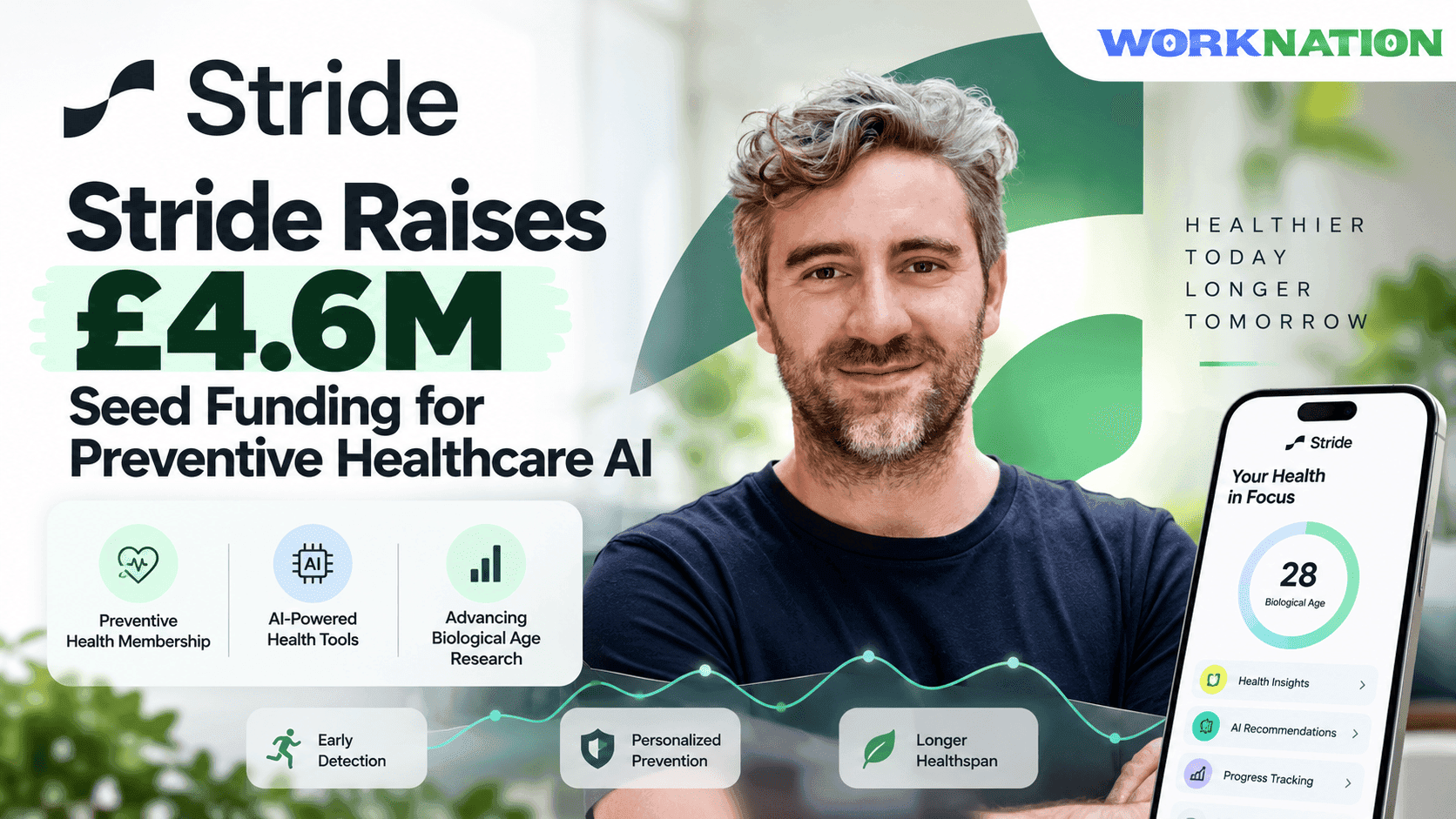
Stride, a UK-based preventive health startup founded by former Olympic sprinter Andrew Steele, has raised £4.6 million in seed funding to expand its personalised health testing and preventive care services. The round includes investment from Arāya Ventures, Better Ventures, Morgan Stanley Inclusive & Sustainable Ventures, Innovate UK, an investor from the a16z Scout Fund, and several angel investors.
Founded in 2023, Stride provides health assessments using DNA, blood and gut samples, alongside personalised insights designed to help people better understand their health. The company plans to expand its Stride One membership internationally by the end of 2026.
The funding will also support two projects backed by Innovate UK: developing a multiomic approach to assessing biological age and building an AI health copilot that can integrate laboratory results, wearable data and health records.
Stride is positioning itself in the growing preventive healthcare market, where companies are using diagnostics and personalised data to encourage people to monitor health indicators before problems become more serious.
Stride's £4.6M Seed Funding Round
Stride's £4.6 million seed round brings together venture capital investors, an innovation funding organisation and angel investors.
The participating investors include Arāya Ventures, Better Ventures, Morgan Stanley Inclusive & Sustainable Ventures and an investor from the a16z Scout Fund. Innovate UK is also supporting research and development projects associated with the company.
The funding will support Stride's international expansion plans, continued product development and research into more advanced approaches to health assessment.
A central priority is expanding Stride One, the company's preventive health membership. The service combines diagnostic testing with personalised insights, allowing members to review selected biological indicators and receive information about their health.
The company also plans to develop new technology that brings together multiple sources of health data. Its proposed AI health copilot is intended to integrate laboratory results, wearable information and health records into a more unified view of an individual's health.
Andrew Steele's Journey From Elite Sport to Preventive Health
Stride was founded by Andrew Steele, a former British Olympic sprinter who competed in the 4x400-metre relay at the 2008 Beijing Olympic Games.
Steele previously founded DNAfit, a personal genetics company acquired by Prenetics in April 2018. He subsequently served as Prenetics' chief product officer for the Europe, Middle East and Africa region before leaving in January 2023.
His experience in elite sport and personal genetics helped shape his interest in testing, monitoring and individualised approaches to health.
Stride applies a similar principle to consumer healthcare. Rather than limiting detailed health monitoring to elite athletes, the company aims to make diagnostic testing and personalised health information available to a wider audience.
Steele has argued that preventive healthcare needs to become more engaging if it is to influence behaviour at scale. The company's approach combines testing with personalised insights intended to help people understand their health indicators and make informed lifestyle decisions.
Stride's commercial opportunity depends on turning that interest into an ongoing service that members continue using beyond their initial tests.
What Stride Offers Through Its Health Membership
Stride provides testing based on DNA, blood and gut samples, alongside personalised health insights.
Its DNA testing examines genes including MTHFR, while members can arrange individual consultations with a dietitian. According to the source article, the testing kits are dispatched from a UK laboratory to customers internationally.
Stride One also provides an estimate of biological age based on nine blood biomarkers. Biological age estimates attempt to assess aspects of physiological ageing using measurable indicators, although such estimates should not be treated as definitive predictions of an individual's health or lifespan.
The service is designed to give members information they can use to better understand selected health indicators and discuss relevant findings with qualified healthcare professionals.
Stride has also begun exploring partnerships in hospitality and wellness settings. These include providing diagnostics through a health concierge at triplebond, a social wellness club located at The BoTree hotel in London's Marylebone area, and collaborating with Long Lane, an alcohol-free wellness club and hotel near Midhurst in West Sussex.
These partnerships provide additional settings through which the company can introduce its services to consumers interested in health and wellbeing.
Two New Projects: Biological Age and an AI Health Copilot
A portion of the funding associated with Innovate UK will support two technology projects.
The first involves developing a multiomic method for assessing biological age. Multiomics combines information from different biological measurement systems to build a broader picture of biological processes. Stride intends to explore how this approach could support more detailed health assessments.
The second project focuses on an AI health copilot that can integrate laboratory results, wearable data and health records.
People increasingly generate health information across multiple sources, including diagnostic tests, activity trackers and medical records. Bringing these data together could help users review information in one place rather than navigating separate systems.
Stride's proposed copilot aims to use AI to help organise and interpret these different inputs. The source article does not specify the system's final capabilities, clinical validation status or planned launch date.
As the product develops, clear boundaries between informational insights and medical diagnosis will be important. Integrating health data can help people understand patterns, but clinical decisions may still require assessment by qualified healthcare professionals.
Preventive Healthcare Is Attracting Larger Investments
Stride is entering a competitive market that includes companies offering extensive testing, personalised health assessments and preventive care services.
The source article highlights several larger funding rounds in the sector. Function Health secured $450 million in non-dilutive growth financing from General Catalyst's Customer Value Fund in July 2026. Neko Health raised $700 million in a Series C round in July 2026, while Superpower raised $30 million in a Series A round in April 2025.
In the UK and Europe, other companies are also developing preventive healthcare services. These include Emerald, which raised $2 million in pre-seed funding in January 2026, Ahead Health, which raised $10 million, and Lucis, which raised $20 million in a Series A round led by Singular.
These businesses reflect different approaches to preventive health, including AI-powered health planning, diagnostics and personalised care.
The market opportunity is substantial, but funding alone does not establish whether a particular business model will be sustainable. Companies must demonstrate that their services provide value to customers and can maintain engagement over time.
The Challenge of Retaining Preventive Health Members
One of Stride's key challenges will be encouraging members to continue using the service after their initial testing experience.
Diagnostic tests can generate interest when customers first join a health programme. Maintaining engagement requires ongoing value, clear communication of results and services that fit into people's routines.
Stride's membership model offers an opportunity to build longer-term customer relationships, but the company will need to show that members find sufficient value in repeat testing, personalised insights and any new AI-supported features.
It also faces competition from companies with significantly greater funding and resources. Differentiation will depend on the usefulness of its assessments, the quality of its customer experience and its ability to turn health information into practical, responsible guidance.
Arāya Ventures founder and managing partner Rupa Popat said the investment reflects the intersection of prevention, personalisation and the growing consumer interest in health data.
What the Funding Means for Stride
Stride's £4.6 million seed round will support its international ambitions and the development of more advanced preventive health technology.
The company's immediate priorities include expanding Stride One, researching a multiomic approach to biological age assessment and developing an AI copilot that integrates laboratory results, wearable data and health records.
Founded by Andrew Steele, Stride draws on his previous experience in personal genetics and elite sport to bring diagnostic testing and health insights to a broader consumer market.
Its next phase will depend on converting that proposition into a service that people continue to use. International expansion, responsible handling of health information and meaningful member retention will be important as the company competes in an increasingly crowded preventive healthcare market.
Have a Funding Round or Exciting Update to Share?
Submit your press release to get featured on WorkNation and reach founders, investors, and tech leaders.