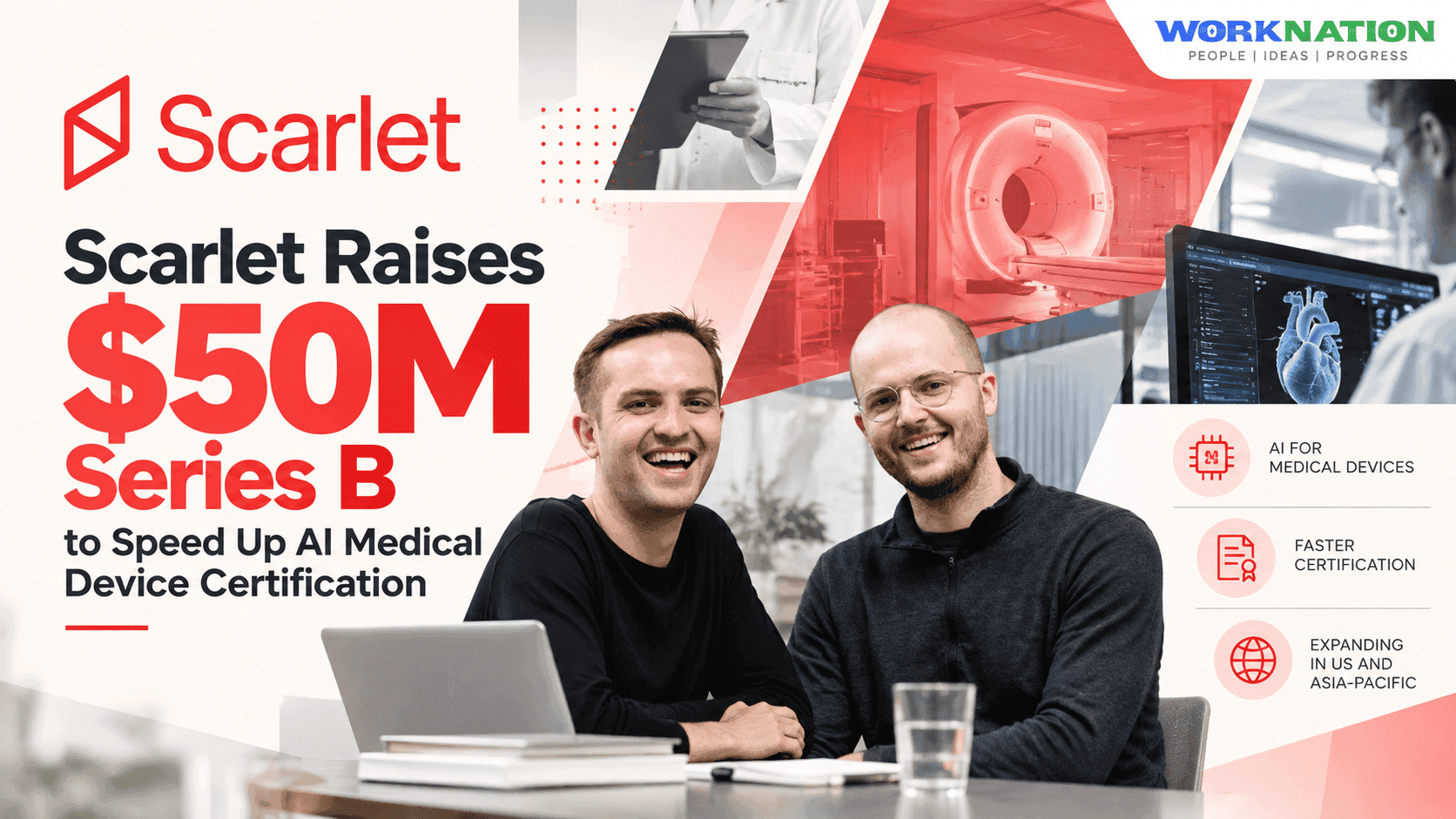
Ex-Babylon Engineers' Scarlet Raises $50M Series B to Speed Up AI Medical Device Certification
Top Picks
Submit PR
Stay Ahead of the Market
Get the latest startup funding, hiring trends and global opportunities delivered to your inbox every week.
sed digital healthcare company.
Their experience in medical AI exposed them to the challenges involved in taking healthcare technology from development to real-world deployment. Scarlet was established in 2021 to focus on the regulatory processes that determine whether medical software and AI products can be marketed.
The company operates in a specialized part of the healthcare technology ecosystem. Rather than developing diagnostic models or patient-facing applications itself, Scarlet evaluates medical software against applicable regulatory requirements.
Its role is to assess whether products meet the standards needed for certification, helping manufacturers navigate a process that can otherwise delay product launches and updates.
Scarlet's $50M Series B Funding Round
Headline led Scarlet's $50 million Series B financing, while Notion Capital joined the company as a new investor.
Existing backers Atomico, Creandum, Kindred Capital, and Entrepreneurs First also participated in the round.
The funding follows two earlier rounds. Scarlet raised £6 million in seed funding in August 2022, with Creandum organizing the round. In June 2024, the company secured $17.5 million in Series A funding led by Atomico.
Including its latest Series B, Scarlet's total funding is estimated to exceed $75 million, although the precise cumulative figure depends on currency conversion and the treatment of previous rounds.
The company has not disclosed its current valuation.
The investment gives Scarlet additional resources to expand its regulatory operations and serve medical technology companies across more markets.
Why AI Medical Device Certification Takes Time
Artificial intelligence is developing rapidly in healthcare, with applications spanning diagnostic support, medical imaging, digital health platforms, and clinical documentation.
However, developing an AI model is only one stage of bringing a medical product to market. Depending on its intended use and regulatory classification, a product may need to undergo a detailed assessment of its technical documentation, safety, performance, and compliance with applicable requirements.
Scarlet argues that this process can become a bottleneck for medical AI companies.
According to the company, training an AI diagnostic model can take only a few weeks, while regulatory assessment may take 12 to 18 months. Even relatively minor product updates can require another six to eight months under traditional processes, it says.
These timelines can affect companies that want to introduce improvements frequently, particularly when their products rely on evolving AI models and software.
Scarlet's approach is designed to make the assessment process more efficient while maintaining documented reviews and regulatory oversight.
As co-founder James Dewar explained in the company's announcement, the goal is to help promising medical technologies reach patients sooner.
Faster certification, however, must not mean weaker evaluation. Medical AI can influence clinical decisions and patient outcomes, making independent scrutiny and appropriate evidence essential.
How Scarlet's Certification Platform Works
Scarlet provides a platform through which customers can upload technical documentation in different formats.
Qualified reviewers assess the submitted materials against relevant regulatory requirements and determine whether the product meets the criteria for certification.
The company's subscription offering includes ongoing surveillance, annual audits, and assessments related to product changes. This is intended to support manufacturers beyond their initial certification, as their software evolves.
Scarlet also says it records its findings so regulators can review the reasoning behind individual decisions.
This traceability is important for medical software, where documentation and evidence help establish how a product was assessed and whether it continues to meet applicable requirements.
One example cited in the source article is Flok Health, a Cambridge-based company operating an AI-powered physiotherapy clinic. The company aims to release device upgrades twice a month, illustrating why efficient processes for evaluating software changes can matter to developers.
Scarlet's model is designed to help companies manage such updates without treating regulatory compliance as a one-time activity.
Which Companies Use Scarlet?
Scarlet's reported customers include companies across digital health, medical imaging, clinical documentation, and AI-powered healthcare services.
These include Flo Health, DeepHealth, NHS England, Skin Analytics, Heidi, Tandem Health, and Flok Health.
Their applications span different areas of healthcare, from women's health and skin cancer detection to radiology and AI-assisted clinical documentation.
The range of customers illustrates the variety of software products that may need regulatory assessment, although requirements differ according to each product's intended purpose, classification, and jurisdiction.
Scarlet says it is an EU notified body and a UK approved body, and it is listed by the US Food and Drug Administration as a recognized third-party review organization under Scarlet NB B.V.
The company also says it is the only specialist among approximately 52 bodies designated under the EU Medical Device Regulation that focuses exclusively on software and AI. This is a company-reported distinction.
Unlike broader certification organizations such as BSI, TÜV SÜD, and DEKRA, which assess products across multiple categories, Scarlet concentrates on software and artificial intelligence in healthcare.
How Scarlet Plans to Use Its New Funding
Scarlet plans to use the $50 million to expand in the United States and Asia-Pacific.
The company also intends to recruit additional reviewers and engineers, including specialists who can help it support a wider range of AI and software medical devices.
The expansion comes as medical technology companies increasingly incorporate AI into products and seek pathways to commercialize them across different markets. Regulatory requirements vary by jurisdiction, making experienced assessment teams and clear documentation important for companies operating internationally.
For Scarlet, growth will depend on increasing its capacity without compromising the independence and rigor of its certification decisions.
Headline partner Xiao McLaughlin described the company's mission as making regulation work alongside innovation rather than against it. She highlighted the founders' firsthand experience with traditional certification processes as a reason for building an AI-native alternative.
That positioning places Scarlet between fast-moving AI developers and regulators responsible for ensuring that medical devices meet the required standards.
The Outlook for AI Medical Devices
The market for AI-powered medical devices is attracting investment as healthcare providers and technology companies explore applications in diagnosis, imaging, monitoring, and clinical workflows.
However, forecasts for the sector vary significantly. The market estimates cited in the source article use different projections, making them unsuitable for direct comparison without examining their underlying definitions, methodologies, and time periods.
Regardless of the precise market size, medical AI companies face a practical challenge: products must satisfy the relevant regulatory requirements before they can be marketed for regulated medical purposes.
Scarlet is betting that a specialized, technology-enabled certification process can reduce unnecessary delays while preserving regulatory accountability.
Its latest funding round provides capital to expand its geographic reach and increase its review capacity. The longer-term test will be whether the company can deliver faster assessments consistently while maintaining trust among regulators, manufacturers, healthcare professionals, and patients.
Certification also requires difficult decisions. A company paying for an assessment must still be prepared to accept an unfavorable outcome if its product does not meet the required standards.
For Scarlet, the opportunity is to make medical AI certification more efficient. Its credibility will depend on demonstrating that speed and rigorous oversight can coexist.
Have a Funding Round or Exciting Update to Share?
Submit your press release to get featured on WorkNation and reach founders, investors, and tech leaders.