Former Plaud Executive Raises $26M for AI Assistant Ambi
Top Picks
Submit PR
Stay Ahead of the Market
Get the latest startup funding, hiring trends and global opportunities delivered to your inbox every week.
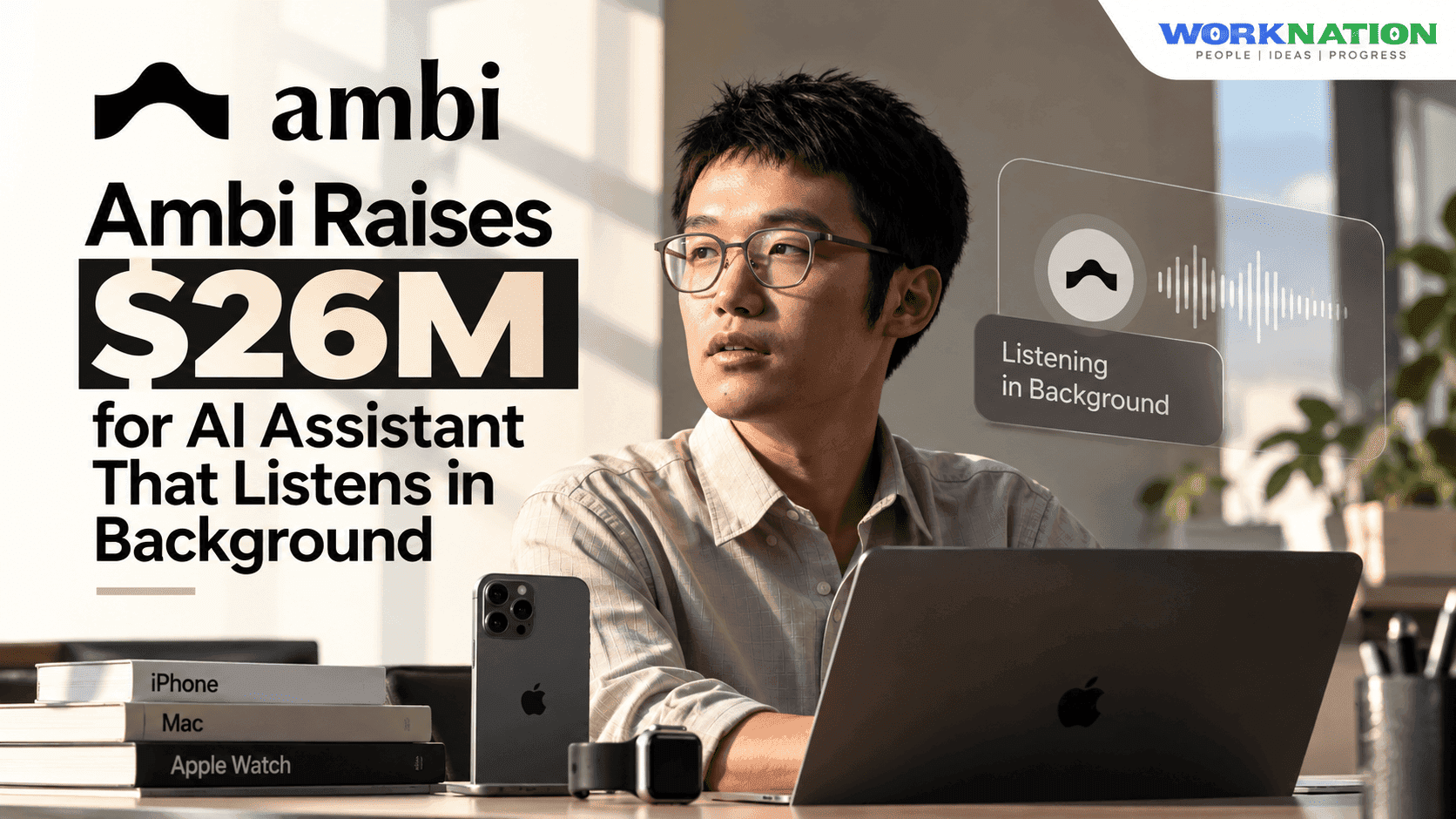
Ambi, an AI startup founded by former Plaud executive Peter Mo, has raised $26 million across multiple funding rounds to develop a personal AI assistant that can capture context throughout the day and deliver real-time insights. The company is launching applications for iPhone, Mac, and Apple Watch, with plans to expand into desktop software and dedicated AI hardware.
The startup is pursuing a broader vision than conventional AI meeting assistants. Rather than limiting its capabilities to summarizing conversations after a meeting, Ambi aims to help users act on information while conversations are still happening.
Ambi Raises $26M Across Multiple Funding Rounds
Ambi announced that it has raised $26 million across multiple funding rounds led by Luminous Ventures and Huaqin, an original design manufacturer.
Luminous Ventures has backed companies including Meituan and Unitree Robotics. Huaqin's participation brings an established hardware manufacturing player into the startup's funding story as Ambi explores a combination of software, AI agents, and its own physical device.
The company is developing an assistant that can use information from users' calendars, meetings, knowledge bases, and web data to offer suggestions and surface relevant information when needed.
Its applications are designed to work across Apple devices, allowing users to begin a task on one device and continue it on another.
The funding amount and investor participation were reported by TechCrunch on October 12, 2026.
From Meeting Notes to Real-Time AI Assistance
Traditional AI meeting assistants generally focus on recording conversations, generating transcripts, summarizing discussions, and identifying action items after a call ends. Some also connect with workplace software to help automate follow-up tasks.
Ambi wants to move beyond that model by making its AI agent useful during the conversation itself.
For example, the assistant aims to surface relevant knowledge or suggestions during a meeting using the information available through connected data sources. Instead of requiring users to search for information manually or wait for a meeting summary, the system is intended to bring useful context into the conversation.
The company is also positioning its products as a way to make AI assistance available across different devices rather than tying it to a single screen or recording workflow.
Peter Mo, Ambi's co-founder and CEO, described the limitations of existing AI interactions in comments to TechCrunch. He argued that intelligence often remains confined to screens and that hardware-based recording workflows can require users to wait for recordings to transfer, upload, and process before receiving useful results.
Ambi's approach is designed to make that assistance more immediate.
Apps for iPhone, Mac, and Apple Watch
Ambi is releasing applications for Apple's ecosystem, including iPhone, Mac, and Apple Watch.
The apps can function as meeting notetakers, but users can also enable ambient listening to capture context throughout the day. This broader mode of operation is central to Ambi's ambition to offer assistance beyond scheduled meetings.
The company says its AI agent can draw on calendar information, meeting context, knowledge bases, and web data to generate suggestions or surface relevant information.
Cross-device continuity is another part of the product's design. Users can start a task on one device and continue working on another, with the goal of making the assistant available wherever it is useful.
However, the broader collection of personal context also raises questions about how much information users should allow an AI system to access and how clearly others should be informed when ambient capture is enabled.
Desktop Software and Dedicated AI Hardware Planned
Ambi's plans extend beyond its initial applications.
The startup is developing a desktop app that will be able to observe users' computer activity and retain important information in its memory. The goal is to use that context to make future suggestions more personalized.
This places Ambi in a growing category of AI products designed to help people search, retrieve, and act on information collected from their digital activity. TechCrunch cited Littlebird and Minimi as other products pursuing related approaches.
Ambi is also planning a dedicated hardware device featuring a screen, speaker, camera, and microphones. The device is intended to capture context and display information, extending the company's vision beyond smartphones and computers.
The article does not specify a launch date, pricing, or detailed technical specifications for this planned device.
Privacy and Consent Remain Major Challenges
Ambi's approach raises important questions about privacy, particularly when an AI system is designed to listen throughout the day or potentially observe activity on a computer.
The company says ambient data capture can be switched off at any time and is disabled by default. It also says it does not store users' recordings and encrypts data. However, the company did not specify the type of encryption used, according to TechCrunch.
There is also an unresolved question about how people around an Ambi user will know when conversations are being captured. The report does not establish whether the company's apps or planned hardware will provide sufficiently clear indicators to alert third parties when ambient capture is active.
This matters because a user enabling an AI assistant may also capture information about colleagues, clients, friends, or other people who have not knowingly agreed to participate.
The wider AI meeting-notetaker market has already faced scrutiny over consent and recording practices. TechCrunch referenced legal disputes involving meeting transcription products and concerns surrounding Apple's newer audio intelligence features.
Mo acknowledged that disclosure remains an industry-wide challenge. He said Ambi instructs users to inform others when ambient capture is being used, while also noting that a company cannot fully resolve the issue if users deliberately conceal that recording or capture is taking place.
That distinction highlights a significant challenge for always-available AI: technical controls can help users manage collection, but they cannot by themselves guarantee that everyone affected understands what is happening.
A Growing Team Across Four Cities
Ambi currently has more than 50 employees across offices in San Francisco, Beijing, Shanghai, and Shenzhen.
Following its fundraising, the company is hiring for go-to-market roles and AI engineering positions focused on speech-recognition models.
These hiring plans suggest that the company is continuing to invest in both commercial expansion and the technical capabilities needed for its product vision.
The funding comes as startups explore AI assistants that use increasingly broad personal context to make their recommendations more useful. Ambi's strategy combines cross-device applications, proactive AI agents, desktop memory, and planned hardware in a single product direction.
Whether that approach becomes useful for everyday work will depend not only on the quality of its AI assistance, but also on whether users and the people around them are comfortable with the level of context it collects.
For Ambi, the opportunity is to make AI assistance more immediate and personal. The challenge is to deliver that convenience while earning trust around privacy, consent, and data handling.
Have a Funding Round or Exciting Update to Share?
Submit your press release to get featured on WorkNation and reach founders, investors, and tech leaders.