Healthleap Raises $38M to Help Hospitals Flag Hidden Patient Risks
Top Picks
Submit PR
Stay Ahead of the Market
Get the latest startup funding, hiring trends and global opportunities delivered to your inbox every week.
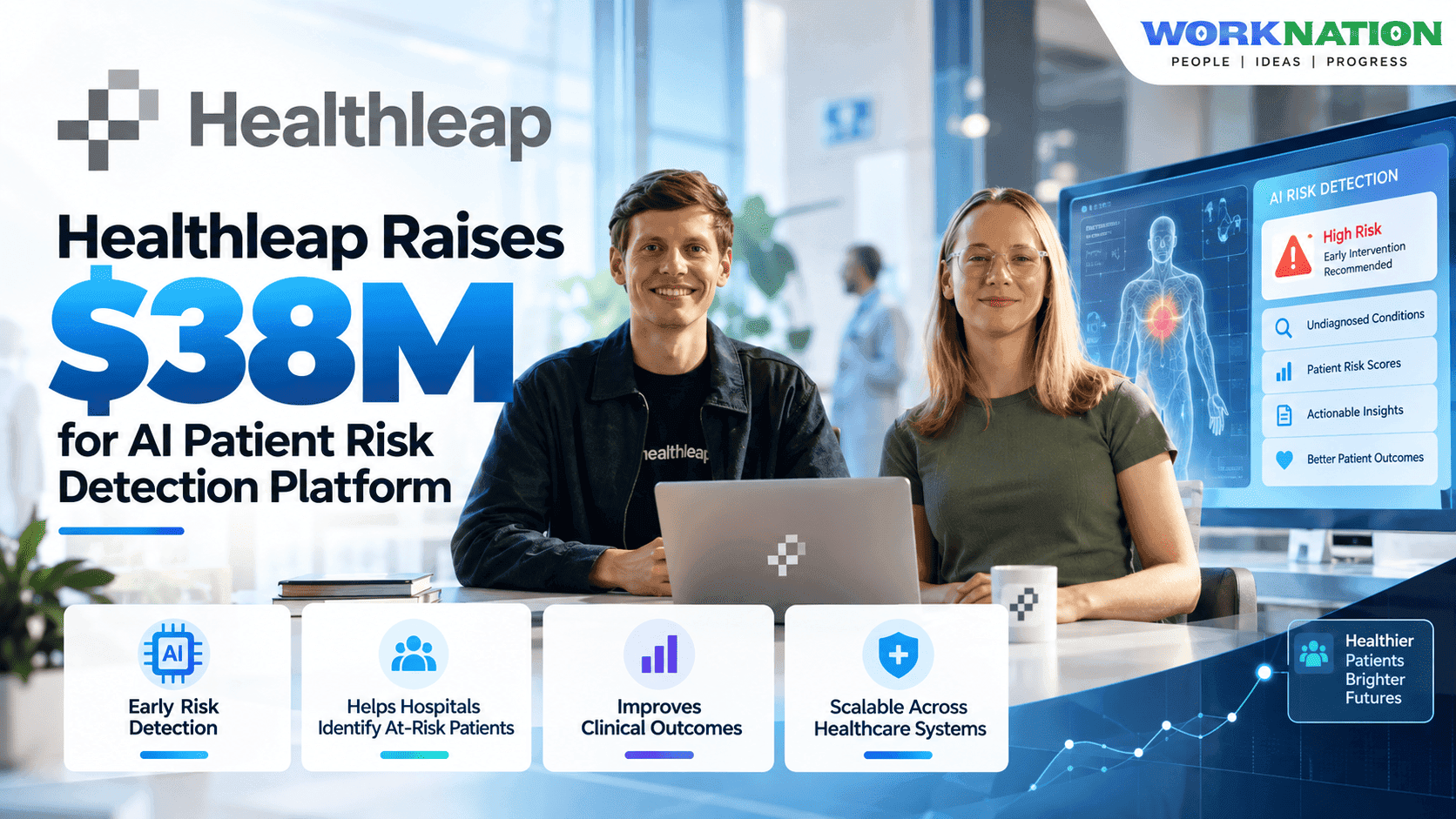
Healthleap has raised $38 million across seed and Series A funding to expand its AI platform that helps hospitals identify patients who may have undiagnosed conditions and need closer clinical review.
The financing includes an $8 million seed round co-led by Sequoia Capital and First Round Capital, followed by a $30 million Series A led by Hummingbird Ventures. Healthleap is not disclosing its valuation.
Founded in South Africa in 2022 by siblings Jemima Meyer and Josiah Meyer, the company initially built a clinical nutrition tool for dietitians before expanding into a broader AI platform for hospitals.
Today, Healthleap's technology is deployed across more than 50 hospitals.
Reading the patient chart for hidden signals
Healthleap's platform connects to a hospital's electronic health record system and analyzes both structured and unstructured patient information.
Structured data can include laboratory results, vital signs, weights, medications, diagnoses and diet orders.
But some of the most useful signals can appear in clinicians' written notes.
A doctor or nurse might document recent weight loss, poor appetite, muscle loss or difficulty swallowing without those details being captured as a structured diagnosis.
Healthleap uses language models to extract these clinical signals and combines them with structured patient information.
Its risk models then identify patients who may need additional review.
The company is careful to position the technology as a screening and prioritization tool rather than a diagnostic system.
It does not diagnose patients. Instead, it highlights potential risks for care teams to investigate.
From nutrition to broader clinical risks
Malnutrition was Healthleap's original focus.
The condition can be difficult to identify early, even though it can affect recovery and lead to complications for hospital patients.
The company's platform now also screens patients for conditions such as delirium.
Healthleap has developed additional programs for aspiration pneumonia, pressure ulcers and the risk of readmission for congestive heart failure. These programs are undergoing further clinical validation, according to the company.
The long-term goal is considerably broader.
Healthleap wants its platform to eventually cover more than 40 major health conditions and expand beyond hospitals into outpatient and home-care settings.
The system works overnight
Healthleap's approach is designed to fit into existing hospital workflows rather than require clinicians to constantly interact with another AI system.
The company says it analyzes adult inpatient records each night.
The system reviews information including laboratory results, vital signs, weights, medications, diet orders, diagnoses and clinicians' notes.
By the following morning, it produces a risk score inside the care team's existing workflow, with a dashboard providing additional information about patient trends.
The idea is simple: identify potential problems earlier, then let clinical teams decide what deserves attention.
Rapid customer growth
Healthleap says it has grown from three hospital partners to more than 50 over the past year.
Its customers now include Penn Medicine, Cedars-Sinai, Intermountain, Houston Methodist and Emory Healthcare.
The company says revenue has grown more than tenfold over the same period, although it has not disclosed specific revenue figures.
Healthleap uses three-year contracts priced according to a hospital's licensed bed count. It also offers outcome-based pricing.
According to CEO Josiah Meyer, every customer to date has achieved at least a 5x hard ROI, with some customers reporting more than 20x annual total ROI.
A large financial incentive for hospitals
The company points to its deployment at the Hospital of the University of Pennsylvania as an example.
Healthleap says its malnutrition program generated $23.8 million in annualized financial impact.
Of that amount, $6.3 million came from additional reimbursement and $17.5 million came from shorter hospital stays.
These figures are company-reported outcomes rather than independent validation, but they illustrate the financial case Healthleap is making to hospital systems.
The pitch is not simply that AI can identify more patients at risk.
It is that earlier identification can potentially improve patient outcomes while reducing avoidable costs.
Building the next layer of clinical AI
Healthleap's evolution reflects a broader shift in healthcare AI.
Many healthcare AI companies initially focused on documentation, coding or administrative automation.
Healthleap is targeting a different problem: finding clinically relevant signals that may already exist in a patient's record but are easy for busy care teams to miss.
That requires combining unstructured clinical notes with structured medical data and turning the result into something useful for clinicians.
The company plans to use the new funding to expand engineering, product, sales and customer success teams while adding support for more conditions.
Its longer-term ambition is to build a system capable of identifying risks across more than 40 major health conditions and eventually extend the platform into outpatient and home-care environments.
If Healthleap can expand its clinical coverage while maintaining strong validation and measurable outcomes, its technology could become another layer between the electronic health record and the decisions care teams make every day.
Have a Funding Round or Exciting Update to Share?
Submit your press release to get featured on WorkNation and reach founders, investors, and tech leaders.