Type One Energy Raises $200M Series B to Build Commercial Fusion Plant
Top Picks
Submit PR
Stay Ahead of the Market
Get the latest startup funding, hiring trends and global opportunities delivered to your inbox every week.
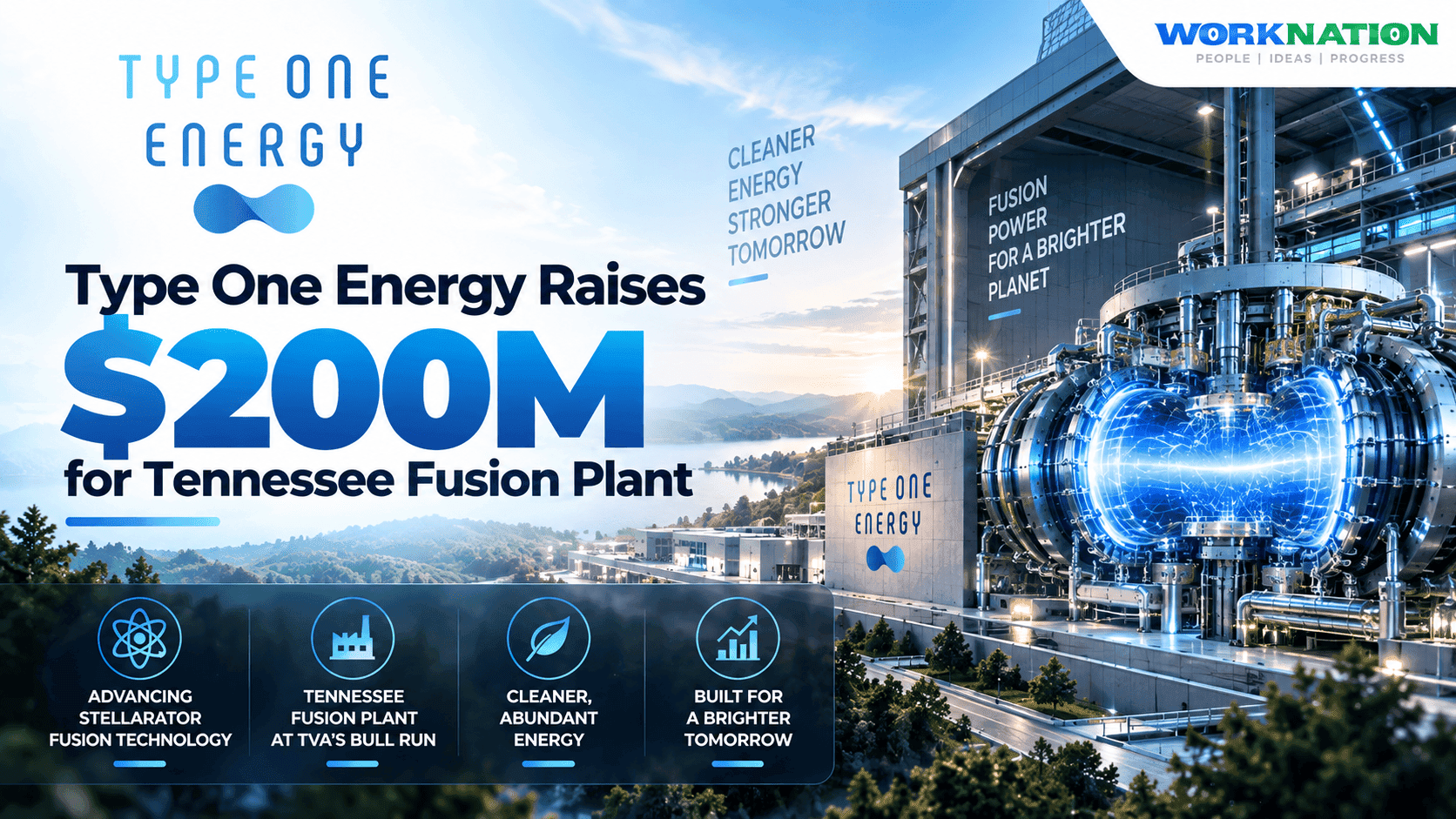
Type One Energy has raised $200 million in Series B funding to advance its plan to build a commercial fusion power plant at the Tennessee Valley Authority's Bull Run site in Tennessee.
The round was co-led by Breakthrough Energy Ventures, the climate fund founded by Bill Gates, and Clutterbuck Capital. Lowercarbon Capital, Siemens Energy Ventures and SiteGround Capital joined as new investors alongside other existing backers.
The funding will support Type One's FusionDirect technology development programme and Project Infinity, its planned fusion power project at the former Bull Run Fossil Plant in east Tennessee.
The latest round brings the company's total funding to more than $360 million, based on the company's previous financing disclosures.
From a former coal site to a fusion project
The Bull Run Fossil Plant stopped burning coal in December 2023. Type One Energy now plans to transform part of the site into a fusion power facility.
The project is being developed in two stages.
The first is Infinity One, a prototype stellarator that Type One plans to commission in 2029. The second is Infinity Two, a planned 400-megawatt electric commercial fusion power plant.
Type One is targeting 2034 for electricity from Infinity Two to reach the grid.
The project reached an important regulatory milestone in August 2026 when the Tennessee Department of Environment and Conservation issued the state's first fusion-specific licence.
That licence allows Type One to begin the first phase of Project Infinity.
Why Type One is betting on stellarators
Type One is developing a stellarator rather than the more widely known tokamak approach.
Both designs attempt to confine extremely hot plasma so that fusion reactions can occur.
A stellarator uses complex, twisted magnetic fields to contain the plasma. Unlike a tokamak, it does not require a large electric current to run through the plasma itself.
Type One argues that this can provide a more stable configuration suited to continuous operation.
The company's technology builds on decades of stellarator research, including work carried out at the University of Wisconsin-Madison and Germany's Max Planck Institute for Plasma Physics.
Type One was founded in 2019 by researchers including Randall Volberg, David Anderson, John Canik, Chris Hegna and Brian Matthews.
Chief science officer John Canik remains involved with the company, while CTO Thomas Sunn Pedersen previously worked on stellarator research at the Max Planck Institute.
A partner-led approach to commercial fusion
Type One does not intend to become a traditional utility company.
Instead, its strategy is to develop the fusion technology and sell key components and systems to power providers such as TVA, which would ultimately build, own and operate commercial plants.
That approach allows Type One to work with established industrial partners for manufacturing, engineering, financing and plant operations.
TVA issued a letter of intent for Infinity Two in 2025.
The company has also expanded its international partnerships. In 2026, Type One formed the UK Infinity Fusion Consortium with Tokamak Energy and AECOM to explore a UK fusion plant based on the same technology.
It also signed an agreement with Oak Ridge National Laboratory focused on fusion fuel-cycle technologies.
Bernard Looney, who previously served as BP's CEO, joined Type One's board in 2026.
Fusion is attracting billions
Type One's new funding arrives as private investment in fusion continues to grow.
The Fusion Industry Association reported that 56 fusion companies raised $4.48 billion in the 12 months to July 2026. Total funding into the sector since 2021 reached $14.24 billion.
But building a commercial fusion plant requires far more capital than a typical venture round.
Companies surveyed by the association estimated that a commercial fusion plant would require an average of $2.7 billion, with individual estimates ranging from $100 million to $10.9 billion.
That means Type One's $200 million Series B represents only a fraction of the capital potentially required for Infinity Two.
Other fusion companies are also raising increasingly large rounds.
Helion Energy raised $465 million in 2026 to advance its first commercial plant in Washington state, while stellarator developer Proxima Fusion raised €411 million.
Thea Energy, another stellarator company, raised $100 million in May 2026 and is also targeting the mid-2030s for commercial power.
Investors are betting on the next stage of fusion
Breakthrough Energy Ventures has backed Type One since its 2023 seed round.
Carmichael Roberts, who co-leads the investment committee at Breakthrough Energy Ventures, said the fusion sector is moving from scientific discovery toward deployment.
Siemens Energy Ventures also joined the latest round.
The investment gives Siemens Energy another position in the growing fusion market. The company is already working with Marvel Fusion on a conceptual fusion power plant.
Type One will use the new capital to continue developing its stellarator technology, advance Project Infinity and expand its relationships with industrial partners.
The company is also working toward the engineering requirements needed to turn a prototype system into a commercial power plant.
The real challenge is now execution
Fusion has spent decades moving between scientific breakthroughs and ambitious commercial promises.
Type One's project is now entering a different phase.
The company has secured a fusion-specific licence in Tennessee, has a potential site through TVA, has industrial partnerships and has raised another $200 million.
But the commercial plant will require much more capital and a long chain of engineering and industrial milestones.
Infinity One is expected to demonstrate the technology first, with Infinity Two representing the much larger commercial step.
Type One is targeting 2034 for power generation.
The next few years will show whether the company's stellarator approach can move from prototype development to a commercially viable fusion plant.
Have a Funding Round or Exciting Update to Share?
Submit your press release to get featured on WorkNation and reach founders, investors, and tech leaders.