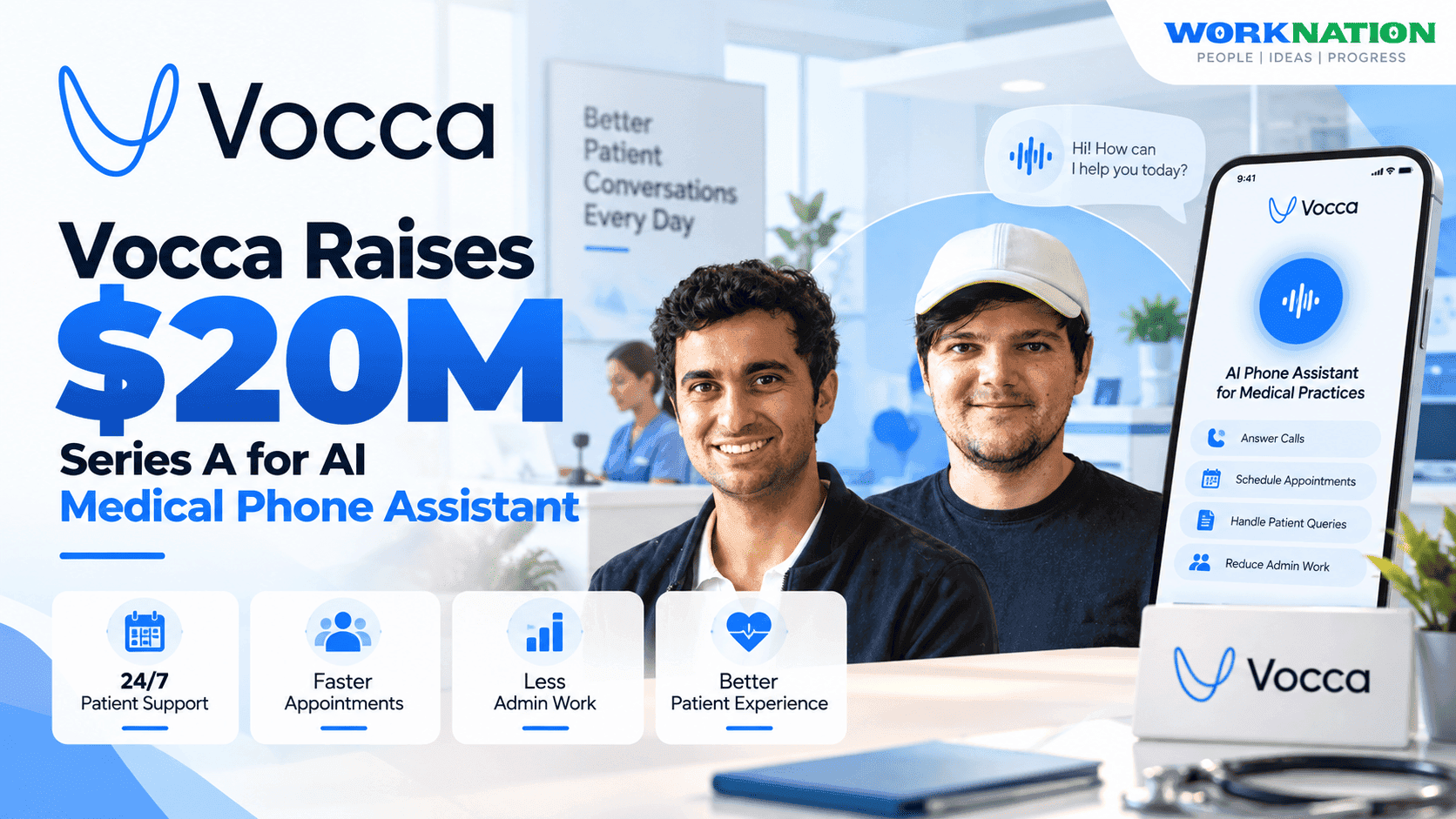
Vocca Raises $20M Series A to Bring AI Phone Assistants to Medical Practices
Top Picks
Submit PR
Stay Ahead of the Market
Get the latest startup funding, hiring trends and global opportunities delivered to your inbox every week.
Vocca has raised $20 million in Series A funding to expand its AI phone assistant for medical practices across the US and Europe.
The Paris and New York-based startup was founded in July 2024 by CEO Eliott Hoffenberg and CTO Hugo Danet. Its product answers patient calls, books appointments, explains exams and consultation preparation, and handles routine administrative requests without requiring staff to pick up every call.
The Series A was led by Norrsken VC, with participation from Heal Capital, Speedinvest and Firstminute Capital. Angel investors include the founders of French health insurer Alan and cloud monitoring company Datadog.
The latest round brings Vocca's total funding to $25 million. Speedinvest and Firstminute Capital previously co-led the company's $5.5 million seed round in September 2025.
Turning the medical front desk into an AI workflow
Medical practices receive a large volume of phone calls every day, covering everything from appointment scheduling to questions about examinations and administrative processes.
Vocca's pitch is straightforward: let an AI assistant handle much of that first-line communication.
Its agents can answer patient questions, schedule appointments and deal with administrative requests. Behind the voice interface is a scheduling engine built around specialty-specific models.
That matters because different medical specialties have different booking requirements.
A dental practice may have completely different scheduling rules from an ophthalmology clinic or medical imaging center. Vocca says its system is designed to follow these specialty-specific rules while connecting with the software practices already use.
The company says this allows practices to deploy the system within days rather than taking months to integrate a new platform.
Vocca's growth is accelerating
Vocca now serves 15,000 medical practitioners across 1,500 practices and more than 20 specialties in the US and Europe.
That represents a major increase from its September 2025 seed round, when the company served around 2,000 practitioners.
The company says inbound call volume has increased tenfold to more than 1 million conversations per month, while revenue has grown sevenfold. Vocca has not disclosed its revenue.
One of the company's most notable metrics is its conversation resolution rate.
Vocca says its agents currently resolve around 70% of conversations end to end without human involvement. Its most mature customers reportedly exceed 85%.
That distinction is important. The company is not simply trying to answer calls. It is trying to complete the task behind the call.
For a patient, that could mean calling a practice, asking for an appointment and receiving a confirmed booking without ever speaking with a human receptionist.
Healthcare AI moves beyond documentation
Vocca sees its product as part of a second wave of healthcare AI.
The first wave focused heavily on clinical documentation. Ambient AI scribes, for example, listen to consultations and help generate clinical notes.
Vocca is targeting a different part of the healthcare workflow: conversations before and around the appointment.
That creates a large potential market.
The company cites estimates that roughly 250,000 people in US healthcare businesses are employed to answer calls from patients and members. It also points to research showing that a significant portion of calls to medical practices can go unanswered during business hours.
The opportunity is therefore not just about reducing administrative workload. Missed calls can also mean missed appointments and lost revenue for practices.
Vocca's system aims to keep those conversations moving even when human staff are busy.
Compliance is critical
Handling healthcare conversations creates a much higher bar than building a general-purpose voice assistant.
Vocca says its infrastructure is designed to meet HIPAA requirements and that it operates as a HIPAA business associate for US healthcare providers.
The company also says its infrastructure partners hold SOC 2, ISO 27001 and HDS certifications.
Vocca hosts data separately in the US and EU, according to the company.
These capabilities are important as medical practices increasingly consider AI systems that interact directly with patients.
Competition is getting stronger
Vocca is entering a market that is attracting significant venture capital.
Prosper AI raised $30 million in Series A funding in June 2026 and is targeting healthcare workflows including scheduling, insurance verification and billing.
Voice AI infrastructure company Vapi has also raised substantial funding and says its agents have handled more than 1 billion calls across multiple industries, including healthcare.
In Europe, startups such as Parallel and calliora are tackling other parts of healthcare administration, including hospital paperwork and billing.
Vocca's strategy is more focused. Instead of trying to automate every administrative process, it is concentrating on patient access and the complex scheduling requirements of medical specialties.
What the funding will fund
Vocca plans to use the new capital to deepen its scheduling infrastructure, support more specialties and complex scenarios, add communication channels beyond voice, and expand further in the United States.
The company currently has around 40 employees across New York and Paris and plans to add another 40 employees across both locations by the end of 2026.
For Norrsken VC, the investment reflects the company's traction with healthcare providers.
"We've rarely seen customer love like this in healthcare," said Alexander Danielsson, a partner at Norrsken VC.
The bigger test now is whether Vocca can maintain its current resolution rates as it expands into more specialties and increasingly complicated patient conversations.
Its average resolution rate is currently around 70%, while the company's strongest customers reportedly exceed 85%.
If Vocca can push that average closer to its best-performing customers while expanding across the US, AI could take on a much larger role in one of healthcare's most persistent bottlenecks: the phone at the front desk.
Have a Funding Round or Exciting Update to Share?
Submit your press release to get featured on WorkNation and reach founders, investors, and tech leaders.