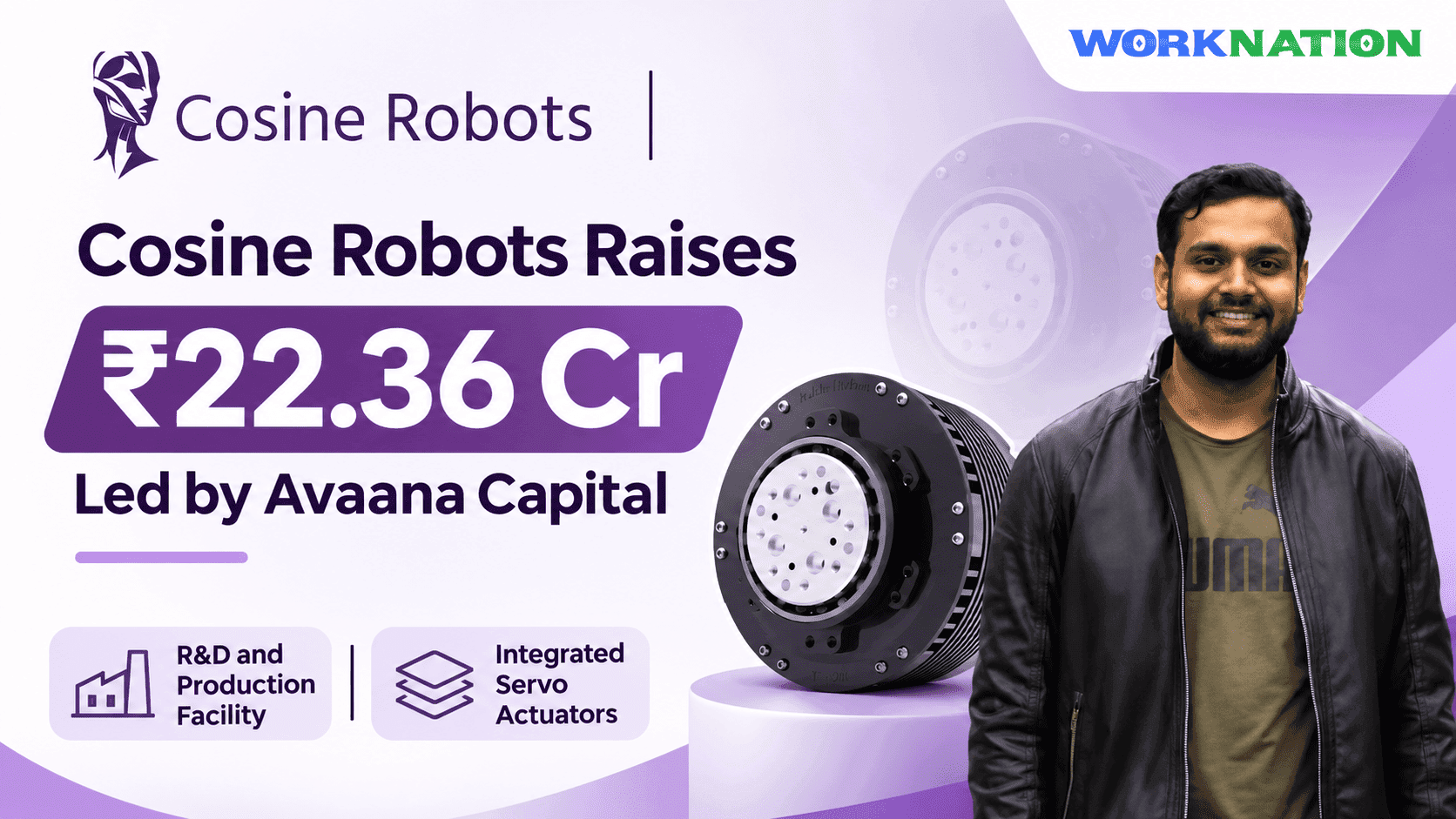
Cosine Robots Raises ₹22.36 Cr Led by Avaana Capital
Top Picks
Submit PR
Stay Ahead of the Market
Get the latest startup funding, hiring trends and global opportunities delivered to your inbox every week.
Cosine Robots has raised ₹22.36 crore ($2.4 million) in a funding round led by Avaana Capital, with participation from WEH Ventures and angel investors. The Bengaluru-based deeptech startup develops integrated servo actuators and motion-control systems for industrial robots, collaborative robots, quadrupeds and humanoid robots.
The Cosine Robots ₹22.36 crore funding round will support a dedicated research and development (R&D) and production facility, engineering team expansion and the development of its integrated actuator portfolio. The company is targeting a critical layer of the robotics industry: the hardware that converts electrical power and control signals into precise physical movement.
Cosine Robots raises ₹22.36 crore from Avaana Capital
Avaana Capital led the latest funding round, with participation from WEH Ventures and angel investors.
The company plans to deploy the fresh capital across three priorities:
R&D and manufacturing facility: Establishing a dedicated facility in Bengaluru for precision machining, assembly, calibration and endurance testing.
Engineering expansion: Hiring specialised talent to strengthen product development and manufacturing capabilities.
Actuator portfolio development: Accelerating the development of integrated servo actuators for different robotic applications.
The upcoming facility is expected to bring several stages of actuator production under one roof. This could help Cosine improve control over product quality, testing and manufacturing processes as it prepares to supply robot manufacturers in India and overseas.
The funding announcement does not disclose the company's valuation, equity dilution or a formal Series designation. It should therefore be described as a funding round rather than labelled a seed or Series A round without further confirmation.
What does Cosine Robots do?
Cosine Robots develops actuators and motion systems used in robotic applications.
An actuator is a component that converts energy into controlled movement. In a robot, actuators drive the movement of joints, arms, legs and other mechanical parts.
They influence how much force a robot can generate, how accurately it can move and how quickly it can respond to control instructions.
Instead of manufacturing only individual motors or mechanical components, Cosine is developing integrated servo actuators that combine multiple functions into a single system.
These systems bring together:
Electric motors
Gearboxes
Position sensors
Electronic components
Proprietary control software
By integrating these elements, the company aims to simplify the process of designing and deploying robotic motion systems.
Cycloidal and planetary actuators for different robotic applications
Cosine is developing a modular motion architecture built around cycloidal and planetary actuator designs.
Both technologies are used in mechanical systems that require controlled rotation and torque, but they have different engineering characteristics and application trade-offs.
Cycloidal actuators
Cycloidal gear mechanisms use an eccentric-driven disc and associated components to transmit motion. They are used in applications requiring high torque capacity, compact packaging and precision movement.
Cosine is developing cycloidal actuators for different torque requirements across robotic applications.
Planetary actuators
Planetary gear systems use a central sun gear, surrounding planet gears and an outer ring gear to transmit motion.
They are widely used where compact dimensions, efficient power transmission and different gear ratios are important.
Cosine's planetary actuator portfolio is intended to complement its cycloidal products and provide options for different robotic designs.
Target applications
The company's actuator architecture is designed for multiple categories of robots:
Industrial robotic arms: Precision movement for manufacturing, assembly and material handling.
Collaborative robots: Robotic systems designed to work alongside human operators.
Quadruped robots: Legged robots that require coordinated movement and torque control.
Humanoid robots: Robotic systems with multiple joints that need compact, responsive motion hardware.
A modular actuator portfolio could allow robot manufacturers to select components based on the torque, size and performance requirements of individual joints.
How Cosine's 25 kHz control architecture works
One of the company's technical differentiators is its proprietary control architecture, which combines dual-position sensing with a 25 kHz control loop.
A 25 kHz control loop means the system can process control updates at a frequency of 25,000 times per second.
In a robotic actuator, control systems continuously monitor position and adjust motor behaviour to achieve the desired movement.
Dual-position sensing provides two position measurements within the system's sensing architecture. Combined with high-frequency control updates, this is designed to improve the precision of movement and torque regulation.
The architecture is particularly relevant to robotics applications where small errors in joint movement can affect the behaviour of an entire machine.
However, a high control-loop frequency alone does not establish the complete performance of an actuator. Accuracy, torque density, thermal performance, reliability, mechanical backlash and performance under real operating conditions will also determine its suitability for demanding robotic applications.
Why local actuator manufacturing matters for India's robotics industry
Robotics development depends on more than artificial intelligence, computer vision and software. Every physical robot also requires motors, gearboxes, sensors, controllers and mechanical systems that work together reliably.
Advanced actuator systems can be difficult to design and manufacture because they combine mechanical engineering, electronics, embedded software and precision manufacturing.
India's robotics and automation ecosystem has growing demand for these components, while advanced motion-control systems remain an area where global suppliers have established product portfolios and customer relationships.
Cosine's plan to develop and manufacture integrated actuators locally could contribute to a domestic supply base for robotics hardware.
The company's manufacturing facility will bring precision machining, assembly, calibration and endurance testing together. This is important because actuator performance depends not only on component selection but also on manufacturing tolerances, integration and repeatable testing.
The opportunity is not limited to Indian robot manufacturers. If its products meet the required performance, reliability and commercial standards, Cosine could also supply customers in overseas markets.
Who founded Cosine Robots?
Cosine Robots was founded by Kiran Mathew Koshy and Delip Thomas.
The founders are building the company around a component-first approach to robotics: developing the motion systems that other robotics companies can integrate into their machines.
The company's broader ambition is to make high-quality robotics hardware more accessible to developers, researchers and robotics manufacturers.
Cosine has also been selected for the Karnataka government's Elevate 2025 programme, which recognises and supports innovative startups in the state.
Who is investing in Cosine Robots?
Avaana Capital
Avaana Capital is an India-focused venture capital firm investing in innovation-led businesses across areas including climate technology, advanced manufacturing, mobility, artificial intelligence and deep technology.
Its portfolio includes companies such as Eggoz, Tsuyo Manufacturing, Dreamfly and Kazam.
The investment in Cosine Robots aligns with its focus on technology and manufacturing businesses that can contribute to industrial transformation.
WEH Ventures
WEH Ventures is an early-stage venture capital firm investing in Indian startups. It participated in the latest funding round alongside Avaana Capital and angel investors.
The funding announcement does not disclose the individual contribution made by WEH Ventures or the angel investors.
Five original insights from the Cosine Robots funding round
The following are editorial analysis based on the company's disclosed technology, funding plans and target applications. They are not additional company-reported performance claims.
1. Cosine is targeting the component layer beneath the robotics boom
Much of the attention around robotics is focused on humanoid robots, autonomous machines and artificial intelligence.
But these systems depend on a supply chain of precision components. Actuators are particularly important because they determine how a robot physically interacts with its environment.
By focusing on motion hardware instead of complete robots, Cosine is targeting a component market that could serve multiple robotics manufacturers rather than depending on the success of a single robot platform.
2. The manufacturing facility is a commercialisation milestone, not just an expansion project
Building an actuator prototype is different from manufacturing it consistently at commercial scale.
Precision machining, assembly, calibration and endurance testing all influence product quality and reliability. Bringing these processes together could help Cosine move from engineering development towards repeatable production.
The real milestone will be whether the facility can deliver consistent products at a competitive cost.
3. A modular actuator portfolio could reduce integration complexity for robot makers
Different robotic applications require different combinations of torque, speed, size and precision.
A modular portfolio covering cycloidal and planetary designs could allow robot manufacturers to select components for specific joints without developing every motion system internally.
This could shorten development cycles, provided Cosine offers compatible interfaces, reliable documentation and sufficient technical support.
4. Control software could become as important as mechanical design
The company's dual-position sensing and 25 kHz control architecture indicate that its proposition extends beyond motors and gearboxes.
Integrated electronics and proprietary software can influence how easily an actuator performs across different applications. Over time, the combination of hardware, firmware and control tools could become an important source of differentiation.
However, customer adoption will depend on measurable performance in real-world robotic systems, not technical specifications alone.
5. Customer qualification could determine the pace of growth
Robot manufacturers cannot select actuators based only on price or advertised torque. They need to test reliability, thermal behaviour, precision, compatibility and performance under repeated operating conditions.
That means design validation and customer qualification can take time.
Cosine's ability to secure repeat orders and become part of customers' production designs will be a more meaningful indicator of commercial progress than the number of actuator models it develops.
What comes next for Cosine Robots?
The immediate focus is to establish its dedicated Bengaluru R&D and production facility, expand its engineering team and accelerate the development of its integrated servo actuator portfolio.
The company is targeting commercialisation of the portfolio around February 2027, according to reporting by The Economic Times. That makes the next stage particularly important: moving from product development into manufacturing readiness and customer adoption.
Cosine will also need to demonstrate that its actuator systems can meet the performance, reliability and cost requirements of robot manufacturers in India and international markets.
The Cosine Robots ₹22.36 crore funding round gives the company capital to pursue that transition. Its long-term opportunity will depend on turning specialised motion-control engineering into reliable, commercially competitive robotics hardware.
Frequently asked questions
How much funding has Cosine Robots raised?
Cosine Robots raised ₹22.36 crore, equivalent to approximately $2.4 million, in a funding round led by Avaana Capital.
Who invested in Cosine Robots?
Avaana Capital led the round, with participation from WEH Ventures and angel investors.
Who founded Cosine Robots?
Cosine Robots was founded by Kiran Mathew Koshy and Delip Thomas.
What does Cosine Robots manufacture?
Cosine Robots develops integrated servo actuators and motion-control systems combining motors, gearboxes, sensors, electronics and proprietary control software.
What are robotic actuators?
Robotic actuators are components that convert energy into controlled physical movement. They drive the movement of robotic joints, arms, legs and other mechanical systems.
What is the difference between cycloidal and planetary actuators?
Cycloidal actuators use an eccentric-driven disc mechanism, while planetary actuators use a central sun gear and surrounding planet gears. Both transmit motion and torque, but their engineering characteristics make them suitable for different design requirements.
What is Cosine Robots' 25 kHz control loop?
The company's control architecture operates at 25,000 updates per second and combines dual-position sensing with high-frequency control. It is designed to improve motion and torque control.
Which industries can use Cosine Robots' actuators?
Potential applications include industrial automation, manufacturing, collaborative robotics, quadruped robots and humanoid robots.
How will Cosine Robots use the new funding?
The company plans to establish an R&D and production facility, expand its engineering team and accelerate development of its integrated servo actuator portfolio.
When does Cosine Robots plan to commercialise its actuator portfolio?
The company is targeting commercialisation around February 2027, according to reporting by The Economic Times. This is a stated target, not confirmation that commercial-scale production has begun.
Conclusion
The Cosine Robots ₹22.36 crore funding round highlights growing investor interest in the hardware infrastructure behind robotics. With Avaana Capital leading the investment, the Bengaluru startup plans to expand its actuator development and manufacturing capabilities. Its focus on integrated servo actuators, modular motion systems and proprietary control architecture gives it an opportunity to serve multiple categories of robots. The next challenge is proving that its technology can move from engineering development to reliable, scalable commercial production.
Have a Funding Round or Exciting Update to Share?
Submit your press release to get featured on WorkNation and reach founders, investors, and tech leaders.