VitusCare Raises $3 Million in Series B to Expand Dialysis Care Network
Top Picks
Submit PR
Stay Ahead of the Market
Get the latest startup funding, hiring trends and global opportunities delivered to your inbox every week.
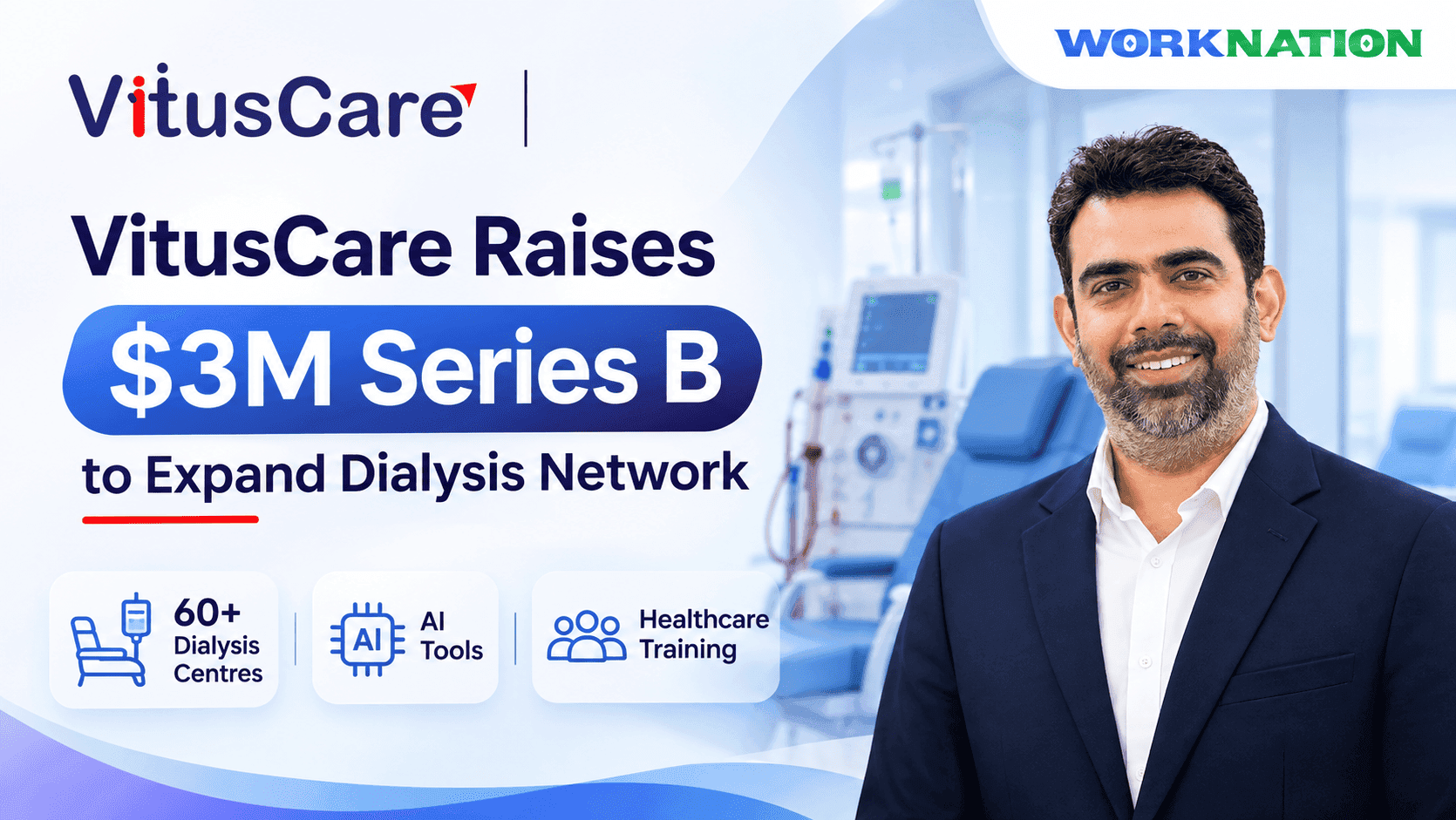
VitusCare has raised $3 million in Series B funding to expand its dialysis care network, strengthen healthcare technology and train more dialysis professionals. The Gurugram-based healthcare provider plans to grow beyond 100 centres by the end of FY27 while exploring opportunities in select Asian markets.
Founded in 2017 by Prabhat Shrivastava, VitusCare delivers specialised dialysis services through partnerships with existing hospitals. Rather than building standalone facilities, the company uses a capital-light shop-in-shop model to expand access to dialysis treatment.
The latest funding comes as the company reports nearly threefold revenue growth since its previous funding round in April 2024.
VitusCare Series B Funding: Investors and Capital Deployment
VitusCare raised $3 million in its Series B round with participation from Singapore-based Liberty Ridge Capital, HDFC Bank, Equentis and NAFA Capital Advisors. Existing investors 1Crowd and 3i Partners also participated, alongside several angel investors.
The announcement does not identify a lead investor, so the round should be understood as having participation from the named investors rather than being attributed to a specific lead.
The company previously raised $2.7 million in a Series A round led by Tomorrow Capital in April 2024. It had also secured Rs 10.83 crore in seed funding in 2019.
Where will VitusCare deploy the new funding?
The fresh capital is intended to support four priorities:
Dialysis centre expansion: Grow the company's network across existing and new markets.
Technology development: Build AI-native business modules to improve healthcare delivery and operational efficiency.
Workforce training: Develop a Technician Academy to train dialysis professionals.
International expansion: Explore opportunities in selected Asian markets.
The combination of physical network expansion, technology investment and workforce development suggests that VitusCare is working to scale both its care infrastructure and the operating systems behind it.
VitusCare's Dialysis Network Has Expanded to 60+ Centres
VitusCare has expanded from 22 dialysis centres to more than 60 centres across nine states and over 50 cities. The company says it has treated more than 35,000 patients and conducted over 8 lakh dialysis sessions.
Its workforce has also grown from 110 to 300 employees.
The company reported positive corporate EBITDA in FY26, supported by faster breakeven at newly opened centres and same-centre growth of more than 30%. It also said revenue has nearly tripled since its previous funding round.
These figures point to two different growth drivers: expansion into new locations and increased activity at existing centres. The latter is important because it indicates that growth may not depend entirely on opening additional facilities.
VitusCare targets 100+ dialysis centres by FY27
VitusCare aims to operate more than 100 dialysis centres by the end of FY27. Reaching that target would require the company to add at least 40 centres to its current network of more than 60.
The pace and quality of that expansion will matter as much as the headline centre count. New locations need sufficient patient demand, trained staff, reliable equipment and hospital partnerships to reach sustainable utilisation.
Its plans to explore select Asian markets also indicate that the company is evaluating growth beyond India, although it has not publicly identified specific countries or expansion timelines.
How VitusCare's Shop-in-Shop Dialysis Model Works
VitusCare follows a capital-light shop-in-shop model by partnering with existing hospitals instead of establishing independent dialysis facilities.
Under this arrangement, the dialysis provider brings specialised equipment, trained professionals, technology and operational support into a hospital's existing infrastructure. The hospital provides the clinical setting and associated facilities.
This approach can reduce the capital required to enter a new location and may allow providers to expand into cities where building a standalone centre would be more expensive or operationally difficult.
Why the model matters for dialysis access in India
Dialysis is a recurring treatment. Patients with kidney failure often require multiple sessions every week, making distance, availability and continuity of care important considerations.
A hospital-partnership model can help bring services closer to patients by using infrastructure that is already present in local healthcare markets.
However, the model is not automatically low-risk. Its performance depends on the quality of hospital partnerships, equipment uptime, clinical protocols, staffing availability and the ability to maintain consistent standards across locations.
For VitusCare, scaling the model beyond 60 centres will test whether it can preserve service quality while expanding its geographic footprint.
VitusCare Is Investing in AI and Dialysis Workforce Training
Alongside its physical expansion, VitusCare is developing AI-native business modules intended to improve healthcare delivery.
The company has not publicly detailed the modules, their technical capabilities or whether they will be used for clinical decision-making, patient management or internal operations. Their actual impact will depend on how they are deployed and integrated into existing care workflows.
VitusCare also plans to establish a Technician Academy to train dialysis professionals.
This is a relevant part of its expansion strategy. Adding centres requires more than equipment and hospital agreements. Each location needs trained personnel who can operate dialysis systems, follow treatment protocols and support patients through recurring care.
A dedicated training programme could help the company build a more consistent talent pipeline as its network grows.
VitusCare and the Competition in India's Dialysis Care Market
VitusCare operates in a competitive dialysis care market that includes established providers such as NephroPlus, Apex Kidney Care, DCDC Kidney Care, 7Med and Rahi Care.
The segment is also attracting investor interest. DCDC Kidney Care raised Rs 150 crore from Temasek-backed ABC Impact in March 2025, while The Renal Project secured $1.3 million in a pre-seed round led by JITO Angel Network in September 2026.
These funding announcements indicate continued investor interest in specialised kidney care and dialysis delivery models. However, the companies differ in scale, operating models and funding stages, so their fundraising amounts should not be treated as direct measures of market share or competitive strength.
What could differentiate VitusCare?
VitusCare's stated strategy combines hospital partnerships, a growing multi-city network, technology development and workforce training.
Its ability to execute across these areas could determine how effectively it competes with larger and newer dialysis providers. In particular, centre-level profitability and patient retention will be important indicators to watch as the company expands.
Five Key Insights From VitusCare's $3 Million Funding Round
The funding announcement offers several signals about the direction of India's dialysis care market. The following are analytical takeaways based on the disclosed figures and operating model, rather than additional facts reported by the company.
1. The next phase of growth is about network density, not just centre count
VitusCare already operates in more than 50 cities. Adding centres in existing markets could improve patient access and operational coverage, but spreading too quickly across new geographies could increase management complexity. The balance between geographic reach and local network density will matter.
2. Same-centre growth may be as important as opening new locations
The company reports same-centre growth above 30%. If sustained, stronger activity at existing facilities could improve the economics of the network without requiring the same level of investment as opening new centres. Future disclosures on centre utilisation and mature-centre performance would help validate this.
3. Hospital partnerships shift the expansion challenge
The shop-in-shop model can reduce the need for standalone infrastructure investment. But it also makes execution dependent on partner hospitals. Partnership quality, service-level agreements and operational consistency could become major determinants of performance as the network expands.
4. Workforce capacity could become a growth constraint
A network target of more than 100 centres creates demand for additional trained dialysis professionals. The proposed Technician Academy addresses a practical scaling challenge: ensuring that expansion in physical capacity is matched by trained staff and consistent care standards.
5. Positive corporate EBITDA does not tell the full story of centre economics
VitusCare's reported positive corporate EBITDA in FY26 is an important milestone. However, corporate-level profitability does not necessarily mean every centre is profitable. The speed at which new centres break even, alongside mature-centre margins and central operating costs, will provide a clearer picture of the model's scalability.
What to Watch as VitusCare Scales
The next phase of VitusCare's growth will depend on whether it can translate its funding into sustainable expansion. Investors and healthcare operators will likely watch its progress towards the 100-centre target, the performance of newly opened locations, the development of its technology modules and the execution of its training programme.
International expansion could create another growth avenue, but the company has not yet disclosed specific Asian markets or launch plans.
VitusCare's $3 million Series B funding gives the company additional capital to expand its dialysis network and invest in the people and technology required to support it. Its ability to maintain clinical consistency, improve centre-level economics and scale its hospital-partnership model will determine how far that strategy can go.
Search-intent FAQ section to add to the article
These questions reflect practical search intent around dialysis services and kidney care. They are not verified search-volume rankings, so they should be treated as relevant reader questions rather than claims about the most searched queries.
Frequently Asked Questions About VitusCare and Dialysis Care
What does VitusCare do?
VitusCare provides specialised dialysis services through partnerships with existing hospitals. Its shop-in-shop model allows it to operate dialysis centres within partner facilities.
How many dialysis centres does VitusCare operate?
VitusCare reported operating more than 60 dialysis centres across nine Indian states and over 50 cities as of November 2026. The company aims to cross 100 centres by the end of FY27.
How does a shop-in-shop dialysis centre work?
A dialysis provider brings equipment, trained professionals and operational support into an existing hospital. This allows the provider to use established healthcare infrastructure rather than building a standalone facility.
Who invested in VitusCare's Series B round?
The $3 million round included participation from Liberty Ridge Capital, HDFC Bank, Equentis, NAFA Capital Advisors, existing investors 1Crowd and 3i Partners, and angel investors. No lead investor was identified in the announcement.
What is the difference between a dialysis centre and a hospital-based dialysis unit?
A standalone dialysis centre operates as an independent facility, while a hospital-based unit functions within an existing hospital. The latter can make use of the hospital's infrastructure and surrounding clinical services, although the exact arrangement depends on the provider and hospital.
Have a Funding Round or Exciting Update to Share?
Submit your press release to get featured on WorkNation and reach founders, investors, and tech leaders.