IntelliProve Raises €2.7M Seed Funding Led by Miles Ahead
Top Picks
Submit PR
Stay Ahead of the Market
Get the latest startup funding, hiring trends and global opportunities delivered to your inbox every week.
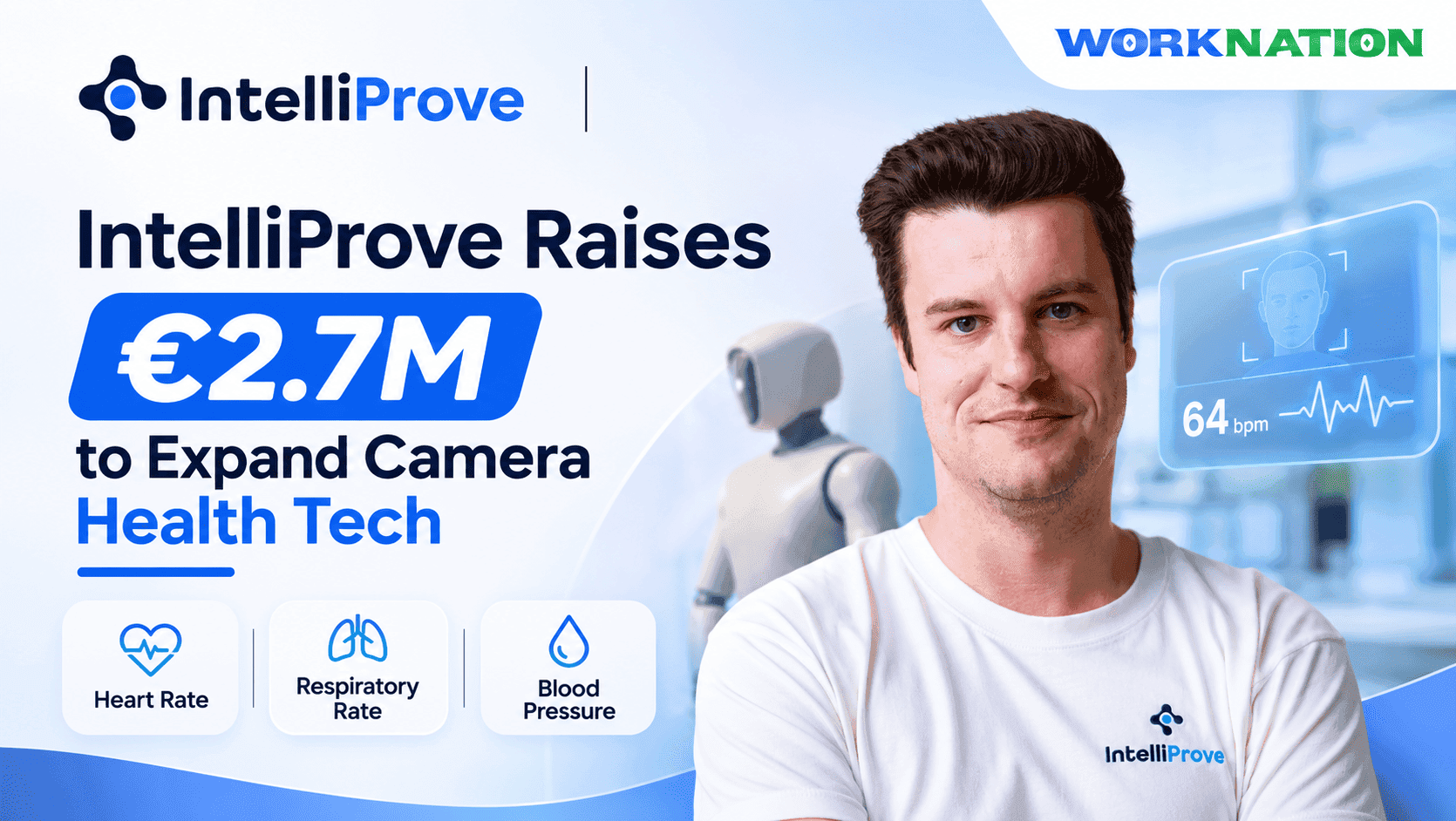
Belgian healthtech startup IntelliProve has raised €2.7 million in seed funding to expand its camera-based health monitoring technology beyond virtual care and into humanoid robots and other connected devices.
The round was led by Belgian early-stage investment fund Miles Ahead, with participation from Wit-Gele Kruis (The White and Yellow Cross), the imec.istart Fund and several business angels. The company will use the funding to strengthen research, improve measurement accuracy, expand clinical validation and pursue regulatory certification in markets beyond Europe.
Based in Ghent, IntelliProve develops software that turns standard smartphone and laptop cameras into health-monitoring tools. Its technology is designed to measure vital signs through a 30-second facial scan, without requiring wearables, blood pressure cuffs or other dedicated monitoring hardware.
This is the company's third announced funding round. IntelliProve previously raised €1 million in November 2022 and €1.25 million in January 2025, with Miles Ahead also leading the 2025 round.
Turning Everyday Cameras into Health Monitoring Tools
IntelliProve's software uses remote photoplethysmography (rPPG), a technique that detects subtle changes in facial skin colour caused by blood circulation. Each heartbeat produces small variations in blood volume beneath the skin. Although these changes are invisible to the human eye, a camera can capture them and software can analyse the resulting signals.
The company's 30-second face scan is designed to measure six biomarkers:
Heart rate
Heart rate variability (HRV)
Respiratory rate
Systolic blood pressure
Diastolic blood pressure
Resonant breathing
Capturing reliable measurements through an ordinary camera presents challenges, particularly when people move, lighting conditions change or devices use different camera specifications.
To address these issues, IntelliProve has developed three proprietary technologies. VitalMesh tracks facial skin, PulseShape estimates vital signs from pulse signals, and TripleGate checks the quality of the video, extracted signals and final measurements.
The company says its models have been tested and validated using more than six million data points. It also reports that virtual care, health insurance and wellbeing platforms in more than 50 countries use its technology, with partners integrating it into their own applications.
From Virtual Care to Humanoid Robots
IntelliProve's existing applications allow people to complete health check-ins at home using a smartphone or laptop. The resulting measurements can give healthcare professionals additional information before a virtual consultation and support online triage.
The company's next target is humanoid robotics.
Robots entering homes and care facilities already rely on cameras to understand their surroundings. IntelliProve wants to extend those capabilities by allowing robots to use their existing cameras to measure the vital signs of people nearby.
Under this approach, a robot could conduct the same 30-second facial scan without requiring additional monitoring hardware. In elderly care environments, the measurements could provide carers with additional information about a resident's condition.
The robot would pass the readings to a human caregiver, who would interpret the information and decide whether further action is necessary.
IntelliProve says it is already working with selected robotics partners, although it has not publicly identified them. The company is also exploring applications in smart glasses and self-service kiosks.
Founders Focus on Scientific Validation and Global Expansion
IntelliProve was founded in 2021 by Joeri Tulkens, Tanguy Sanglet, Brecht Dhuyvetters and Maxime Mattelin. Tulkens and Mattelin serve as co-CEOs, while Sanglet is the CTO and Dhuyvetters is the CPO.
The company works with research and healthcare institutions including TU Delft and Ghent University Hospital. It also holds ISO 27001 certification.
Regulatory certification is an important part of its expansion strategy. IntelliProve already holds a CE mark as a Class I medical device for its core signal-acquisition technology and is working towards Class IIa certification under the EU Medical Device Regulation.
The latest funding will help the company expand its datasets across different skin tones, age groups, lighting conditions and camera types. It also plans to improve the accuracy of individual measurements, beginning with blood pressure and HRV, using established reference methods such as blood pressure cuffs and breathing belts.
The company wants to strengthen its scientific validation and pursue certification in additional international markets before expanding its technology into more healthcare and connected-device applications.
Competition and the Remote Patient Monitoring Market
Camera-based vital-sign monitoring is an emerging area of digital health, but IntelliProve is not the only company developing contactless measurement technology.
Israeli company Binah.ai also uses remote photoplethysmography and raised a $13.5 million Series B in June 2020.
Other startups are exploring different approaches to remote health monitoring. YOU(th) Health Tech raised $4.5 million in February 2026 for smartphone-based screening that analyses selfies and voice to detect more than 50 biomarkers. Smedo raised €1.66 million in April 2022 for contactless biometric monitoring technology targeting hospitals and nursing homes. Hilo raised a $19 million Series B extension in July 2026 for a wrist-worn blood pressure monitoring system that uses cuff calibration.
The wider remote patient monitoring market is also attracting growing investment. Grand View Research estimates that the global remote patient monitoring systems market was worth $26 billion in 2025 and could reach $110.7 billion by 2033.
Camera-based sensing represents only one part of this market, but its potential advantage is that it can operate through devices people already own.
For IntelliProve, the opportunity now depends on proving that its measurements remain accurate across different people, devices and real-world environments. Its expansion into humanoid robotics will also depend on regulatory progress and the ability to translate its existing virtual-care technology into practical care applications.
With €2.7 million in fresh funding, the company is looking to establish camera-based health sensing as a software layer that can work across smartphones, computers and emerging connected devices.
Have a Funding Round or Exciting Update to Share?
Submit your press release to get featured on WorkNation and reach founders, investors, and tech leaders.