Remanence Raises $30M to Turn Enterprise AI Agent Data Into Models Companies Own
Top Picks
Submit PR
Stay Ahead of the Market
Get the latest startup funding, hiring trends and global opportunities delivered to your inbox every week.
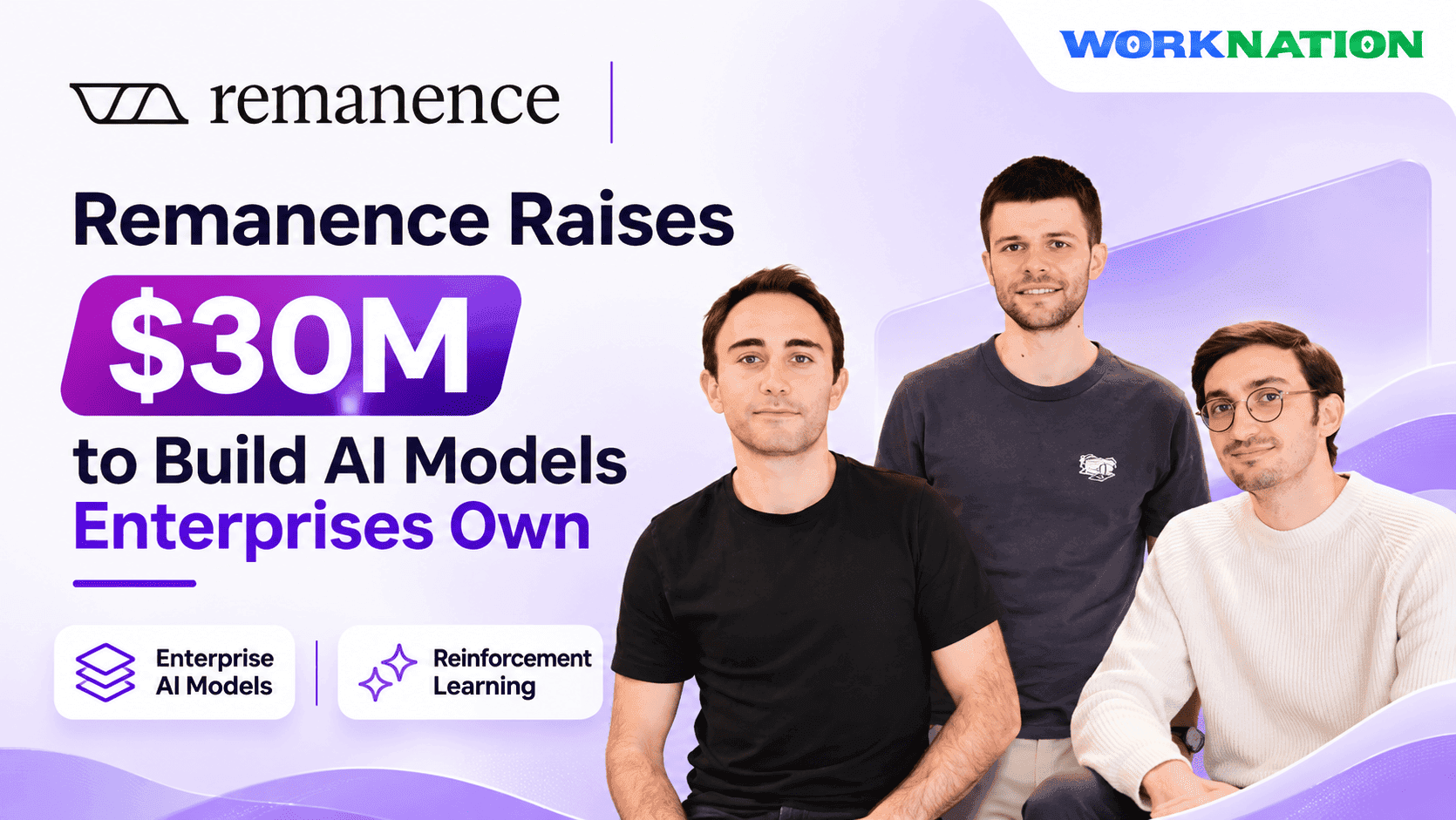
Paris-based Remanence has raised $30 million in seed funding to help businesses turn the data generated by their AI agents into specialised models they can own and continuously improve.
The round was co-led by EQT Ventures and FirstMark, with participation from Zero Prime, Emblem, Drysdale, Global Founders Capital and Yellow. The angel investors include Datadog CEO Olivier Pomel, Mirakl co-founder Philippe Corrot, Pigment co-founder Romain Niccoli, Synthesia co-founders Victor Riparbelli and Steffen Tjerrild, and Mehdi Ghissassi of AI71.
Founded by former H Company researchers Pierre-Louis Cedoz, Hamza Benchekroun and Axel Moyal, Remanence is developing infrastructure that automates reinforcement learning and post-training for open-weight AI models.
The company wants to address a growing enterprise problem: businesses are spending more on AI agents, but the operational data generated by those agents is rarely used to improve the underlying models.
The new funding will support research, a dedicated GPU cluster, development of reinforcement learning environments and hiring, primarily in Paris, with an early presence planned in London and San Francisco.
Turning AI agent activity into proprietary intelligence
AI agents generate valuable information every time they perform a task.
Their execution traces can include tool calls, decisions, successful actions, failed attempts, corrections and the steps taken to complete a workflow. Together, these records reveal how a company's systems operate and where its AI agents struggle.
However, businesses often discard much of this information or use it only for monitoring and debugging. The next time an agent performs a similar task, it may rely on the same general-purpose model and repeat the same mistakes.
Remanence wants to turn that operational experience into a training resource.
Its platform connects to the AI models a company already uses and analyses their execution traces. It then converts those records into tailored training environments where AI models can practise tasks, receive feedback and improve through reinforcement learning.
The resulting specialised models are built around the company's own workflows, tools and operational requirements.
This creates a continual-learning process: as agents generate more execution data, the platform can use it to identify weaknesses, create new training scenarios and retrain the models.
The objective is to improve task accuracy, reduce latency and lower the cost of running AI agents over time.
How Remanence automates model post-training
Post-training is the process of adapting an already trained model to perform better on particular tasks or within specific environments.
For enterprises, this can be difficult to implement. It requires specialised machine-learning expertise, substantial computing resources, reliable evaluation systems and environments that accurately reproduce real business workflows.
Remanence is building a platform around four connected stages:
1. Trace analysis
The platform connects to an organisation's AI observability systems and examines execution records to identify where agents succeed, fail or require corrections.
2. Environment synthesis
It converts those traces into interactive training environments. These environments are designed to reproduce the company's applications and workflows, allowing agents to practise tasks in controlled conditions.
3. Long-horizon reinforcement learning
The generated environments are used to post-train open-weight models through reinforcement learning. This allows models to improve across more complex, multi-step tasks rather than simply responding to isolated prompts.
4. Inference and deployment
The specialised models can be deployed through a managed service or within the customer's own cloud infrastructure.
A central part of the proposition is ownership. Remanence says customers retain the resulting model weights, while their data can remain within their own infrastructure.
This gives businesses an alternative to relying exclusively on external proprietary models for every AI task.
Founded by former H Company researchers
Remanence was founded by Pierre-Louis Cedoz, Hamza Benchekroun and Axel Moyal, who previously worked together at H Company, the French AI lab focused on computer-use agents.
At H Company, the founders worked on post-training its open-weight Holo models, developing expertise in reinforcement learning, agent evaluation and training environments.
Their wider professional backgrounds include Google DeepMind, Meta and InstaDeep.
The team's experience is particularly relevant to Remanence's strategy. Post-training advanced models and building reliable environments for agents have traditionally required specialist research teams and significant compute resources.
Remanence is attempting to package some of that expertise into infrastructure that enterprises can use without building an entire post-training research operation themselves.
The company is already working with design partners across legal services, customer support and enterprise software in Europe and the United States.
However, these are design partnerships rather than a publicly disclosed list of commercial customers. Remanence has not yet published customer performance benchmarks or quantified cost savings.
Why open-weight models matter to enterprise AI
Many companies currently access advanced AI capabilities through proprietary models offered by external providers.
This approach can provide access to powerful technology without requiring businesses to train their own models. But it also creates dependencies around pricing, model availability, data handling and the provider's product roadmap.
Open-weight models offer another option.
Businesses can adapt these models to specific tasks, deploy them in their own environments and retain greater control over the resulting systems.
Remanence believes the next stage of enterprise AI will combine both approaches: frontier models will continue to handle broad and demanding tasks, while specialised open-weight models will take on workflows where company-specific performance, cost and control matter most.
The platform is designed to make that second category easier to build and maintain.
Its proposition is not simply to fine-tune a model once. It is to create a repeatable process in which a company's own agent activity becomes the source of continuous model improvement.
EQT Ventures and FirstMark back the ownership model
The $30 million seed round was co-led by EQT Ventures and FirstMark.
Both investors see an opportunity in the growing gap between enterprise AI adoption and companies' ability to own the intelligence their systems generate.
EQT Ventures partner Tom Mendoza argues that companies deploying agents are producing valuable operational data but lack the infrastructure to turn it into models that continuously improve.
FirstMark general partner Matt Turck sees a future enterprise AI stack where closed frontier models coexist with specialised models that businesses own and control.
The investor group also brings experience from major software businesses. Datadog CEO Olivier Pomel, Mirakl co-founder Philippe Corrot, Pigment co-founder Romain Niccoli and Synthesia co-founders Victor Riparbelli and Steffen Tjerrild are among the angel backers.
For Remanence, the backing provides more than capital. It brings investors familiar with enterprise software, infrastructure and the operational complexity of scaling technology businesses.
Competition in enterprise AI training infrastructure
Remanence is entering a market where several companies are developing tools to improve how AI agents learn, perform and operate in enterprise environments.
Bespoke Labs is building simulated enterprise environments where AI agents can practise complex tasks before deployment. Its focus overlaps with Remanence's environment-generation approach, although the companies' broader product strategies are not identical.
Mercor operates in AI training, evaluation and data infrastructure, connecting experts and organisations with the development of advanced AI systems. Its business is broader than automated enterprise post-training.
River AI is developing infrastructure for running and improving open-weight models through fine-tuning and reinforcement learning.
These companies address different parts of the AI development stack. Remanence's particular approach is to use a company's own agent execution traces to generate training environments and then improve models against those workflows.
That distinction could become valuable if enterprises increasingly want AI systems trained around their internal processes rather than relying entirely on generic model capabilities.
Building the infrastructure for continual learning
Remanence plans to invest the new capital in research, engineering and computing infrastructure, including a dedicated GPU cluster in Europe.
Hiring will focus primarily on Paris, with an early presence planned in London and San Francisco. The company also intends to expand its reinforcement learning environments, evaluation systems and post-training capabilities.
The ambition is to make continual learning more accessible to businesses that already deploy AI agents but lack the specialist resources to train and maintain their own models.
There are still important challenges.
Generated training environments must accurately represent real business systems. Evaluation mechanisms must reliably distinguish successful task completion from incorrect or incomplete results. Models must also demonstrate that they can outperform existing alternatives on the workflows that matter to customers.
And while model ownership may reduce dependence on external providers, training and operating specialised models still carries infrastructure and maintenance costs.
Remanence has secured a substantial seed round and assembled a team with experience in advanced AI research. Its next milestone is proving that the platform can turn enterprise agent data into measurable improvements in real-world performance.
The larger bet is that companies will increasingly want to own not just their data, but the specialised AI intelligence built from it.
Have a Funding Round or Exciting Update to Share?
Submit your press release to get featured on WorkNation and reach founders, investors, and tech leaders.