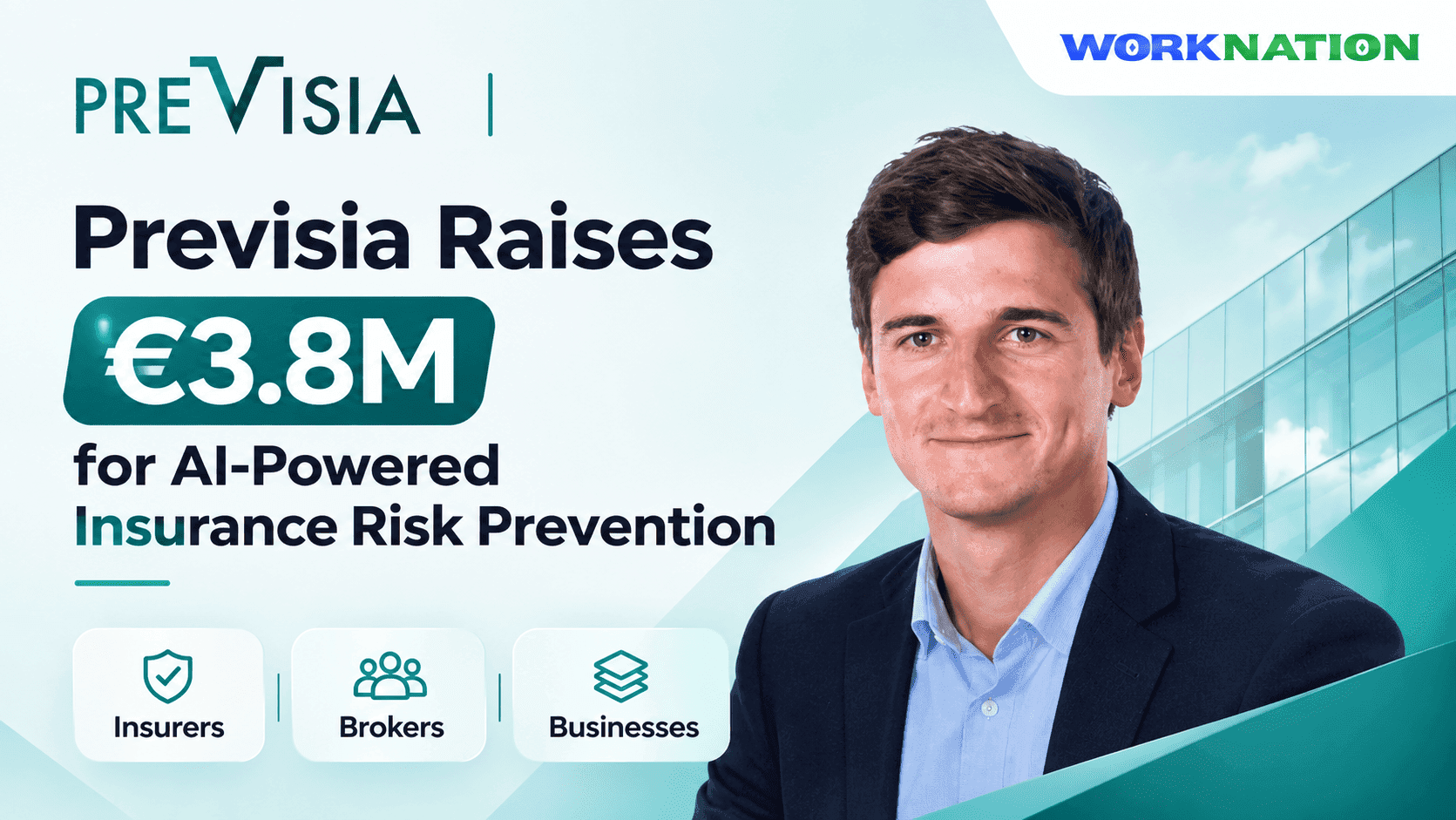
Previsia Raises €3.8M to Make AI-Powered Risk Prevention Accessible to Businesses
Top Picks
Submit PR
Stay Ahead of the Market
Get the latest startup funding, hiring trends and global opportunities delivered to your inbox every week.
French insurtech startup Previsia has raised €3.8 million in seed funding to expand its AI-powered risk prevention platform, helping businesses, insurance brokers and insurers identify potential risks before they turn into costly claims.
Based in Toulouse, Previsia was founded in October 2023 by Hélie Brouchet and David Salom. The company is developing a platform that digitises the risk prevention process, from site assessments and inspections to reports, action plans and ongoing monitoring.
The seed round was backed by French investment funds IRDI Capital Investissement and ARIS. The funding comes as Previsia reports that it has been profitable since 2025 and increased its revenue 2.5 times over the past year.
Its platform is already used by more than 40 insurance-sector clients, including Groupama, Diot-Siaci, Verspieren, MSIG Europe and Helvetia.
The new capital will support product development, commercial expansion and international growth, with plans to make risk prevention more accessible to businesses that cannot afford traditional engineering inspections.
Turning Expensive Risk Inspections Into a Scalable Platform
Previsia's business idea started with a challenge from a major French insurance broker.
The broker wanted to understand how risk prevention could be carried out across a client portfolio containing more than 1,000 sites. The traditional approach would involve sending an engineer to inspect each location.
According to CEO Hélie Brouchet, an individual visit can cost approximately €3,000. That would put the cost of assessing 1,000 sites at around €3 million for a single round of inspections.
For many businesses, particularly smaller companies, that approach is difficult to afford.
Previsia set out to make the process more scalable by building a platform that allows brokers and other authorised users to conduct structured risk assessments with AI assistance.
The company says one customer group operating more than 200 sites had completed just six risk surveys over three years through its previous process. Using Previsia, the broker assessed 70 sites in less than three months.
That gave the broker more comprehensive information to support insurance renewal discussions and helped individual sites identify and monitor preventive actions.
The example illustrates the opportunity: instead of relying exclusively on expensive specialist visits, businesses can collect and organise risk information more frequently.
How Previsia Uses AI for Risk Prevention
Previsia brings businesses, brokers and insurers together through a shared platform for managing risk information.
Its technology supports the entire prevention process:
Site setup: Create business profiles and configure assessments for specific types of locations.
Risk assessments: Use structured questionnaires, photographs and information collected during site visits.
AI-powered reporting: Generate summaries, risk scores and prioritised recommendations.
Action plans: Identify measures businesses can take to reduce potential risks.
Follow-ups: Track whether recommended actions have been implemented.
Portfolio analysis: Give brokers and insurers a broader view of risk across multiple locations.
For example, a broker assessing a car dealership can create a tailored site profile and use photographs and conversations during the visit to populate the relevant questionnaire.
The platform then helps generate an insurer-ready report that can be sent to underwriting on the same day.
This reduces the administrative work involved in preparing assessments and makes it easier to organise information across large portfolios.
Why Human Validation Still Matters
AI-generated risk assessments cannot simply be accepted without oversight.
An incorrect assessment could affect insurance decisions, business operations or the prioritisation of safety measures.
Previsia therefore keeps human validation as part of its workflow.
Brouchet has emphasised that the platform does not replace engineers. Instead, it helps them carry out more assessments and makes prevention processes accessible to brokers, sales teams and business leaders.
The company also says its AI has been specifically adapted to risk prevention workflows using the expertise of its engineering team.
This distinction matters. General-purpose AI tools can process documents and answer questions, but insurance risk assessments require specialised context, structured information and professional judgement.
Previsia's approach combines that domain expertise with automation rather than attempting to remove human involvement entirely.
Why Risk Prevention Is Becoming More Important for Insurers
Insurance companies are facing growing challenges in assessing and pricing commercial risks.
Climate-related events, fires, theft and changes in business activities are increasing the complexity of underwriting. At the same time, repair costs and emerging risks can make some commercial properties more expensive to insure.
According to figures cited by Previsia and its reporting partners, commercial property claims in France increased by 74% between 2014 and 2024.
The company also estimates that fewer than 5% of insured sites currently benefit from genuine risk prevention.
That leaves a large gap between identifying risks after an incident and helping businesses reduce those risks beforehand.
For insurers, better prevention data could provide greater visibility into the condition of insured properties and the actions businesses are taking to improve safety.
For brokers, it could strengthen the information available during renewal discussions.
For businesses, it creates a more structured way to understand potential risks and prioritise improvements.
However, better risk information does not automatically mean lower insurance premiums. Whether prevention data eventually changes pricing will depend on how insurers incorporate it into their underwriting models.
More Than 40 Insurance Clients and Profitable Growth
Previsia has built a customer base of more than 40 insurance-sector clients, including Groupama, Diot-Siaci, Verspieren, MSIG Europe and Helvetia.
These relationships are important because the company distributes its platform through insurance intermediaries rather than relying only on direct sales to individual businesses.
That gives Previsia a route to reach multiple sites through a smaller number of large broker and insurer relationships.
The company also reports that revenue increased 2.5 times over the past year and that it has been profitable since 2025.
It currently has a team of approximately 15 people, with operations in Toulouse and an office in Hamburg supporting its international expansion.
Profitability at the seed stage is notable, particularly in a market where many startups raise capital to fund years of product development and customer acquisition before reaching sustainable operations.
For Previsia, the funding is intended to accelerate a business that has already established commercial relationships and demonstrated demand for its platform.
Investors Backing Previsia's Expansion
The €3.8 million seed round was backed by two French investment organisations: IRDI Capital Investissement and ARIS.
The investment will support the company's next stage of growth, including technology development, stronger commercial operations and expansion into additional European markets.
Previsia plans to invest in three main areas:
Product development: Launching a new application for insured businesses, extending natural hazard analysis across Europe and integrating prevention data into underwriting tools.
Commercial expansion: Strengthening sales teams and building relationships with more insurance brokers and insurers.
International growth: Expanding its existing presence in Germany and preparing to enter additional European markets.
The company already reports traction in Spain, Italy, Belgium and Germany.
CEO Hélie Brouchet has also indicated that the business is considering a Series A round in approximately two years.
Competing in the AI Insurance Risk Market
Previsia is entering a growing market for technology that helps insurers identify, assess and manage risks more efficiently.
Several companies are targeting different parts of the insurance risk landscape.
London-based Nettle raised a $4.8 million seed round to help commercial insurers manage inspection backlogs through risk engineering technology.
Paris-based Stoïk takes a different approach, combining cyber risk prevention with insurance products for small and medium-sized businesses.
Previsia's focus is broader physical risk prevention across commercial sites. Its platform aims to make site assessments, reporting and follow-up more accessible without requiring an engineer to personally conduct every inspection.
The difference in positioning could help Previsia build relationships with brokers and insurers managing large portfolios of commercial properties.
What Previsia Needs to Prove Next
Previsia has several encouraging indicators: early profitability, 2.5x revenue growth and relationships with more than 40 insurance-sector clients.
But its next stage will depend on whether those results can translate into a larger international business.
There are five important areas to watch:
International scalability: Risk assessment requirements and insurance practices differ between countries. Previsia must adapt its platform to local markets without making implementation too complex.
Risk assessment accuracy: AI can accelerate inspections, but maintaining reliable assessments and professional validation will remain essential.
Insurance pricing impact: Better prevention data may improve underwriting decisions, but it remains unproven whether it consistently translates into lower premiums for customers.
Customer expansion: The company needs to demonstrate that its broker and insurer relationships can generate adoption across increasingly large site portfolios.
Commercial sustainability: Maintaining profitability while investing in hiring, product development and international expansion will be an important test.
Previsia is addressing a problem that has traditionally been expensive and difficult to scale. Its €3.8 million seed round gives it the resources to bring AI-powered risk prevention to more businesses and insurance providers.
The bigger opportunity is to make prevention an ongoing part of how commercial risks are managed, rather than an occasional inspection reserved for companies that can afford specialist visits.
Have a Funding Round or Exciting Update to Share?
Submit your press release to get featured on WorkNation and reach founders, investors, and tech leaders.