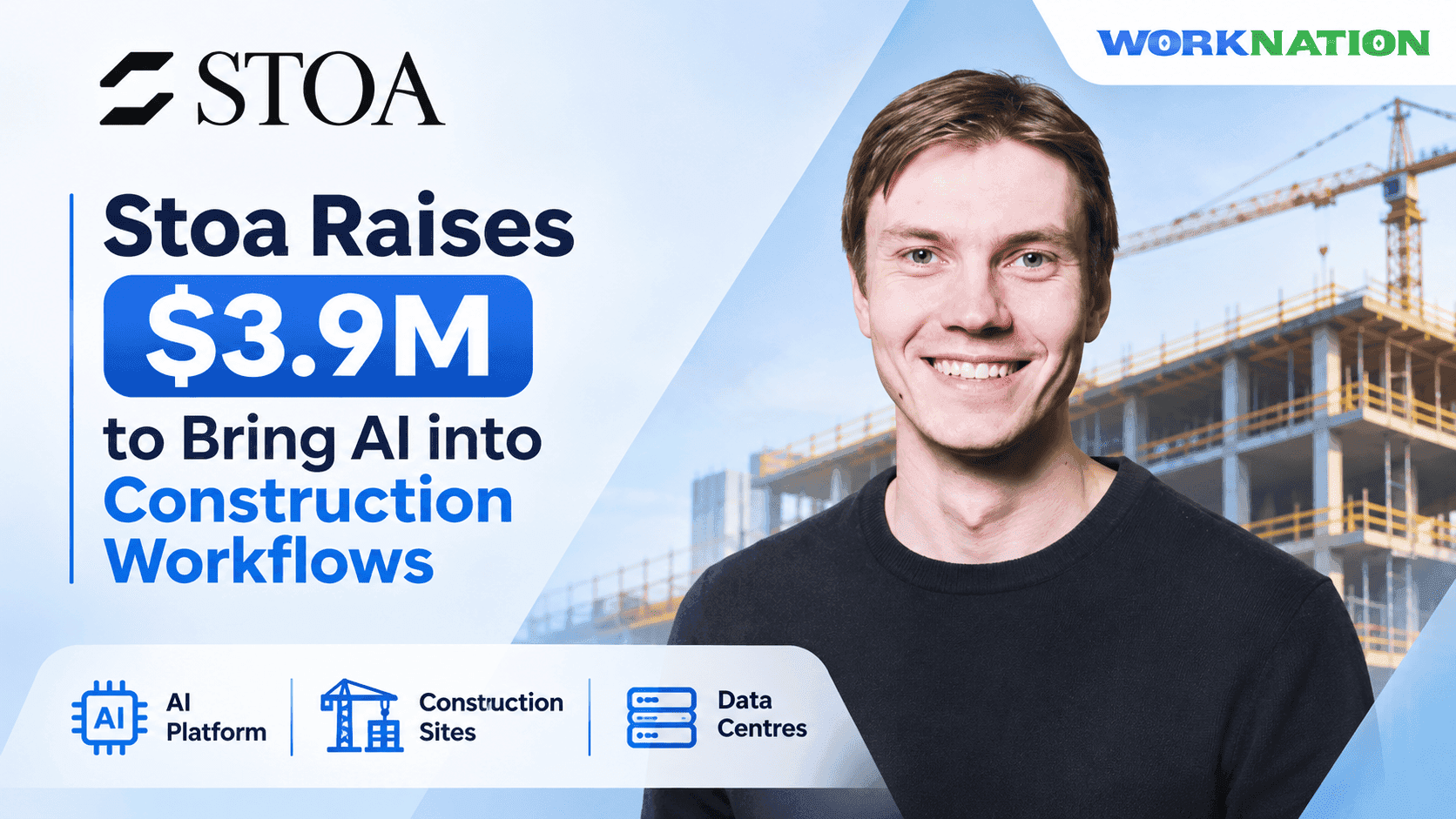
Stoa Raises $3.9M to Bring AI-Powered Intelligence to Construction Sites
Top Picks
Submit PR
Stay Ahead of the Market
Get the latest startup funding, hiring trends and global opportunities delivered to your inbox every week.
Helsinki-based construction technology startup Stoa has raised $3.9 million (€3.5 million) in pre-seed funding to bring AI-powered intelligence into construction sites and data centre projects. The round was led by Lifeline Ventures, with backing from investors connected to Supercell, Wolt and PlanGrid.
Founded by entrepreneurs from Founders House, Stoa is developing an AI-powered platform that brings construction drawings, schedules, quality records and safety reports into one system. Its goal is to help project teams find the right information faster, identify potential problems earlier and make better decisions while construction is underway.
The funding round closed in under a week, according to CEO Johannes Korpela. Alongside Lifeline Ventures, participants included Illusian, the investment company of Supercell co-founder Ilkka Paananen and Wolt co-founder Miki Kuusi, and Helsinki-based Wave Ventures.
The round also attracted several experienced angel investors, including former Nokia CEO Pekka Lundmark, Virala CEO Alexander Ehrnrooth, SRV board member Tuomas Kokkila, and PlanGrid co-founders Tracy Young and Ralph Gootee.
Stoa plans to use the capital for product development, international expansion and hiring.
Bringing Construction Information Into One System
Construction projects generate enormous amounts of information. Drawings, contracts, schedules, building information models, quality records and safety reports are often spread across different systems and workflows.
This creates a practical problem: the information needed to prevent a mistake may already exist, but the right person may not find it at the right time.
Stoa is designed to address this information gap.
Its platform brings different project documents and records together, using AI to give construction teams a more current view of project information. Instead of searching across disconnected systems, engineers and site managers can access relevant information in one place and track changes more efficiently.
The challenge becomes particularly important in large infrastructure projects and data centres. According to Stoa, billion-euro facilities can take between 18 and 24 months to complete, making timely access to accurate project information essential.
The company says its platform is already being used across more than 25 Nordic sites, including projects involving contractors and data centre operators.
Stoa also reports that project engineers and site managers save between two and eight hours per week through its platform.
Why AI could make a difference on construction sites
Construction remains a fragmented industry, with information frequently distributed across multiple tools and teams.
AI creates an opportunity to connect that information and make it more useful during day-to-day operations.
For example, if a drawing changes, project teams need to understand which schedules, decisions or site activities may be affected. An AI-powered system that can identify relevant information and direct it to the right people could help reduce delays and prevent avoidable mistakes.
This is particularly relevant for complex projects, where a small coordination issue can have consequences for multiple contractors and workstreams.
Stoa's approach focuses on making existing project information easier to access and act upon, rather than simply adding another standalone productivity tool.
Human Oversight Remains Essential
AI adoption in construction comes with a significant challenge: accuracy.
A wrong answer about a drawing, contract or construction schedule could lead to costly rework, delays or safety issues. For that reason, Stoa is positioning human oversight as a core part of its product.
The company says its AI-generated answers include citations linking back to original sources, whether those sources are drawings, schedules, spreadsheets or other project documents.
The system is also designed to acknowledge when it does not have enough information to provide a reliable answer, rather than generating a response without sufficient evidence.
CEO Johannes Korpela says the platform uses an ontology graph model, with a bespoke data model built for each customer. This customer-specific approach is intended to help structure project information and reduce the risk of AI hallucinations.
The model is important because construction projects differ in their documentation, workflows and technical requirements.
By keeping the original sources accessible and people involved in decision-making, Stoa aims to make AI useful without removing the accountability required in construction operations.
A Market With a Significant Productivity Gap
The construction industry has long faced productivity challenges compared with other major sectors.
A McKinsey report cited in the source article found that construction productivity increased by 10% between 2000 and 2022, compared with 90% in manufacturing.
That gap points to an opportunity for better coordination, digital workflows and automation across construction projects.
Stoa is entering the market at a time when AI capabilities are becoming more practical for working with complex documents and structured project information.
Its initial focus on large construction projects and data centres is also significant. These projects involve extensive documentation, multiple stakeholders and tight coordination requirements, making information management especially important.
However, the company's ambitions extend beyond data centres. Korpela says Stoa sees value across complex construction projects of different types and sizes.
Investors With Experience in Global Technology Companies
Lifeline Ventures led the €3.5 million pre-seed round. The Finnish venture capital firm has previously backed companies including Wolt, Aiven and Supercell.
Illusian also participated. The investment company was established by Supercell co-founder Ilkka Paananen and Wolt co-founder Miki Kuusi.
Wave Ventures, a Helsinki-based fund run by investors under 25, joined the round alongside a group of experienced angel investors.
The participation of Tracy Young and Ralph Gootee is particularly relevant to Stoa's market. Both co-founded PlanGrid, a construction productivity software company acquired by Autodesk for $875 million in 2018.
Their experience building construction technology gives Stoa access to investors who understand the challenges of digitising project workflows and scaling software in the industry.
The funding also comes as Finland sees substantial investment in data centre infrastructure. The source article puts the country's data centre investment pipeline at €67 billion and highlights Pure DC's planned Seinäjoki campus, which could reach €7.5 billion.
Competing in the Race to Build AI for Construction
Stoa is entering an increasingly competitive construction technology market, where companies are developing AI tools to improve project management, scheduling and operational workflows.
US-based Trunk Tools raised a $40 million Series B in July 2025, while Munich-based Conxai raised €5 million in April 2026.
These companies illustrate the growing investor interest in applying AI to construction workflows.
Stoa's differentiation lies in bringing project information together and making it actionable, with an emphasis on source-backed answers and human oversight.
The broader competition is likely to centre on which platforms can become deeply integrated into the daily operations of construction companies, rather than remaining optional tools used by individual teams.
For Stoa, its existing deployments across more than 25 Nordic sites provide an early base from which to develop the product and expand into new markets.
What Stoa Needs to Prove Next
The €3.5 million pre-seed investment gives Stoa capital to develop its product and pursue international growth. But moving from early deployments to broader adoption will require more than strong AI capabilities.
Several challenges will shape its next stage:
Accuracy in real-world projects: AI-generated information must remain reliable when working with complex drawings, contracts and changing project documentation.
Integration with existing workflows: Construction teams already use multiple systems. Stoa will need to fit into their operations without creating additional administrative work.
Measurable productivity gains: Its reported two-to-eight-hour weekly time savings provide an early indication of value. Demonstrating consistent results across different project types will strengthen its case.
Expansion beyond the Nordics: International growth will require adapting to different construction practices, documentation standards and customer requirements.
Competition from established players: Larger construction technology companies and well-funded AI startups are also targeting this market.
Stoa is betting that construction companies need more than another software tool. They need a system that can connect project information, surface relevant answers and help teams prevent mistakes before they become expensive.
With backing from Lifeline Ventures, experienced technology founders and construction industry investors, Stoa has an opportunity to build in a market where AI adoption is still developing.
Its next test will be turning early customer adoption into a scalable product for construction projects across international markets.
Have a Funding Round or Exciting Update to Share?
Submit your press release to get featured on WorkNation and reach founders, investors, and tech leaders.