Asynchronics Raises $3.1M to Build a Marketplace for Spacecraft Digital Twins
Top Picks
Submit PR
Stay Ahead of the Market
Get the latest startup funding, hiring trends and global opportunities delivered to your inbox every week.
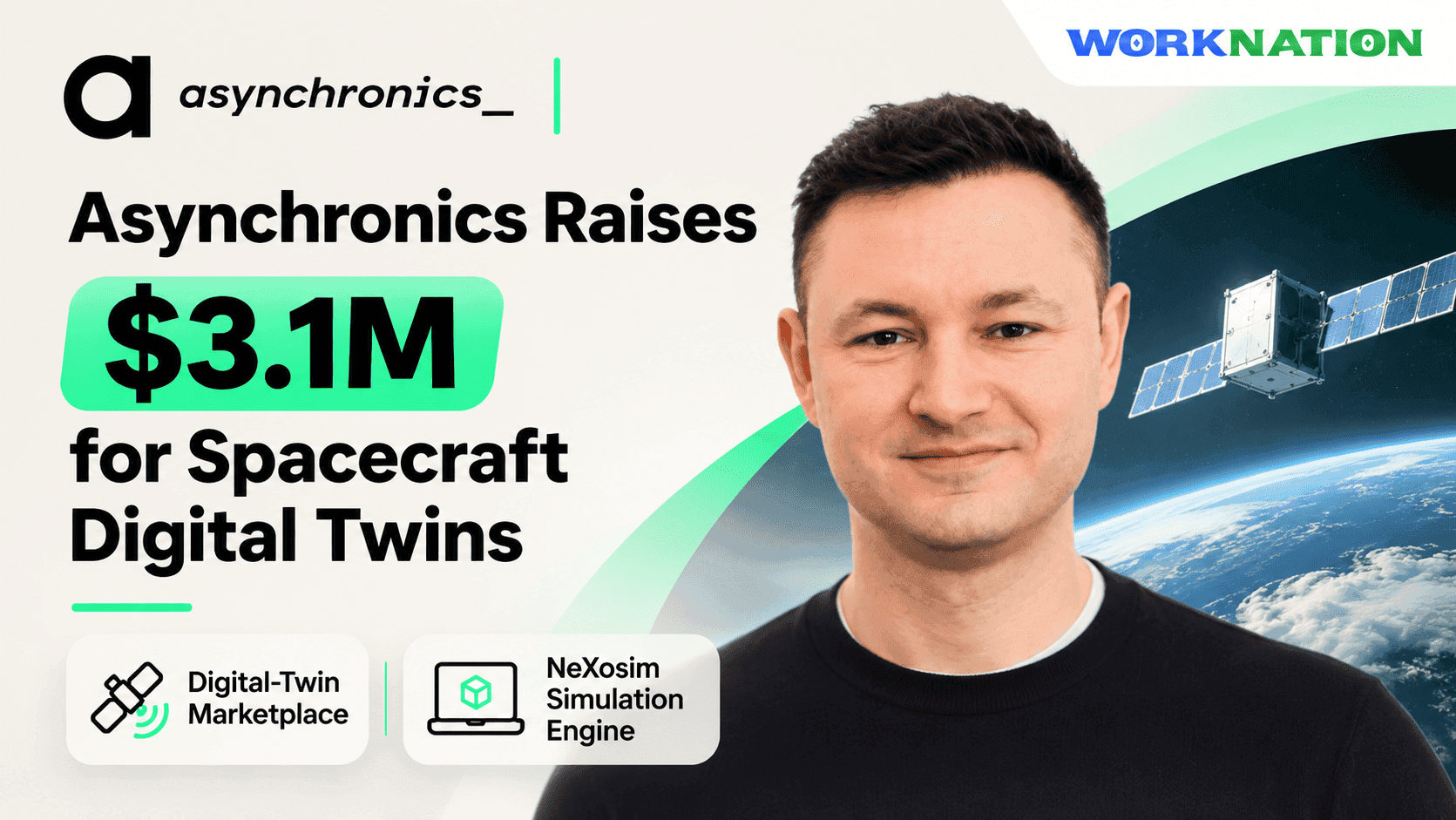
Warsaw-based Asynchronics has raised $3.1 million in seed funding to make spacecraft simulation software and reusable digital twins more accessible to the growing commercial space industry. The round was led by b2venture, with participation from Movens Capital, Heartfelt and Hard2beat.
Founded by Adam Chikha and Serge Barral, Asynchronics develops software that allows engineers to test spacecraft hardware and flight software together in virtual environments, even before physical components are delivered.
The company's ambition is to build a shared catalogue of digital models for spacecraft components, reducing the need for every engineering team to recreate simulations from scratch. The new capital will support the expansion of that catalogue, development of a graphical simulation interface and growth of the team.
The software problem behind spacecraft failures
Spacecraft missions depend on more than reliable hardware. Flight software, component interfaces and system integration all need to work together under demanding operating conditions.
For smaller and newer space companies, testing can become difficult when physical hardware arrives late or when they lack access to the sophisticated simulation environments used by established aerospace manufacturers.
Asynchronics argues that this creates a gap in the market: large aerospace companies have spent years building internal simulation tools, while smaller teams often have to develop their own models or wait for physical components before conducting meaningful integration tests.
The company's solution is to let engineers test system behaviour earlier through executable digital models of actual spacecraft hardware.
These models can receive commands, produce telemetry, reproduce component behaviour and simulate different operating conditions. Engineers can connect them to flight software and other virtual systems to identify integration problems before a spacecraft is assembled.
The distinction is important: these are not simply 3D visualisations of spacecraft parts. They are software models designed to reproduce how components behave and communicate.
NeXosim: the engine behind the digital twins
At the centre of Asynchronics' technology is NeXosim, an open-source simulation framework written in Rust.
The engine is designed to run complex system simulations using asynchronous programming and automatic parallel execution across available processor cores. This allows different models within a simulation environment to operate concurrently while the framework manages their coordination.
The company chose Rust for its concurrency and safety characteristics, rather than relying on the C++ systems traditionally used in many established aerospace simulation environments.
NeXosim is available publicly under permissive MIT and Apache 2.0 licences. Its open-source approach is intended to make the underlying simulation technology inspectable and extendable by engineering teams.
Asynchronics is building NeXosim.io on top of this engine: a marketplace where spacecraft manufacturers and engineering teams can access reusable digital models of individual components.
The longer-term vision is for a digital twin to become a standard companion to spacecraft hardware, allowing engineers to begin integration testing as soon as they select a component.
NewSpace Systems and Infinite Orbits provide early validation
Asynchronics has already developed digital twins for four components manufactured by South African aerospace supplier NewSpace Systems:
Reaction wheel
Magnetometer
GPS receiver
Sun sensor
The company says its reaction-wheel model was tested using the same software used to test the physical hardware. The comparison focused on electronic behaviour, including commands, responses and telemetry.
This is an important early test of the company's approach because the usefulness of a digital twin depends on how accurately it reproduces the behaviour of the real component.
Another important relationship is with French space company Infinite Orbits. Asynchronics has worked with the company on virtual testing environments for its Endurance and Orbit Guard 3 missions.
The relationship has progressed beyond development work. In August 2026, Asynchronics announced a direct commercial contract for the Orbit Guard 3 mission, describing it as its first commercial sale of space hardware digital-twin licences and a source of recurring revenue.
The companies are using the models for flight-software regression testing, anomaly simulation and operator training.
Asynchronics and Infinite Orbits also received a €450,000 European Space Agency contract in 2025 for the SAVIOR project, focused on a digital twin of the Endurance servicing satellite.
What the $3.1M funding will support
Asynchronics plans to use the seed funding primarily to expand its engineering and commercial capabilities.
Its main product target is to grow the digital-twin catalogue to at least 50 models over the next 24 months. The planned catalogue will cover more commonly used spacecraft components, including systems involved in satellite attitude control and power management.
The company is also developing a graphical interface that will allow engineers to assemble digital models into virtual test environments, configure simulations and examine results without relying entirely on code-based workflows.
It is exploring AI-assisted tools internally to help engineers generate initial models from technical documentation. However, the company says these models will still require engineering review, refinement and validation before they can be relied on for testing.
The team is also expanding, with a Toulouse office planned alongside its Warsaw base. Paulina Prachnio-Janušauskas, co-founder of neptune.ai, is joining to lead commercial growth.
Why reusable digital twins could matter to the space industry
The commercial space industry increasingly relies on specialised suppliers producing standardised spacecraft components. Different satellite manufacturers may purchase the same reaction wheels, sensors or other subsystems, yet each engineering team can still end up recreating its own simulation models.
A shared catalogue could reduce that duplication.
For component manufacturers, providing validated digital twins alongside physical products could become an additional way to support customers. For satellite developers, reusable models could help start software testing and integration before equipment arrives.
This could be particularly useful for smaller companies that cannot afford to build and maintain extensive in-house simulation infrastructure.
The opportunity also extends beyond spacecraft. Asynchronics says it sees potential applications in defence, robotics and other industries where complex hardware and software systems must operate reliably together.
The challenge: building trust in the marketplace
Asynchronics has demonstrated that its technology can support real engineering workflows, with work involving NewSpace Systems, Infinite Orbits and European Space Agency programmes.
But turning those projects into a broad marketplace will require more than building a larger catalogue.
Each digital twin must accurately reproduce the behaviour of its corresponding hardware, work with relevant interfaces and remain dependable across different simulation environments. Manufacturers will also need reasons to create, validate and maintain digital models for external users.
That makes manufacturer adoption a key part of the business model. If component suppliers begin offering reusable digital twins alongside their hardware, Asynchronics could become an important connection point between suppliers and spacecraft integrators. If adoption remains limited, the company may continue to operate primarily as a specialist simulation and modelling provider.
With $3.1 million in new funding, a growing customer base and a target of 50 digital twins, Asynchronics is now working to prove that spacecraft simulation can become shared infrastructure rather than a capability rebuilt for every mission.
Have a Funding Round or Exciting Update to Share?
Submit your press release to get featured on WorkNation and reach founders, investors, and tech leaders.