Traitomic Raises €20M to Commercialise Non-GM Traits Across Crops and Microbes
Top Picks
Submit PR
Stay Ahead of the Market
Get the latest startup funding, hiring trends and global opportunities delivered to your inbox every week.
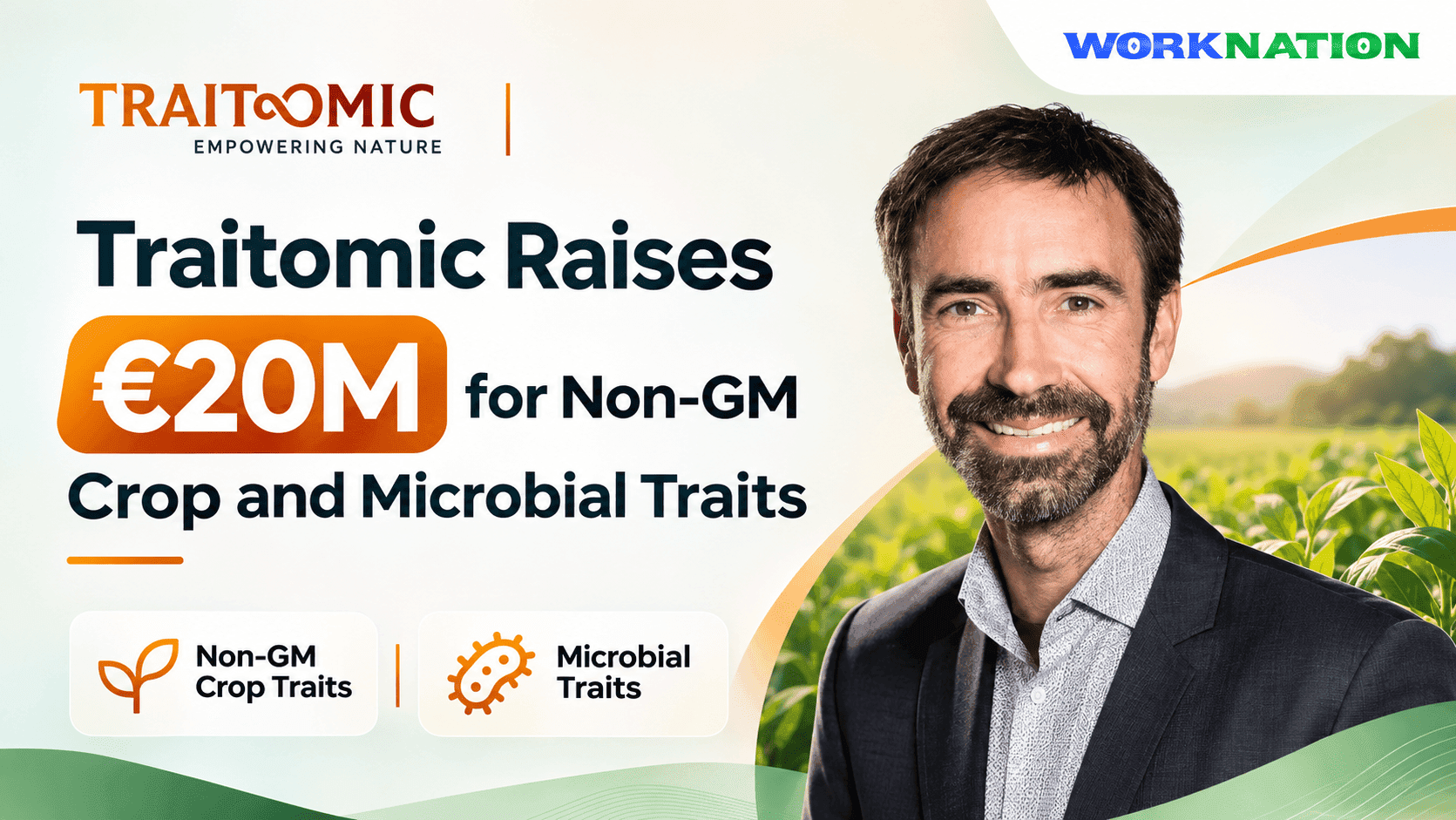
Danish agricultural biotechnology startup Traitomic has raised €20 million in Series A funding to commercialise its technology for discovering and developing improved biological traits across crops, food production and industrial biotechnology.
The round was led by Sofinnova Partners, with participation from the Export and Investment Fund of Denmark, Footprint Firm, Nordic Foodtech VC, PSV Hafnium and SVG Ventures.
Spun out of Carlsberg Group, Traitomic uses FIND-IT, a screening technology originally developed at Carlsberg Research Laboratory. The platform identifies useful genetic variations without directly editing an organism's DNA, allowing customers to develop improved traits through conventional breeding and biological processes.
Led by CEO and co-founder Gustav Hambraeus, the company has delivered 116 traits to 47 customers across 32 organisms. Its applications range from crop improvement to food production and industrial enzymes.
The funding represents Traitomic's first external investment since its spinout from Carlsberg. The company plans to use the capital to expand internationally, strengthen its commercial operations and move further into end-to-end trait development.
From Carlsberg Research to an Independent Biotechnology Company
Traitomic's technology began inside Carlsberg, where researchers developed FIND-IT to identify useful genetic variations in barley.
The technology was described in a 2022 research publication and was initially developed to support barley improvement. Carlsberg subsequently licensed the platform to Traitomic for applications outside brewing.
The licensing arrangement is important to understanding the company's business model.
Carlsberg retains ownership of FIND-IT's intellectual property and continues using the technology for brewing-related applications. Traitomic holds an exclusive licence for applications outside brewing.
This gives the startup access to a technology developed through years of research while allowing it to build an independent business across agriculture, food and industrial biotechnology.
The spinout also marks a transition from operating within a large brewing group to serving customers across multiple industries and international markets.
For Traitomic, the €20 million investment provides the resources to make that transition at a larger scale.
How FIND-IT Identifies Better Biological Traits
Traditional breeding often involves screening large populations of plants or microorganisms to identify individuals with desirable characteristics.
These characteristics, known as traits, can include improved crop performance, disease resistance, product quality or more efficient biological production.
Finding the right variation can be time-consuming, particularly when researchers need to examine large populations and identify the specific genetic changes associated with a useful characteristic.
Traitomic's FIND-IT platform is designed to make that discovery process faster and more targeted.
Rather than directly editing DNA to create a desired genetic change, the technology screens existing biological populations to identify naturally occurring variations that produce useful characteristics.
Once a promising trait is identified, Traitomic works with the customer to develop it within the customer's own crop variety or production strain.
This means the customer can receive a trait developed in the biological material it already uses commercially, rather than simply receiving a research result that still requires extensive integration work.
Why the non-GM approach matters
Traitomic's approach differs from technologies that directly modify an organism's genetic material.
Its screening platform identifies useful genetic changes already present in biological populations. This can provide an alternative route for developing improved crops and microorganisms without introducing genetic edits.
For customers, this distinction can matter commercially and from a regulatory perspective, depending on the organism, the method used and the markets where the resulting product will be sold.
The company is targeting applications across:
Agriculture: Identifying crop traits that can improve plant performance and resilience.
Food production: Developing biological characteristics that can improve food quality and production.
Industrial biotechnology: Finding useful traits in microorganisms that support more efficient industrial processes.
Emerging biological applications: Expanding into organisms such as mushrooms, algae and probiotic bacteria.
116 Traits Delivered Across 32 Organisms
Traitomic has already built a commercial track record beyond its original barley application.
The company reports that it has delivered 116 traits to 47 customers across 32 different organisms.
Its customer work spans crop improvement, food-related applications and industrial biotechnology, including the development of enzymes for industrial use.
The company is also assessing approximately 100 additional traits with customers before taking them towards commercialisation.
The time required to identify a trait depends on the organism and whether Traitomic has previously established a platform for it.
According to CEO Gustav Hambraeus:
For plants where the company already has an established platform, identifying a trait can take around one to two months.
For a crop it has not previously worked with, the process can require one complete seed-to-seed cycle.
For bacteria, setting up the process can take approximately one week.
These timelines illustrate how the company is attempting to make trait discovery more repeatable across different biological systems.
However, delivering a trait is not the same as achieving widespread commercial adoption.
The next important milestone will be seeing how many of the 116 delivered traits, alongside those currently under assessment, make their way into commercial crops, food products or industrial production.
Moving Beyond Trait Discovery
Traitomic's business is also evolving beyond identifying promising genetic variations.
Historically, the company focused heavily on finding useful traits and delivering them to customers. It now wants to become more involved in developing those traits within customer-specific biological material.
That shift could give the company a larger role in the commercial development process.
For example, a plant breeder may already have an established crop variety with a strong customer base. Traitomic can help identify and develop an additional characteristic within that existing variety rather than requiring the breeder to start with an entirely different plant.
The same concept applies to microorganisms used in industrial production.
The company is also exploring additional organisms, including mushrooms, algae and probiotic bacteria.
This broader approach could increase the range of applications it serves and create deeper commercial relationships with customers.
Investors Backing Traitomic's Expansion
Sofinnova Partners led the €20 million Series A round.
The other participating investors were:
Export and Investment Fund of Denmark
Footprint Firm
Nordic Foodtech VC
PSV Hafnium
SVG Ventures
The investment marks the first external funding round raised independently by Traitomic since its separation from Carlsberg.
Michael Krel, partner at Sofinnova Partners, said Traitomic has demonstrated an ability to develop commercially relevant traits across a broad range of organisms and applications.
He also highlighted the company's customer traction and track record as important foundations for future growth.
The company currently employs approximately 30 people, according to Hambraeus.
The new capital will primarily support business expansion, including hiring, commercial development and strengthening its presence in international markets.
Why the Regulatory Landscape Matters
Agricultural biotechnology is operating in a changing regulatory environment, particularly in Europe.
In June 2026, the European Parliament and Council adopted new rules covering certain plants developed through new genomic techniques, including targeted mutagenesis and cisgenesis.
The regulation entered into force in July 2026 and will apply from 17 July 2028.
These rules introduce a differentiated framework for certain gene-edited plants, with different requirements depending on the type of genetic modification.
However, the regulation does not cover every biotechnology method or organism. Its scope is limited to specified new genomic techniques applied to plants. Microorganisms and other excluded applications remain under existing legislation.
This distinction matters for Traitomic because its FIND-IT approach focuses on screening for genetic variations rather than directly editing DNA.
The changing rules could influence the broader competitive landscape for crop improvement technologies, but they should not automatically be treated as a direct regulatory change for Traitomic's screening method.
The company will still need to consider the applicable rules for each organism, product and market in which its customers commercialise the resulting traits.
Expanding Into the US and Australia
Traitomic already works with customers across Europe, the United States, Australia, Southeast Asia and East Asia.
With the new funding, the company plans to prioritise expansion in the United States and Australia.
It is looking to build local teams and establish a stronger presence in both markets. Its Australian operation will focus particularly on plant trait development.
These markets provide opportunities to work with agricultural businesses and biotechnology companies that need improved biological traits for different crops and production systems.
The company also wants to strengthen its involvement throughout customer projects, moving from trait discovery towards more comprehensive development support.
This could help it capture more value from each customer relationship while making the technology easier to adopt commercially.
What Traitomic Needs to Prove Next
Traitomic has demonstrated that its platform can identify useful traits across multiple organisms and has already built relationships with dozens of customers.
The next stage is about turning that technical progress into broader commercial adoption.
Several factors will determine its success:
Commercialisation of delivered traits: The company needs to show how many of its 116 delivered traits become products used in commercial agriculture, food production or industrial biotechnology.
Conversion of the development pipeline: Approximately 100 traits are under pre-commercial assessment. Converting these into commercial outcomes will be an important milestone.
International scaling: Expanding in the United States and Australia will require local customer relationships, teams and market-specific expertise.
End-to-end development: Moving beyond trait discovery could create greater customer value, but it also introduces more development responsibility and complexity.
Regulatory positioning: The company needs to demonstrate how its approach fits different regulatory frameworks across crops, microorganisms and international markets.
Traitomic's €20 million Series A gives it the capital to expand beyond its origins in Carlsberg's barley research.
Its opportunity is to make the discovery and development of useful biological traits more accessible across agriculture, food production and industrial biotechnology.
The bigger test is no longer just whether Traitomic can identify promising traits. It is whether those discoveries can consistently reach commercial products and create measurable value for its customers.
Have a Funding Round or Exciting Update to Share?
Submit your press release to get featured on WorkNation and reach founders, investors, and tech leaders.