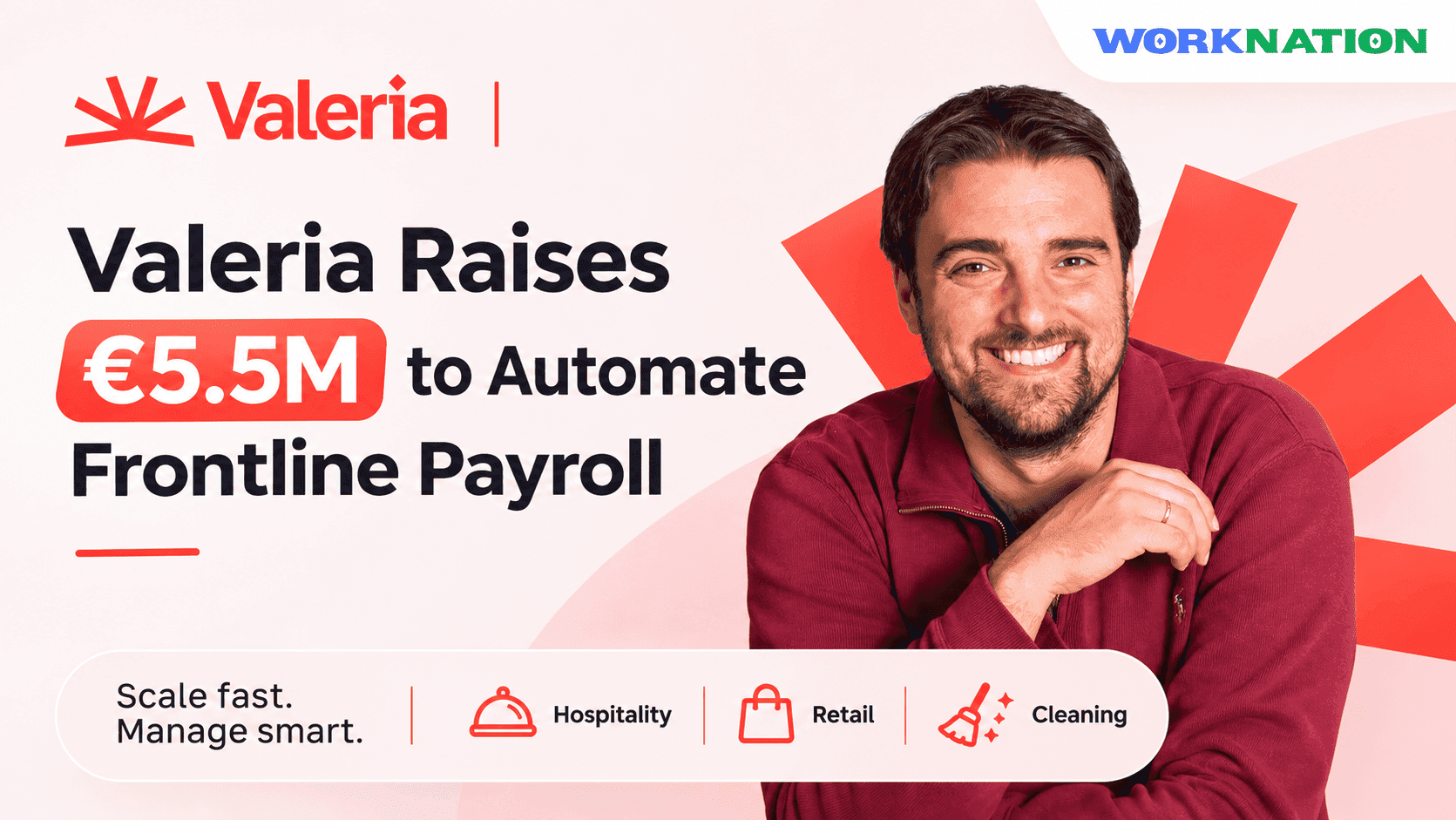
Valeria Raises €5.5M to Expand AI Payroll Beyond Delivery and Logistics
Top Picks
Submit PR
Stay Ahead of the Market
Get the latest startup funding, hiring trends and global opportunities delivered to your inbox every week.
Barcelona-based HR technology startup Valeria has raised €5.5 million in seed funding to expand its AI-powered payroll platform into new industries, including hospitality, retail and cleaning.
The round was led by BlackFin, with existing investors VentureFriends and Fortino participating alongside new investor GoHub Ventures. The investment follows a €1.7 million pre-seed round announced in February 2026, taking Valeria's total funding raised this year to more than €7 million.
Founded by Pau Laporte, Carlos Saiz and Sergio Morales, Valeria builds payroll and workforce management technology for businesses with high employee turnover. Its platform is designed to automate complex employment administration, particularly for companies that regularly hire, onboard and manage frontline workers.
The startup currently serves more than 100 businesses and 20,000 workers, according to the company. Its customers include businesses such as Glovo, Uber Eats, Goiko, Honest Greens and Desigual.
With the new funding, Valeria plans to strengthen its payroll engine, expand into additional industries and pursue international growth.
The Payroll Problem That Started Valeria
Valeria's origins came from a practical problem experienced by CEO and co-founder Pau Laporte.
He found himself needing to onboard employees over the weekend, but his accountant was unavailable. For businesses operating in delivery and logistics, where staffing requirements can change quickly, waiting for traditional administrative processes can create operational problems.
In Spain, companies need to complete employment registrations and other administrative procedures before workers can legally begin their jobs. Traditional payroll and labour advisory services often operate around standard office hours, while frontline businesses frequently operate around the clock.
Valeria was created to address this mismatch.
Rather than offering another HR dashboard, the company developed its own payroll calculation engine and connected it directly to Spanish public administration systems through APIs.
These connections include:
Social Security: Employment registrations and related administrative procedures.
SEPE: Spain's State Public Employment Service.
Spanish Tax Agency: Tax-related employment administration.
The platform is designed to automate processes including employee onboarding, sick-pay administration, wage garnishments and workplace accident reporting. It also handles collective bargaining requirements relevant to sectors such as fleet management, delivery and courier services.
The objective is to reduce manual processing and allow businesses to manage employment administration whenever operational requirements arise.
How Valeria Combines AI With Payroll Expertise
Payroll is more complicated than calculating salaries and generating payslips.
Businesses with high employee turnover must account for changing schedules, employment contracts, sick leave, wage adjustments and sector-specific labour agreements. Mistakes can create compliance problems and additional administrative costs.
Valeria combines its proprietary payroll engine and AI capabilities with an in-house team of employment law specialists.
The software handles recurring processes, while human experts monitor anomalies and provide additional oversight when situations require judgement.
This combination is central to its positioning. Valeria is not simply trying to automate individual HR tasks. It wants to manage the underlying payroll and employment administration process.
According to CEO Pau Laporte, the platform is available 24 hours a day, allowing businesses to operate without waiting for manual processing or external intermediaries.
For companies managing large numbers of frontline employees, that availability could be particularly useful during weekends, seasonal hiring periods and unexpected changes in staffing requirements.
More Than 100 Businesses and 20,000 Workers
Valeria says its platform currently supports more than 100 businesses and 20,000 workers.
Its customer base includes companies such as Glovo, Uber Eats, Goiko, Honest Greens and Desigual, spanning delivery, hospitality and retail-related operations.
The company has also reported rapid growth in its workforce and revenue.
According to reporting by The New Barcelona Post, Valeria finished 2025 with nearly €500,000 in annual turnover. The company expected revenue to exceed €2 million in 2026, although this remains a forecast rather than a confirmed financial result.
Its team has grown to more than 40 people, according to the company's investor announcement.
These figures suggest that Valeria is building a business around a specific operational problem rather than competing solely as a general-purpose HR software provider.
The next question is whether it can maintain that growth while expanding into industries with different employment structures and compliance requirements.
Why Valeria Is Expanding Beyond Delivery and Logistics
Valeria's initial focus on fleet management, delivery and courier companies gave it a concentrated market in which frequent hiring and complex workforce administration create recurring payroll demands.
The new funding will help extend its platform into three additional sectors:
Hospitality: Restaurants, hotels and other hospitality businesses regularly manage changing shifts, seasonal hiring and employee turnover.
Retail: Retailers often operate across multiple locations and need to coordinate payroll and employment administration for large frontline teams.
Cleaning services: Cleaning companies manage distributed workforces, changing assignments and employment arrangements that can create administrative complexity.
These industries share an important characteristic: their workforce operations are often more dynamic than those of businesses with stable, office-based teams.
Valeria's opportunity is to reuse its existing payroll infrastructure while adapting it to the specific labour requirements of each sector.
However, expanding into new industries will require more than simply adding new customer categories. Different sectors have their own collective agreements, payroll rules and operational workflows.
The company's ability to adapt its engine without losing accuracy will be an important factor in its next growth phase.
Investors Backing Valeria's Payroll Ambitions
BlackFin led the €5.5 million seed round, with VentureFriends and Fortino participating as existing investors. GoHub Ventures joined as a new investor.
The investment follows Valeria's €1.7 million pre-seed round in February 2026, which was led by VentureFriends with participation from Fortino and 10K Ventures.
The latest round brings Valeria's funding raised during 2026 to more than €7 million.
BlackFin sees an opportunity in the fragmented nature of payroll management, particularly for companies that need flexibility and reliable employment administration.
Chloé Buil Novène, investment director at BlackFin, said the company is redesigning payroll outsourcing around AI while retaining the human support businesses expect.
Pablo Perea, partner at GoHub Ventures, also highlighted the opportunity to replace manual labour management processes with an AI-native solution.
The backing gives Valeria additional resources to strengthen its technology and build a larger presence in Spain's workforce management market.
Competing in a Growing HR Technology Market
Valeria operates in a competitive European HR technology landscape.
Barcelona-based Factorial is one of the region's major HR software companies. It raised a $150 million Series D in June 2026 at a reported $2.5 billion valuation.
Paris-based Skello, which focuses on workforce management for frontline businesses, also raised €200 million from Bridgepoint.
These companies demonstrate the investor interest in software designed to manage employees, schedules and business operations.
However, Valeria is taking a more specialised approach.
Instead of positioning itself as a broad HR management platform, it focuses on automating payroll and employment administration for businesses with high employee turnover.
Its direct connections to Spanish public authorities and its combination of software with employment expertise are central to that positioning.
The company estimates the Spanish workforce management market to be worth more than €1 billion. This is Valeria's own market estimate, rather than an independently verified market-size figure.
Where the €5.5M Funding Will Go
Valeria plans to use the new capital to accelerate development of its payroll engine and expand into additional industries.
The company also intends to grow its presence in Spain while preparing for international expansion.
According to Laporte, Germany and Poland are among the markets the company plans to enter over the next year.
International expansion will introduce another layer of complexity. Payroll systems need to account for local employment legislation, tax requirements, social security processes and collective agreements.
Valeria's model depends partly on integrating its software with public administration systems. Replicating that approach in new countries will require adapting its technology and compliance processes to each market.
The company will therefore need to prove that its approach can work beyond the Spanish employment system.
What Valeria Needs to Prove Next
Valeria has raised more than €7 million in 2026 and established an initial customer base in Spain. Its next stage will test whether the business can expand its product and market without creating additional operational complexity.
There are five important areas to watch:
Expansion into new sectors: Hospitality, retail and cleaning have different payroll requirements. Valeria must demonstrate that its technology can adapt to each one.
International expansion: Germany and Poland offer growth opportunities, but their employment regulations and public administration systems will require local adaptation.
Customer growth: Serving more than 100 businesses is a useful starting point. The company will need to demonstrate that customer acquisition can scale alongside its growing team.
Automation and human oversight: Its combination of AI and employment specialists is a key differentiator, but maintaining service quality as customer numbers increase will be important.
Financial performance: The reported 2025 turnover and 2026 revenue forecast provide an early indication of growth. Future financial results will show whether that momentum is sustainable.
Valeria is betting that payroll for frontline workers needs a different operating model from traditional HR software.
Its €5.5 million seed round gives the company more resources to take that model beyond delivery and logistics. The real test will be whether an engine built around Spain's employment system can scale across new industries and eventually different European markets.
Have a Funding Round or Exciting Update to Share?
Submit your press release to get featured on WorkNation and reach founders, investors, and tech leaders.