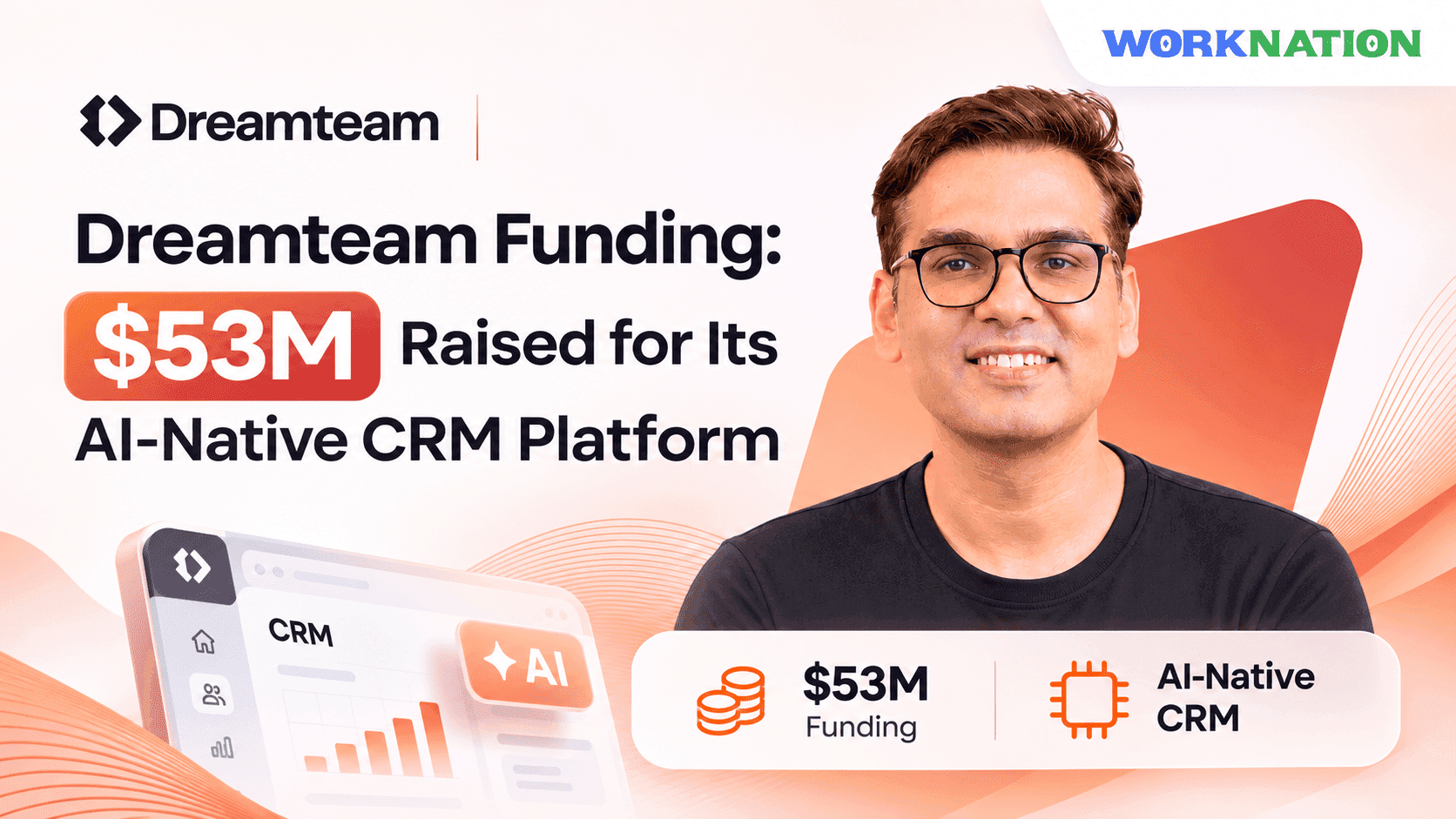
Dreamteam Raises $53 Million to Expand Its AI-Native CRM Platform
Top Picks
Submit PR
Stay Ahead of the Market
Get the latest startup funding, hiring trends and global opportunities delivered to your inbox every week.
AI-native CRM startup Dreamteam has raised $53 million in a funding round with participation from Together Fund, Accel and Premji Invest. Founded in 2025, the California-headquartered company is building an AI-powered customer relationship management platform designed to automate sales workflows and manage customer information through AI agents.
The company plans to use its platform as a foundation for broader customer lifecycle management, with plans to expand into prospecting, onboarding, customer success and upselling.
Dreamteam was founded by Anand Venkatraman, Ramesh Parthasarathy and Senthil Kanthaswamy, who previously held senior roles at Freshworks and were involved in scaling the software company from its early stages through its IPO.
How Dreamteam's AI-Native CRM Platform Works
Traditional CRM platforms depend heavily on employees to enter customer information, update deal records, track conversations and maintain sales pipelines. Dreamteam is attempting to reduce this manual work by using AI agents to collect information, maintain records and recommend actions.
At the centre of its platform is a system called Company Brain. It gathers information from emails, calendars, meetings, customer conversations and connected business tools to create a shared record of customer interactions and activities.
This information gives the platform context about customer relationships and ongoing sales activity. Rather than treating each interaction as an isolated record, Dreamteam aims to connect conversations, commitments and deal information into a more complete view of each account.
Meet Dreamteam's Four AI Agents
Dreamteam has developed four AI agents, each assigned a different sales and CRM responsibility.
Rachel: Conducts account research to help sales teams understand prospects and customers.
Sally: Drafts follow-up emails and suggests updates to sales deals.
Raj: Monitors the sales pipeline and identifies potential risks.
Alex: Handles CRM setup and administrative tasks through conversational commands.
The agents can also prepare meeting briefs, track commitments and highlight potential issues in sales pipelines.
An important part of the company's approach is that the agents propose actions while sales teams retain approval over CRM updates and outgoing communications. This keeps employees involved in decisions that affect customer relationships.
Dreamteam's Customers and Market Adoption
Dreamteam said hundreds of companies across several industries use its platform. These include businesses in AI, online media, healthcare, manufacturing and consulting.
Its named customers include DMS Health, InVideo and Plex.
The range of industries suggests that the platform is being positioned for B2B sales teams with different customer management requirements. However, the company has not disclosed detailed revenue figures, customer retention metrics or the amount of sales activity being managed through its platform.
Who Founded Dreamteam?
Dreamteam was founded in 2025 by Anand Venkatraman, Ramesh Parthasarathy and Senthil Kanthaswamy.
The three founders previously held senior positions at Freshworks and were involved in the company's growth from its early startup stage through its public listing. Together, they bring more than 25 years of experience in building and selling B2B software, according to the company.
Their experience in enterprise software provides relevant background for building a CRM product, a category where customer trust, integrations, workflow reliability and long-term adoption are important.
Beyond CRM: Dreamteam's Magic Apps and Developer Tools
Dreamteam is also developing products beyond its core CRM platform.
One of these is Magic Apps, a feature that allows users to create applications and dashboards using natural language instead of writing code. The goal is to let teams build tools around their workflows without depending entirely on conventional software development.
The company also provides an API and an MCP server, allowing teams to access its services outside the traditional CRM interface.
These capabilities could help Dreamteam connect customer information and AI-powered workflows with other applications used by businesses.
What Dreamteam's $53 Million Funding Means
The $53 million funding round gives Dreamteam additional capital to develop its AI-native CRM platform and expand into more stages of the customer lifecycle.
Its broader ambition is to move beyond sales record management and support a larger portion of the customer relationship, from identifying prospects to onboarding customers, managing ongoing relationships and identifying upselling opportunities.
Several factors will shape the company's progress:
Data quality and context: The usefulness of AI agents depends on whether Company Brain can accurately collect and interpret information from multiple business systems.
Human oversight: Keeping employees in control of important updates and communications may help address concerns about AI-generated errors in customer-facing workflows.
Integration depth: CRM platforms need to work reliably with the email, calendar, meeting and business applications that sales teams already use.
Workflow expansion: Moving into onboarding and customer success could make the platform relevant to more teams, but those functions have different requirements from sales.
Commercial adoption: The number of companies using the platform is an early adoption indicator, but revenue, retention and usage data will be needed to assess its long-term traction.
The Opportunity for AI-Native CRM Software
The CRM category is evolving as businesses explore ways to use AI to reduce administrative work and make customer information more actionable.
Traditional CRM systems primarily organise customer records and sales activity. AI-native platforms are attempting to build on that foundation by interpreting information, identifying next steps and executing selected tasks.
Dreamteam's agent-based approach is one example of this shift. Its Company Brain provides shared customer context, while specialised agents handle research, follow-ups, pipeline monitoring and administrative work.
The challenge for AI-native CRM companies will be demonstrating that these systems can deliver consistent results in real business environments. Accuracy, data security, integration reliability and employee trust will matter as much as the capabilities of the AI agents themselves.
What Comes Next for Dreamteam?
Dreamteam plans to extend its platform beyond sales into prospecting, onboarding, customer success and upselling.
If it can connect these stages through a shared customer intelligence layer, the company could position its software as a broader customer lifecycle platform rather than a standalone CRM tool.
The $53 million funding round provides resources to pursue that expansion. The next important indicators will be how quickly customers adopt the additional workflows, how deeply the platform integrates with existing business systems and whether its AI agents can deliver measurable improvements to sales and customer operations.
Have a Funding Round or Exciting Update to Share?
Submit your press release to get featured on WorkNation and reach founders, investors, and tech leaders.