Opdo Raises $2.3 Million Pre-Seed Funding Led by Angular Ventures to Bring AI Agents into Optical Design
Top Picks
Submit PR
Stay Ahead of the Market
Get the latest startup funding, hiring trends and global opportunities delivered to your inbox every week.
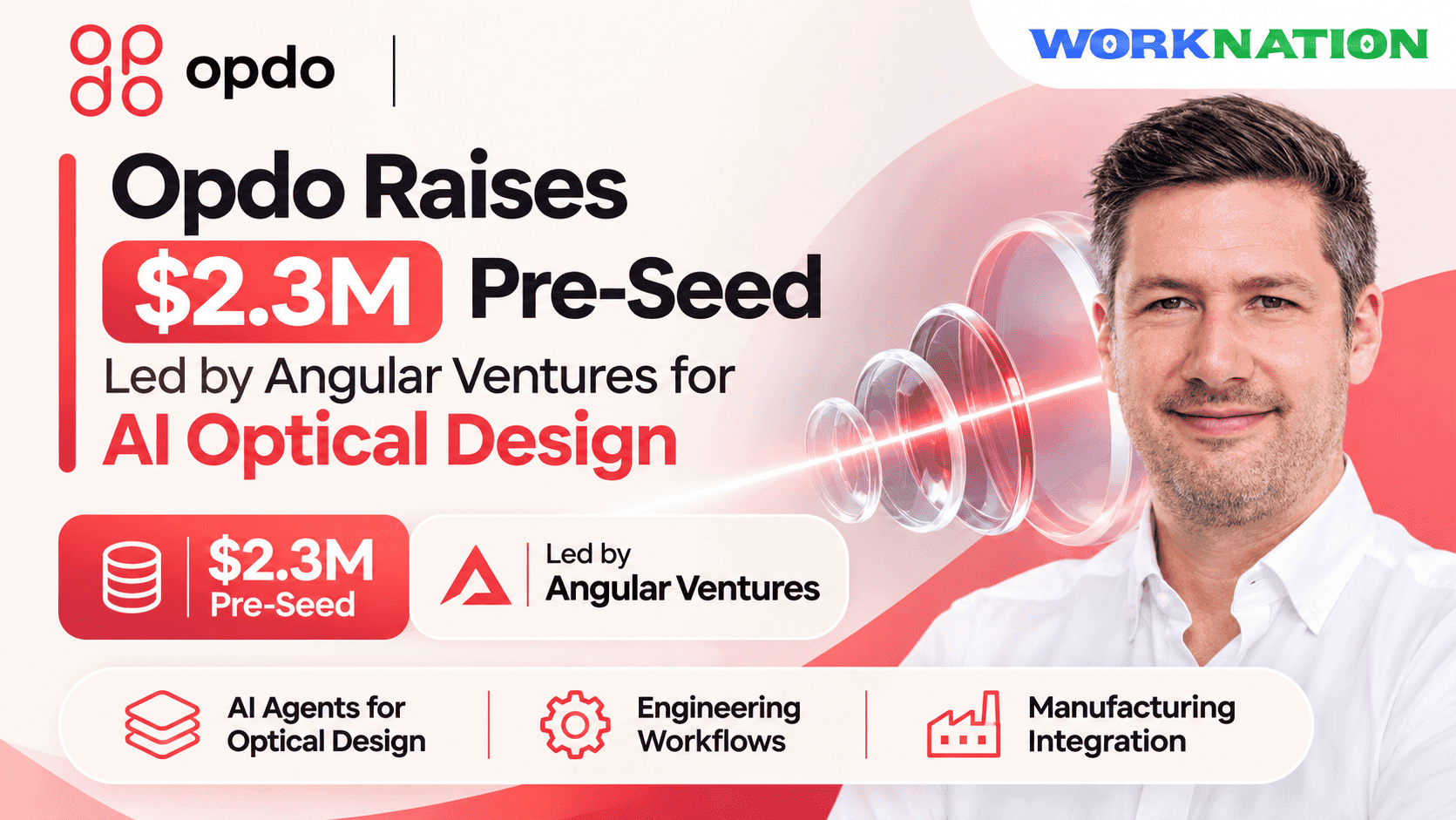
Opdo, a deeptech startup operating between Los Angeles and Berlin, has raised $2.3 million in pre-seed funding led by Angular Ventures, with participation from Inflection and Tiny.vc. The company is developing AI agents that automate parts of optical engineering and manufacturing, helping hardware teams reduce the time required to design and produce optical components.
Founded by Stephan Kuehr and Yousef Arzhangnia, Opdo integrates its AI agents into established optical design software, including Zemax and CODE V, rather than replacing existing engineering tools.
The funding will support engineering expansion, tooling development and initial steps towards in-house production. The company currently has a team of five and is hiring optical designers, photonics engineers and metrologists.
Why Opdo Is Bringing AI into Optical Engineering
Optical components are essential to technologies across quantum computing, aerospace, defence and augmented and virtual reality hardware.
However, designing and manufacturing these components can be time-consuming and requires specialised engineering expertise. A shortage of experienced optical engineers adds another constraint for hardware companies developing complex products.
Opdo aims to address these challenges by introducing AI agents into existing engineering workflows. Instead of requiring engineers to abandon familiar software, its platform works alongside tools already used in optical design.
According to the company, this approach has helped reduce development and manufacturing timelines from months to weeks. This is a company-reported result rather than an independently established industry-wide improvement.
How Opdo's AI Agents Work with Zemax and CODE V
Opdo's platform integrates AI agents into established optical design environments, including Zemax and CODE V.
The software is designed to help engineers move from design specifications to manufacturable optical systems. Its capabilities extend beyond generating initial designs, connecting engineering workflows with the manufacturing and testing stages.
A key part of the platform is its feedback loop. Data from manufactured and tested optical components can be fed back into the company's models, helping improve subsequent simulations and designs.
This creates a connection between digital engineering and physical production, allowing real-world manufacturing results to inform future design decisions.
The company aims to develop this into a more integrated system covering optical design, engineering, prototyping and manufacturing.
Founders and the Technology Behind Opdo
Opdo was founded by Stephan Kuehr and Yousef Arzhangnia, who previously worked together at xolo, a company developing machines for producing optical elements.
Kuehr served as chief commercial officer at xolo, while Arzhangnia worked on the software side. Before joining xolo, Kuehr founded 3YOURMIND, a manufacturing automation company whose customers have included the US Department of Defense, Ford and Bosch.
The founders launched Opdo's first product in June 2025. Its initial AI co-pilot was designed to take a written prompt and generate a manufacturable optical system.
In November 2025, Opdo partnered with Luximprint on 3D printing. The company has since expanded its offering towards AI agents embedded in existing optical design tools.
Competition in AI-Powered Optical Design
Opdo is entering a market where established engineering software providers are already introducing AI capabilities.
Keysight's CODE V 2026 includes an AI Start Expert feature designed to generate initial optical designs from short specifications. Ansys Zemax, now owned by Synopsys, has also introduced AI assistant capabilities.
Other startups are targeting adjacent engineering markets. Photonium is working on AI for electronic design automation in optics, while Axiomatic AI focuses on AI-based verification for semiconductors and photonics.
The global optical design software market was estimated at $237 million in 2025 and is projected to reach $398 million by 2031, according to a market research estimate cited in the source article.
Opdo's differentiation lies in connecting optical design with manufacturing feedback rather than focusing exclusively on design automation.
Funding, Team Expansion and Early Commercial Traction
The $2.3 million pre-seed round will help Opdo strengthen its engineering capabilities, develop tooling and take initial steps towards in-house production.
The company currently employs five people and is recruiting specialists in optical design, photonics engineering and metrology.
Opdo has not publicly named any customers in the funding announcement. It says it works with design and research partners, while its website reportedly references work involving people from the University of North Carolina, Google and Amazon. These references should not be interpreted as confirmed commercial customer relationships.
The distinction is important at this stage: Opdo has demonstrated an initial product and attracted early investor backing, but its ability to convert engineering partnerships into repeatable commercial revenue remains to be established.
What Opdo's Funding Means for AI in Hardware Engineering
AI adoption in software development has advanced rapidly, but applying AI to physical engineering introduces additional challenges. Systems must account for manufacturing constraints, material properties and the performance of real-world components.
Opdo is attempting to address this gap by connecting AI-driven optical design with actual manufacturing and testing data.
Its $2.3 million pre-seed funding gives the company resources to develop this approach and expand its engineering team. The next challenge will be demonstrating that its technology can consistently reduce development time, improve manufacturing workflows and deliver measurable value to paying customers.
If successful, Opdo could help make specialised optical engineering more accessible to hardware companies working across photonics, aerospace, defence and advanced computing.
Have a Funding Round or Exciting Update to Share?
Submit your press release to get featured on WorkNation and reach founders, investors, and tech leaders.