Biomatter Raises $18 Million Series A to Expand AI-Powered Enzyme Design
Top Picks
Submit PR
Stay Ahead of the Market
Get the latest startup funding, hiring trends and global opportunities delivered to your inbox every week.
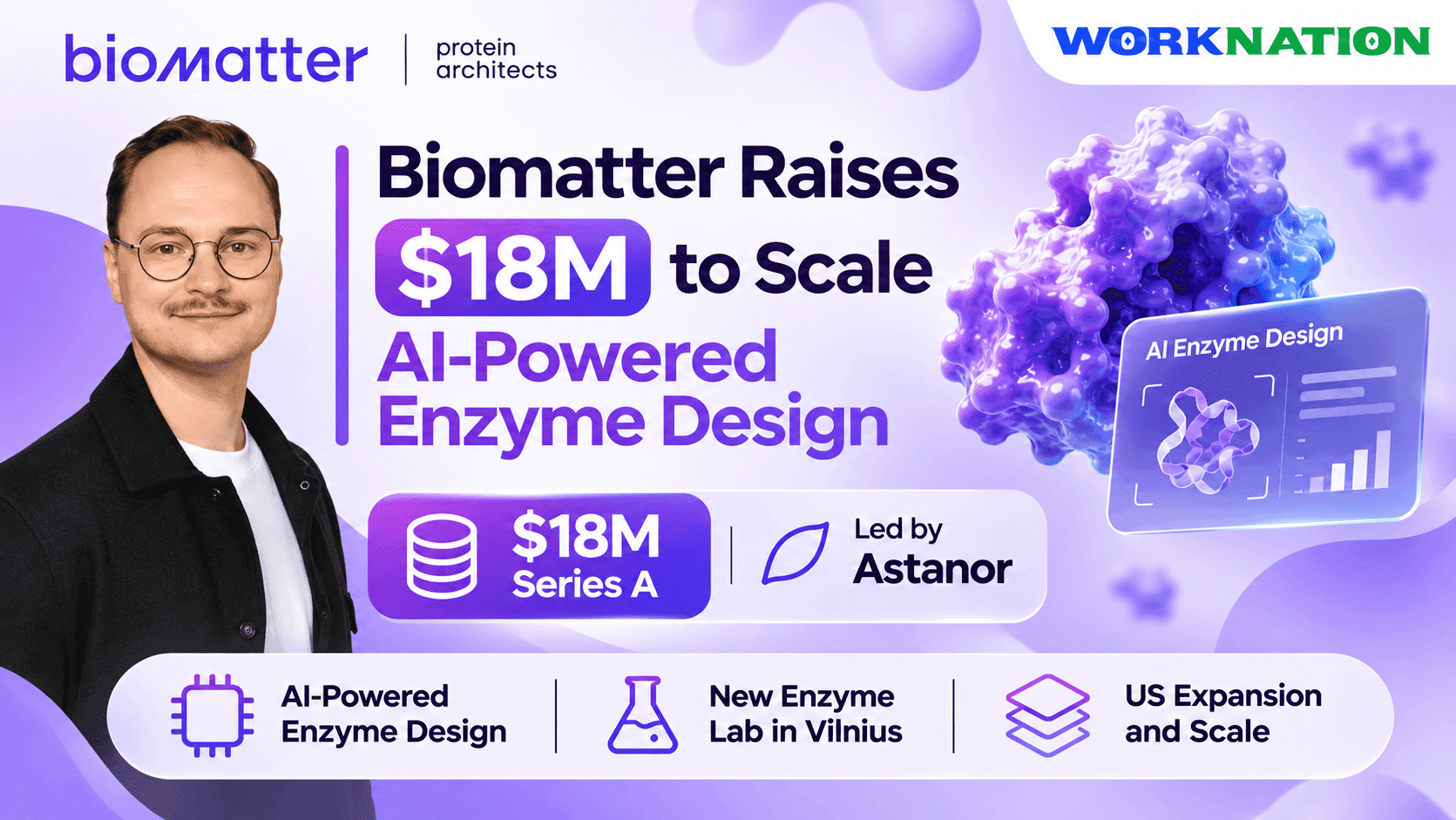
Biomatter has raised $18 million in an oversubscribed Series A funding round to scale its AI-powered enzyme design platform, build a new laboratory in Vilnius, and expand its commercial presence in the United States.
The round was led by Astanor, with existing investors UVC Partners, Inventure and Metaplanet also participating. The Lithuanian biotechnology company has not disclosed its valuation or total funding raised to date.
The investment will support a 2,000-square-metre design-and-testing facility in Vilnius, scheduled to open in 2027. Biomatter also plans to expand its commercial team and strengthen its US presence, where approximately half of its customers are based.
The company aims to shorten enzyme development timelines by combining AI-driven design with in-house laboratory testing.
AI-designed enzymes built around specific chemical reactions
Founded in 2018, Biomatter develops custom enzymes using artificial intelligence and experimental biology. Its platform starts with the chemical reaction a customer wants to achieve, rather than relying solely on modifying enzymes already found in nature.
This approach is relevant to industries such as pharmaceuticals, food production, diagnostics and industrial manufacturing, where specialised enzymes can improve production processes but may take months or years to develop.
Biomatter's models generate enzyme designs for specific target reactions. Each design is then tested in a laboratory, with experimental results fed back into the company's proprietary dataset to improve future designs.
The company's scientific work includes a 2021 publication in Nature Machine Intelligence demonstrating how generative models can produce functional enzymes substantially different from naturally occurring examples.
One example cited by Biomatter is a methylase designed for mRNA vaccine manufacturing that works without S-adenosyl methionine (SAM), an expensive additive required by natural methylases.
More than 50 enzymes delivered to enterprise customers
Biomatter says it has delivered more than 50 custom enzymes to over 25 enterprise customers across Europe, the United States and Japan.
Its customer list includes AstraZeneca, BASF, Kirin Holdings, Neogen, Sanofi and Tereos, spanning pharmaceuticals, diagnostics, agriculture and industrial biotechnology.
The company's technology has also been incorporated into a commercial product through its work with Thermo Fisher Scientific. Biomatter helped improve the oxidation resistance of Invitrogen SuperScript V Reverse Transcriptase, an enzyme used in molecular biology and mRNA research.
According to the company, the improvement supports reagent stability, including ambient shipping and room-temperature storage for up to six months.
Biomatter also reports that some customer relationships have developed from individual projects into multi-year programmes involving multiple enzymes. This repeat engagement is an important indicator of commercial adoption beyond laboratory demonstrations.
New Vilnius facility targets faster enzyme development
The planned 2,000-square-metre facility is central to Biomatter's next phase. By bringing more enzyme design and experimental testing under one roof, the company expects to increase its development capacity and reduce the time between designing an enzyme and validating its performance.
Biomatter says its current development programmes take weeks, compared with months or years for conventional approaches. Its ambition is to bring some development cycles down to days as the new facility comes online.
The expansion also reflects the company's intention to serve more customers directly, particularly in the United States, which already accounts for approximately half of its customer base.
Competition in AI-powered enzyme and protein engineering
Biomatter operates in an increasingly competitive field that applies AI and computational biology to protein and enzyme development.
Manchester-based Imperagen raised £5 million in seed funding in May 2026 to combine quantum simulation, AI models and laboratory automation for enzyme engineering. Spanish startup ZYMVOL raised €3 million in February 2025 to advance computational enzyme discovery, particularly for green chemistry and industrial applications.
Amsterdam-based Cradle raised a $73 million Series B in November 2024 for its AI-powered protein engineering platform.
Biomatter's stated differentiation lies in its chemistry-first design approach, proprietary experimental data and custom enzyme programmes for industrial customers. Rather than focusing only on improving existing proteins, it aims to design enzymes for reactions that may not have suitable natural counterparts.
The challenge will be to maintain performance and reliability as the company scales production and serves more complex industrial requirements.
Engineered enzymes market creates a wider opportunity
The market opportunity extends across pharmaceutical manufacturing, diagnostics, food processing and industrial biotechnology. Grand View Research estimates that the global engineered enzymes market could grow from $3.3 billion in 2026 to $7.3 billion by 2033, at a compound annual growth rate of 11.6%.
This estimate covers the broader engineered enzymes market, not just AI-designed enzymes. Biomatter is therefore competing for a share of a wider market in which customers are looking for more efficient, specialised and reliable biological processes.
The company's existing enterprise relationships and reported commercial product integration give it a starting point as it expands. However, the next test is whether its new facility can deliver faster development without compromising enzyme performance, and whether existing customers increase their programmes over time.
With its $18 million Series A, Biomatter is moving to scale AI-powered enzyme design from specialised customer projects toward a larger commercial operation.
Searching 12 websites
Have a Funding Round or Exciting Update to Share?
Submit your press release to get featured on WorkNation and reach founders, investors, and tech leaders.