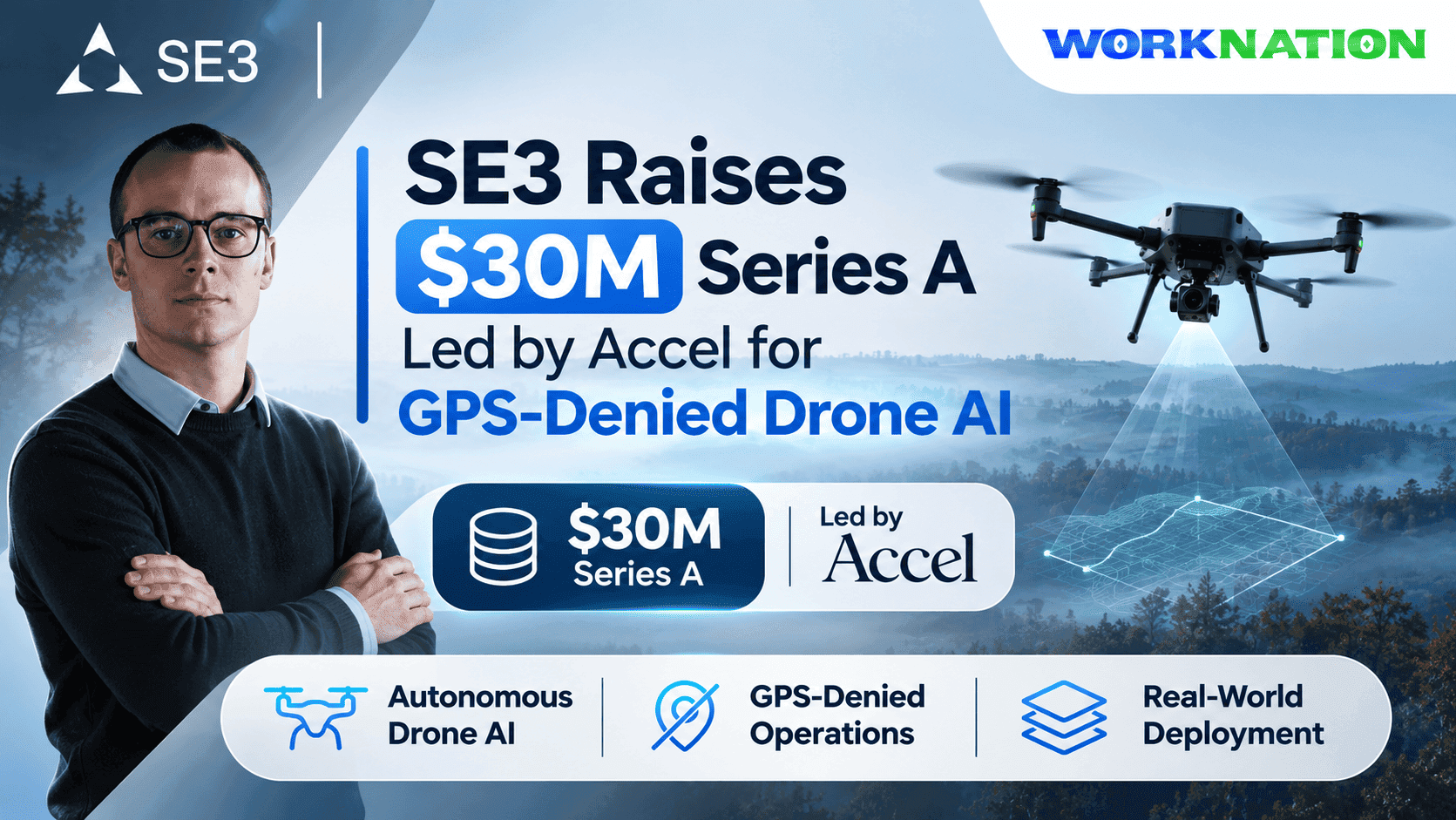
SE3 Raises $30 Million Series A Led by Accel to Advance GPS-Denied Autonomous Drone Technology
Top Picks
Submit PR
Stay Ahead of the Market
Get the latest startup funding, hiring trends and global opportunities delivered to your inbox every week.
SE3, a Munich-based spatial intelligence startup, has raised $30 million in Series A funding led by Accel, with participation from Keen, Lakestar and Seedcamp. The company is developing AI-powered software that enables autonomous drones and ground vehicles to navigate complex environments, coordinate operations and continue functioning when GPS signals are disrupted.
The funding will support SE3's engineering, commercial and operations teams as it fulfils existing contracts and expands its customer base. The company plans to strengthen its presence in Germany and Ukraine, open an office in the United Kingdom and pursue additional opportunities across Europe.
SE3 has not disclosed its valuation or total funding raised.
How SE3's Spatial Intelligence Technology Works
SE3 is building a shared software layer that allows autonomous systems from different manufacturers to understand and operate within the same physical environment.
Its platform combines computer vision and artificial intelligence to process sensor data from drones and ground vehicles. The system creates a shared three-dimensional representation of the surroundings, helping autonomous machines understand their environment, coordinate movements and adjust routes as conditions change.
Unlike manufacturers that develop individual drones or unmanned ground vehicles, SE3 focuses on software that can operate across equipment from different suppliers.
Its technology is designed to address several operational challenges:
GPS-denied navigation: Helps autonomous systems continue operating when satellite navigation signals are unavailable or jammed.
Multi-vehicle coordination: Combines sensor information from different vehicles into a shared understanding of the environment.
Edge computing: Runs directly on devices rather than depending on continuous cloud connectivity.
Voice-based control: Allows operators to command fleets through voice instructions.
Platform compatibility: Supports integration across autonomous systems from different manufacturers.
This approach could help defence operators manage larger groups of autonomous systems without requiring a separate software environment for every vehicle supplier.
SE3's Origins at the Technical University of Munich
SE3 was founded by Lukas Köstler, Simon Klenk and Professor Daniel Cremers. The company emerged from Cremers' computer vision laboratory at the Technical University of Munich (TUM), where Köstler and Klenk were pursuing PhDs in computer vision and robotics.
Köstler serves as co-founder and CEO, while Cremers is the company's chief science officer. Cremers holds TUM's chair for computer vision and AI and received the Gottfried Wilhelm Leibniz Prize, one of Germany's prominent research awards.
The founding team's academic background in computer vision and robotics forms the foundation of SE3's spatial intelligence platform.
Defence Contracts and European Market Expansion
Defence applications represent SE3's immediate commercial opportunity.
The company says it has shipped thousands of systems over the past two years and is working on multiple contracts with Ukraine and Germany's armed forces, the Bundeswehr.
Its customers and partners include:
HENSOLDT, a defence electronics company.
Auterion, an autonomous systems software provider.
ERC System, an autonomous systems scale-up.
SE3's technology also runs on Auterion's Skynode platform. This integration allows customers to access spatial intelligence capabilities through systems they already operate.
The company has designed its software around the Modular Open Systems Approach (MOSA), which encourages defence organisations to integrate equipment and technology from multiple suppliers rather than depend on closed systems.
Germany's MOSABw programme is part of this broader effort to create more interoperable defence capabilities.
Why GPS-Denied Autonomy Matters for Defence
Modern autonomous systems increasingly operate in environments where satellite navigation and communications can be disrupted.
Electronic warfare can interfere with GPS signals, making it difficult for drones and ground vehicles to determine their positions and coordinate operations reliably.
SE3's software aims to address this challenge by helping machines understand their surroundings through onboard sensors and computer vision.
Its edge-based architecture also reduces dependence on continuous cloud connectivity, an important consideration for military operations in contested environments.
The company's platform-agnostic approach could also reduce the integration challenges that arise when armed forces purchase autonomous systems from multiple manufacturers.
Competition in Autonomous Defence Software
SE3 is entering a growing European defence technology market that includes companies developing autonomous drone operations and GPS-denied navigation.
Norwegian startup Six Robotics develops software that enables one operator to control multiple drones. London-based Occam Industries is developing onboard autonomy technology for operations in GPS-denied environments.
Other companies, including Quantum Systems and Destinus, are also attracting significant investment in autonomous defence technology, although their businesses focus more heavily on hardware.
SE3's positioning is different: it aims to provide a shared software layer that connects autonomous systems across manufacturers.
The global autonomous intelligence, surveillance and reconnaissance (ISR) systems market was valued at approximately $5.9 billion in 2025 and is projected by Grand View Research to reach $14.5 billion by 2033. This broader market includes technologies beyond SE3's specific offering, but illustrates the growing commercial interest in autonomous sensing and intelligence systems.
How SE3 Plans to Use Its $30 Million Funding
The Series A investment will support three major priorities:
Engineering expansion: Advancing its spatial intelligence software and autonomous system capabilities.
Commercial growth: Supporting existing customer contracts and expanding its customer base.
European operations: Strengthening teams in Germany and Ukraine while establishing a new office in the United Kingdom.
The company is targeting further opportunities across European defence markets as demand for interoperable autonomous systems increases.
What SE3's Funding Means for European Defence Technology
SE3's $30 million Series A highlights investor interest in the software infrastructure needed to operate autonomous systems in increasingly complex environments.
While drone manufacturers focus on building individual platforms, SE3 is developing technology that aims to make different machines work together through a shared understanding of their surroundings.
The main commercial challenge will be convincing defence organisations to adopt independent software platforms rather than relying on solutions bundled with hardware. Its existing contracts, integrations and GPS-denied capabilities provide an initial foundation, but wider adoption will depend on operational performance and procurement decisions.
With new funding from Accel and other investors, SE3 is positioning itself to become a software infrastructure provider for Europe's expanding autonomous defence ecosystem.
Have a Funding Round or Exciting Update to Share?
Submit your press release to get featured on WorkNation and reach founders, investors, and tech leaders.