PORT Raises €14.5 Million to Build an Autonomous Delivery Robot Network Across the UK
Top Picks
Submit PR
Stay Ahead of the Market
Get the latest startup funding, hiring trends and global opportunities delivered to your inbox every week.
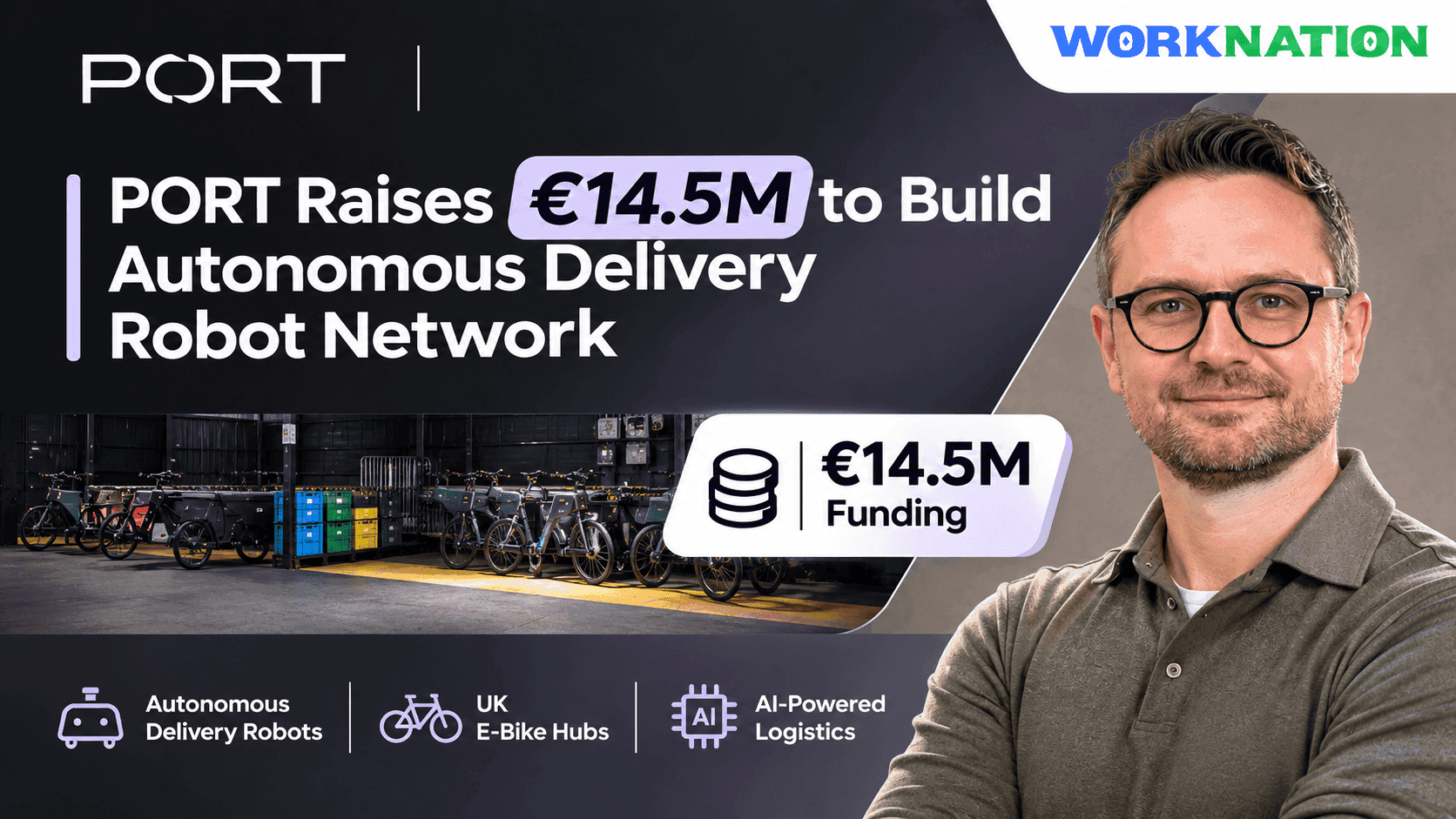
PORT has raised €14.5 million in equity and debt financing to develop autonomous delivery robots and expand its urban logistics infrastructure across the UK. The funding is led by the European Bank for Reconstruction and Development (EBRD) and Balnord, with participation from existing and new investors.
The London-based startup operates an electric bike rental and micro-hub network for delivery couriers. It now plans to build autonomous delivery technology on top of that existing infrastructure, using data collected from its 3,500-vehicle fleet to train its AI-powered driving systems.
Founded in 2020 by Kamil Suda, Matas Simonavicius and Dmitri Liberman, PORT expects its first delivery robot to enter service in the coming months, initially focusing on parcel logistics.
The investment will support robotics and technology development, while the remaining capital will strengthen its core e-bike rental business. The latest financing brings PORT's total funding to approximately €29 million, including €14.5 million raised previously through pre-seed and seed funding.
What Is PORT and How Does Its Urban Logistics Network Work?
PORT is building an urban logistics platform that combines electric vehicles, local delivery hubs and autonomous delivery technology.
Its original business model addresses the needs of professional delivery couriers who require reliable electric bikes without having to purchase, charge or maintain their own vehicles.
Couriers rent fully charged e-bikes from PORT's local hubs, use them for delivery shifts and return them when finished. The hubs provide access to vehicles and supporting logistics infrastructure in locations close to delivery demand.
The company operates 24 hubs across London, Manchester and Birmingham, using approximately 52,000 square feet of underutilised urban space, including underground car parks, warehouses and railway arches.
PORT reports:
Approximately 3,500 vehicles in its fleet.
More than 50,000 riders registered on its platform.
More than 50 million kilometres travelled by its fleet since 2024.
More than 300,000 parcels delivered using its cargo bikes since trailers were introduced in September 2025.
This existing network gives PORT a foundation for expanding beyond e-bike rentals into automated last-mile delivery.
How PORT Is Using E-Bikes to Train Autonomous Delivery Robots
One of PORT's most distinctive strategies is collecting real-world driving data through its existing delivery operations.
Rather than establishing a separate fleet of autonomous test vehicles, the company is equipping selected e-bikes with NVIDIA cameras and lidar sensors.
These devices capture information about urban environments, including:
Kerbs and pavements.
Cyclists and pedestrians.
Road layouts and obstacles.
Delivery locations and drop-off points.
Other conditions that autonomous vehicles must recognise.
The collected footage is uploaded automatically when bikes return to PORT's hubs, using the hubs' fibre connections.
The company then reviews the data to identify training scenarios for its AI Driver, including everyday driving situations and less common edge cases.
Why real-world delivery data matters
Autonomous delivery systems must operate in environments that are unpredictable and constantly changing.
A robot may encounter parked vehicles, temporary roadworks, pedestrians, cyclists, uneven surfaces and delivery locations that are difficult to access.
Training systems using real-world data from active delivery routes could help PORT build a more representative dataset than one collected through limited testing environments.
The company believes its existing fleet gives it an advantage because data collection happens alongside commercial operations rather than requiring a separate data-gathering fleet.
How PORT addresses privacy concerns
Collecting footage from public streets creates privacy and data protection responsibilities.
CEO Kamil Suda told Tech Funding News that faces and vehicle registration plates are blurred directly on the device before footage reaches PORT's systems.
This edge-processing approach is intended to reduce the amount of identifiable personal information entering the company's central data infrastructure.
PORT's First Autonomous Delivery Robot Is Expected Soon
PORT plans to introduce its first robotic delivery system in the coming months.
Parcel logistics will be its initial application, with the company working alongside Royal Mail on a new robotic delivery system.
The company has not disclosed the robot's design or detailed technical specifications. It has also not provided a confirmed commercial launch date in the supplied report.
Royal Mail's managing director of out-of-home, Jack Clarkson, said the partnership could help the postal operator explore new approaches to customer service, operating costs and sustainability.
The initial deployment will be an important test of whether PORT can translate its existing delivery infrastructure and data capabilities into reliable autonomous operations.
Why PORT Believes Micro-Hubs Are More Important Than Robots
PORT's strategy is based on the idea that autonomous delivery requires more than a vehicle capable of driving without a human operator.
Robots need nearby facilities where they can be stored, charged, loaded and maintained. They also need access to delivery demand within a practical operating radius.
This is where PORT's existing micro-hub network becomes important.
The company says its robots need to operate from facilities located within a few miles of their delivery destinations.
In London, PORT reports that its hub network covers:
92% of the area within one mile of the Congestion Charge Zone.
60% of the area within two miles of the zone in inner London.
The company also plans to open a micro-hub in central Paris in 2026, marking its first location outside the UK.
This infrastructure could allow PORT to introduce autonomous delivery services without building an entirely new network of operating facilities.
Why PORT Is Expanding Beyond E-Bike Rentals
PORT's transition into robotics is a move towards controlling more of the last-mile delivery process.
Its existing rental business provides access to couriers, vehicles and urban delivery locations. Its new robotics programme adds autonomous technology and data collection to that model.
The company is competing across two related markets.
In electric mobility, Whizz offers e-bike subscriptions for last-mile delivery workers and raised $12 million in a Series A round led by Leta Capital.
In autonomous delivery, Coco Robotics has secured $80 million to expand its autonomous delivery operations.
PORT's strategy is different because it aims to combine the vehicle rental business, physical logistics infrastructure, operational data and autonomous delivery technology within one network.
This could create a broader offering for logistics companies than selling or operating delivery robots independently.
Five Insights That Explain PORT's Business Strategy
1. PORT already owns part of the infrastructure autonomous delivery companies need
Many robotics startups must develop their delivery technology while also establishing operational locations, charging facilities and maintenance networks.
PORT has already spent years building its micro-hub infrastructure. This could reduce the additional infrastructure required to introduce robots, although the existing hubs will still need to be adapted for autonomous operations.
2. Its data collection model connects commercial activity with AI development
PORT's e-bikes are not simply revenue-generating assets. Equipped vehicles can also collect information that helps train the company's autonomous driving systems.
This creates a connection between its existing business and its future robotics development. More delivery activity could generate more useful training data, although data quality and coverage will determine its actual value.
3. The company is betting on distribution rather than proprietary robot hardware alone
Suda believes delivery robot hardware and autonomous software could become increasingly commoditised.
If that happens, companies with strong distribution networks, operating locations and customer relationships may have an advantage over businesses that focus only on building robots.
PORT's strategy is to control the infrastructure through which autonomous deliveries can operate.
4. Royal Mail provides a potential route into established parcel logistics
Parcel delivery is a logical starting point because it connects PORT's existing cargo-bike experience with the potential use of autonomous vehicles.
Working with Royal Mail could provide an opportunity to test the technology in a real logistics environment. However, a partnership announcement should not be confused with proof of a scaled commercial rollout.
5. The business has two different sources of execution risk
PORT must continue operating its e-bike rental network while developing a new robotics business.
The rental operation depends on fleet utilisation, hub economics and courier demand. The robotics operation depends on technical reliability, safety, regulatory requirements and customer adoption.
The company must demonstrate that investment in autonomous delivery strengthens its existing business rather than diverting resources from it.
Who Invested in PORT's €14.5 Million Funding Round?
The latest €14.5 million financing combines equity and debt, with the EBRD and Balnord leading the investment.
The round also includes participation from existing and new investors.
The EBRD's involvement is significant because its investment activity includes supporting technology and infrastructure businesses that contribute to more sustainable economic development.
Balnord has also backed companies operating across technology and dual-use sectors.
The funding will be allocated across two broad priorities:
Robotics and technology: Developing autonomous delivery systems, AI capabilities and supporting technology.
Core rental operations: Supporting PORT's existing e-bike business and urban logistics infrastructure.
The company previously raised €14.5 million through pre-seed and seed financing. Adding the latest €14.5 million brings its total funding to approximately €29 million.
What Comes Next for PORT?
PORT is preparing to move from collecting autonomous driving data to deploying its first delivery robot.
The initial focus will be parcel deliveries, with Royal Mail involved in the development of its robotic delivery system.
The company also plans to expand its infrastructure beyond the UK, beginning with a micro-hub in Paris.
Its long-term ambition is to build an urban logistics network in which electric bikes, autonomous robots and strategically located delivery hubs operate together.
The next major milestone is demonstrating that its technology can perform reliably in real delivery environments.
PORT's €14.5 million funding will help the company move from e-bike rentals towards autonomous delivery infrastructure. Its success will depend not just on building robots, but on turning its existing hubs, fleet and real-world data into a scalable delivery network.
Have a Funding Round or Exciting Update to Share?
Submit your press release to get featured on WorkNation and reach founders, investors, and tech leaders.