Tendrils Raises $30M from Benchmark to Build a New Generation of Parallel CPUs
Top Picks
Submit PR
Stay Ahead of the Market
Get the latest startup funding, hiring trends and global opportunities delivered to your inbox every week.
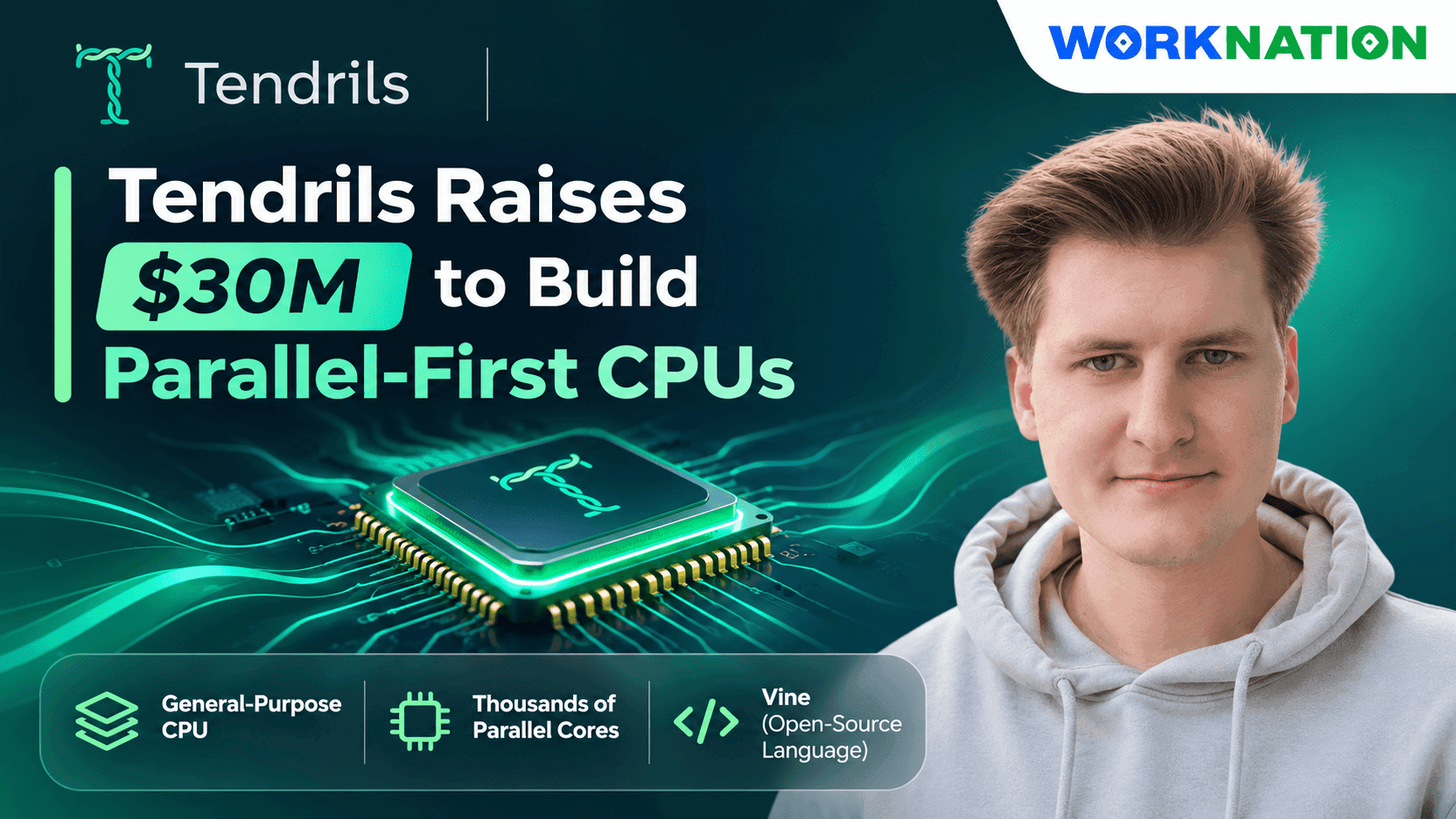
Tendrils has raised $30 million in funding led by Benchmark to develop a general-purpose processor built around thousands of parallel cores. The Cambridge, UK-based semiconductor startup is challenging conventional CPU architecture with a design intended to execute workloads through parallel processing rather than traditional sequential instruction streams.
The round included the UK Sovereign AI Fund, Visionaries Club, FR8, Antimatter, Cloudberry, Conviction, Embassy Ventures, SV Angels and several private investors. Benchmark general partner Jack Altman is joining Tendrils' board of directors.
Founded in 2026, Tendrils is also developing Vine, an open-source programming language designed specifically for its parallel-first chip architecture. The company aims to rethink how processors and software work together as demand for computing capacity grows across artificial intelligence and other data-intensive applications.
Why Tendrils wants to redesign CPU architecture
Modern CPUs have evolved around architectural principles established decades ago. Tendrils argues that maintaining compatibility with traditional computing systems creates constraints when building processors designed for large-scale parallel execution.
The company identifies two particular limitations:
Cache coherency protocols: These help maintain consistent data states across multiple processor cores but introduce coordination requirements.
Reorder buffers: These allow processors to execute instructions out of their original sequence, adding complexity to conventional CPU architectures.
Tendrils wants to approach processor design differently by building a chip around parallel execution from the beginning.
Its proposed architecture moves away from shared mutable memory and linear instruction streams. Rather than simply increasing the number of traditional CPU cores, the company wants to develop a general-purpose processor in which thousands of cores can work in parallel.
This is an ambitious architectural approach. Its success will depend not only on the silicon design but also on whether developers can build software that takes advantage of the new execution model.
Vine: The programming language behind parallel-first chips
Alongside its processor, Tendrils is developing Vine, an open-source programming language intended for parallel-first hardware.
The language is based on interaction nets, a computational model in which local rules execute in parallel without locking.
This is an important part of the company's strategy. New processor architectures often face a software adoption challenge because developers need programming tools that allow them to use the hardware effectively.
Vine is intended to address that problem by giving developers a language designed around the underlying architecture rather than adapting existing programming models.
However, the language remains experimental. Tendrils has not yet demonstrated a mature software ecosystem or disclosed a commercially available processor.
Benchmark and UK Sovereign AI Fund back the startup
Benchmark led the $30 million round, with Jack Altman joining the Tendrils board.
Benchmark has previously backed companies including Uber and eBay and invested in semiconductor company Cerebras during its earlier development.
The UK Sovereign AI Fund also participated. The government-backed investment vehicle has a £500 million mandate to support the UK's artificial intelligence ecosystem. However, the amount it invested in Tendrils has not been disclosed.
Other participating investors include Visionaries Club, FR8, Antimatter, Cloudberry, Conviction, Embassy Ventures and SV Angels.
The funding provides Tendrils with capital to advance processor development and its parallel-first software ecosystem.
Four team members, but founders remain undisclosed
Tendrils has not publicly identified its founders in the supplied funding announcement.
Its website lists four team members: Nils Cremer, Hugo McNally, Enrico Borba and T6t6. However, their specific roles and founder status are not stated in the source.
The company was established in 2026 and has not disclosed its headcount or previous funding history. The $30 million announcement is therefore its first disclosed funding round in the supplied report.
The race to build next-generation CPUs
Tendrils is entering a semiconductor market where startups are exploring alternatives to established processor architectures.
AheadComputing, founded by former Intel architects, raised $30 million in January 2026 to develop CPU cores based on the open RISC-V architecture. Nuvacore is another emerging company pursuing new CPU designs.
Tendrils' approach is distinct because it is attempting to redesign both the processor architecture and the programming model required to use it.
The wider opportunity is significant. Data centres, AI systems and advanced computing applications require increasing processing capacity. However, Tendrils is not simply competing to produce a faster conventional CPU. It is betting that a different architecture can make large-scale parallel computing more practical.
Five challenges Tendrils must overcome
The $30 million investment gives Tendrils resources to pursue its architectural ambitions, but several difficult challenges remain.
1. Delivering working silicon
A proposed processor architecture must eventually become a functioning chip. Tendrils will need to demonstrate that its design can be manufactured and operate as intended.
2. Building a usable programming ecosystem
Developers need practical tools, documentation and applications to adopt unfamiliar hardware. Vine's experimental status means this ecosystem is still developing.
3. Demonstrating general-purpose performance
Thousands of parallel cores could be valuable for particular workloads, but not every computing task benefits equally from parallel execution. The company must demonstrate advantages across a meaningful range of applications.
4. Competing with established architectures
Existing processors benefit from mature software ecosystems, established manufacturing relationships and developer familiarity. Convincing customers to adopt a new architecture will require more than theoretical performance benefits.
5. Connecting hardware and software development
The processor and Vine language need to evolve together. If either side develops more slowly than the other, adoption could become difficult.
What comes next for Tendrils?
Tendrils' $30 million funding round gives it backing from Benchmark and other investors as it attempts to rethink general-purpose processor design.
The company is pursuing a hardware-and-software strategy that combines thousands of parallel cores with a programming language designed to use them. This could create opportunities in computing workloads that benefit from extensive parallel execution.
But the technology remains at an early stage, and the company has not disclosed a commercial chip or a mature software ecosystem.
Tendrils' $30 million funding round puts a new CPU architecture on the semiconductor investment map. Its biggest test will be proving that developers can move beyond conventional programming models and use parallel-first hardware in real-world applications.
Have a Funding Round or Exciting Update to Share?
Submit your press release to get featured on WorkNation and reach founders, investors, and tech leaders.