Sumary Raises $25M Seed Round Led by Singular to Scale AI Accounting Platform
Top Picks
Submit PR
Stay Ahead of the Market
Get the latest startup funding, hiring trends and global opportunities delivered to your inbox every week.
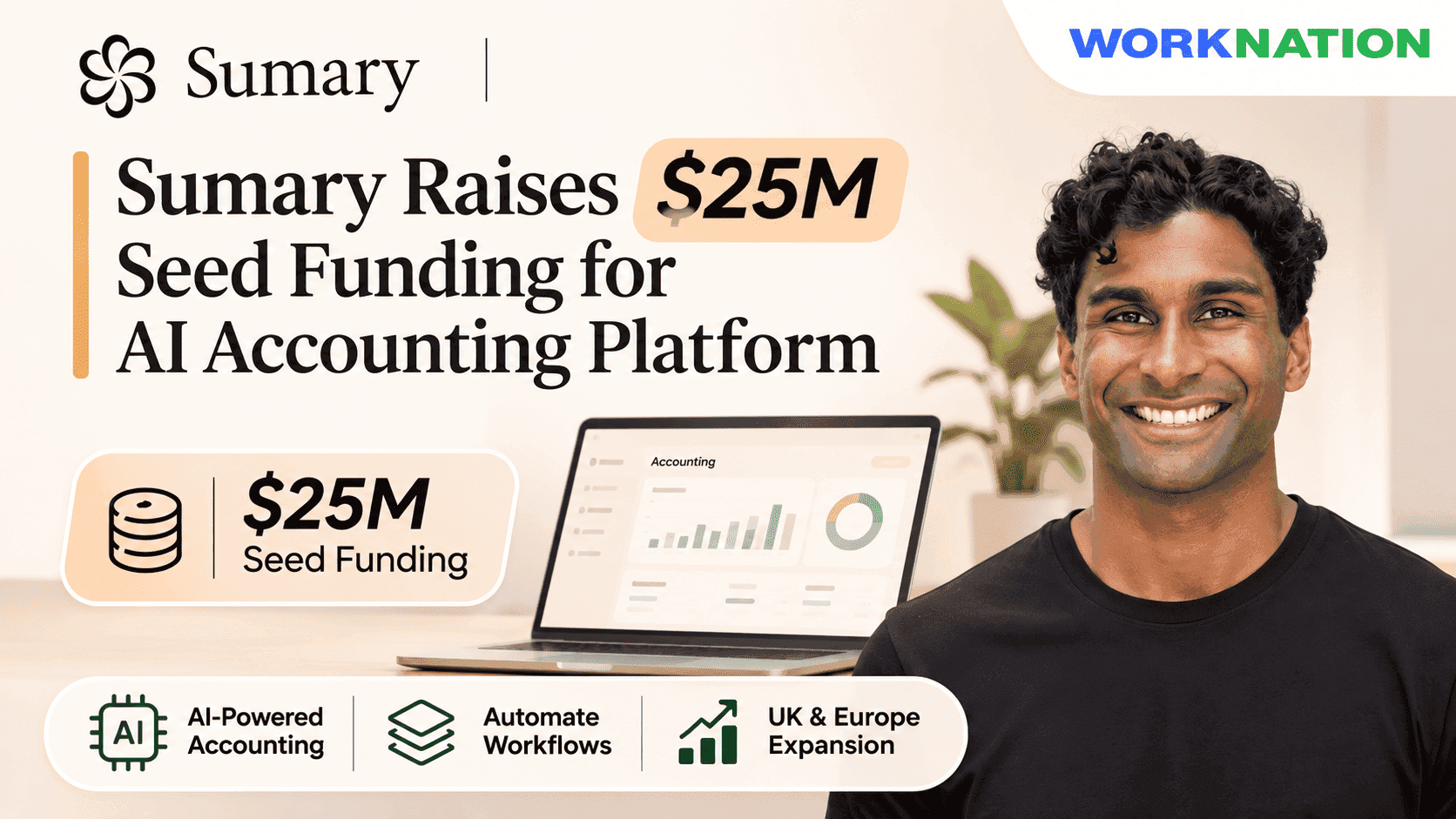
Sumary has raised $25 million in seed funding to expand its AI-powered accounting platform across the UK and Europe. The round was led by Singular, with participation from existing investors byFounders, Partech and Tenity, as the Copenhagen-founded startup targets accounting firms looking to automate their operations.
The investment comes as AI-native accounting companies enter the market, challenging traditional firms with software-driven services. Sumary is taking a different approach: instead of replacing established accounting firms, it provides them with AI tools to automate routine work and improve client services.
The angel investors participating in the round include Steve Anavi of Qonto, Tuomas Artman of Linear, Stanislas Polu of Dust, Steffen Tjerrild of Synthesia, Jannick Malling of Public.com and Ben Freeman of Omnea, among others.
The latest investment follows a $4.2 million pre-seed round in November 2025, led by byFounders. This brings Sumary's total disclosed funding to $29.2 million. The company describes the latest investment as the largest seed round ever raised by an accounting software company in Europe.
What does Sumary do?
Sumary is developing an AI operating system for accounting firms. Its platform automates accounting workflows, checks transactions and generates insights while keeping accountants involved in reviewing and approving important outputs.
The software covers several recurring accounting processes, including:
Monthly financial close
VAT return preparation
Year-end accounting
Transaction checking
Client and ledger workflows
For example, Sumary can prepare a VAT return as a draft for an accountant to review and approve before submission. The goal is to reduce repetitive preparation work while allowing professionals to retain control over final decisions.
The platform is also designed to work with the accounting ledgers firms already use. This means firms can adopt Sumary without necessarily replacing their existing accounting infrastructure.
Five founders and a growing European presence
Sumary was founded by Pascar Sivam, Bastian Schneider, Lucas Rantzau, Frederik Hvilshøj and Frederik Skov Wacher.
CEO Pascar Sivam and co-founder Bastian Schneider are former McKinsey consultants. Frederik Hvilshøj previously worked as a lead machine learning engineer at Encord and holds a PhD in explainable deep learning and generative models from Aarhus.
The company is now reorganising its geographical operations to support expansion. London will become its main commercial centre, while Copenhagen will remain the hub for technology development and AI research.
Sivam and COO Frederik Skov Wacher are moving from Copenhagen to London to lead the company's UK growth. Sumary also plans to expand into other European markets, with the Benelux region identified as its first expansion market.
Accounting firms report faster workflows
Sumary says its platform is already being used by major accounting organisations, including Deloitte, Grant Thornton and Baker Tilly.
The company reports that it has arrangements with most of the 20 largest accounting firms across the Nordic countries and contracts with several leading UK firms.
It also claims that firms using its platform for three months spend:
50% less time on monthly financial close processes.
75% less time preparing VAT returns.
These figures are company-reported results, rather than independently verified industry-wide performance measures.
Sumary's Copenhagen research team has also developed an internal benchmark based on real accounting work. The company says it evaluates leading AI models against this benchmark before deploying them in customer workflows.
This focus on accounting-specific evaluation is important because general-purpose AI performance does not necessarily translate into reliable financial reporting. Accounting workflows require accurate calculations, consistent documentation and outputs that professionals can review.
The AI accounting market is splitting into two models
The AI accounting market is developing along two distinct approaches.
One group of startups provides AI software to existing accounting firms. Sumary follows this model, alongside companies such as Basis, Kabilio and Ravical. These platforms aim to help established firms automate their workflows and improve productivity without requiring them to change their business model.
Another group is building AI-native accounting firms that deliver accounting services directly to businesses. Companies such as Skalar, Integral, Dougs and Gradient are pursuing this approach.
The difference is strategic. Software providers such as Sumary depend on established accounting firms adopting their technology, while AI-native accounting firms compete to serve customers directly.
Sumary believes existing firms can remain competitive if they adopt AI quickly. Its strategy is to become an operational technology partner, allowing accountants to spend less time on repetitive preparation and more time advising clients.
Why the $25M funding matters
The European accounting software market offers a substantial opportunity. Grand View Research estimates that the market was worth $5.4 billion in 2024 and forecasts that it could reach $8.4 billion by 2030.
However, Sumary's opportunity is not simply about selling another accounting application. It is attempting to automate work that traditionally requires significant professional time, while preserving the review and approval processes that accounting firms depend on.
The new funding gives the company resources to accelerate UK expansion, enter additional European markets and develop its AI capabilities.
There are several challenges ahead:
Building trust: Accounting firms must be confident that AI-generated outputs are accurate and auditable.
Proving productivity gains: The reported reductions in monthly close and VAT preparation time need to translate into consistent results across different firms.
Integrating with existing systems: Supporting different ledgers and accounting workflows will be essential for wider adoption.
Competing with AI-native firms: Established accounting firms will need to demonstrate that adopting Sumary can help them compete with businesses built around AI from the beginning.
Scaling across markets: Expansion into the UK and Benelux will require adapting to different accounting requirements and customer workflows.
What comes next for Sumary?
Sumary has secured $25 million to pursue a strategy focused on strengthening existing accounting firms rather than replacing them.
Its reported customer relationships, accounting-specific AI research and expansion plans give it an opportunity to establish itself in Europe's evolving accounting technology market.
But the long-term test will be whether the platform can deliver reliable results across different firms, accounting systems and regulatory environments.
Sumary's $25 million seed funding marks a significant step in its effort to bring AI into everyday accounting operations. As competition intensifies, the company must prove that helping existing firms adopt AI can be as effective as building entirely new accounting businesses around it.
Have a Funding Round or Exciting Update to Share?
Submit your press release to get featured on WorkNation and reach founders, investors, and tech leaders.