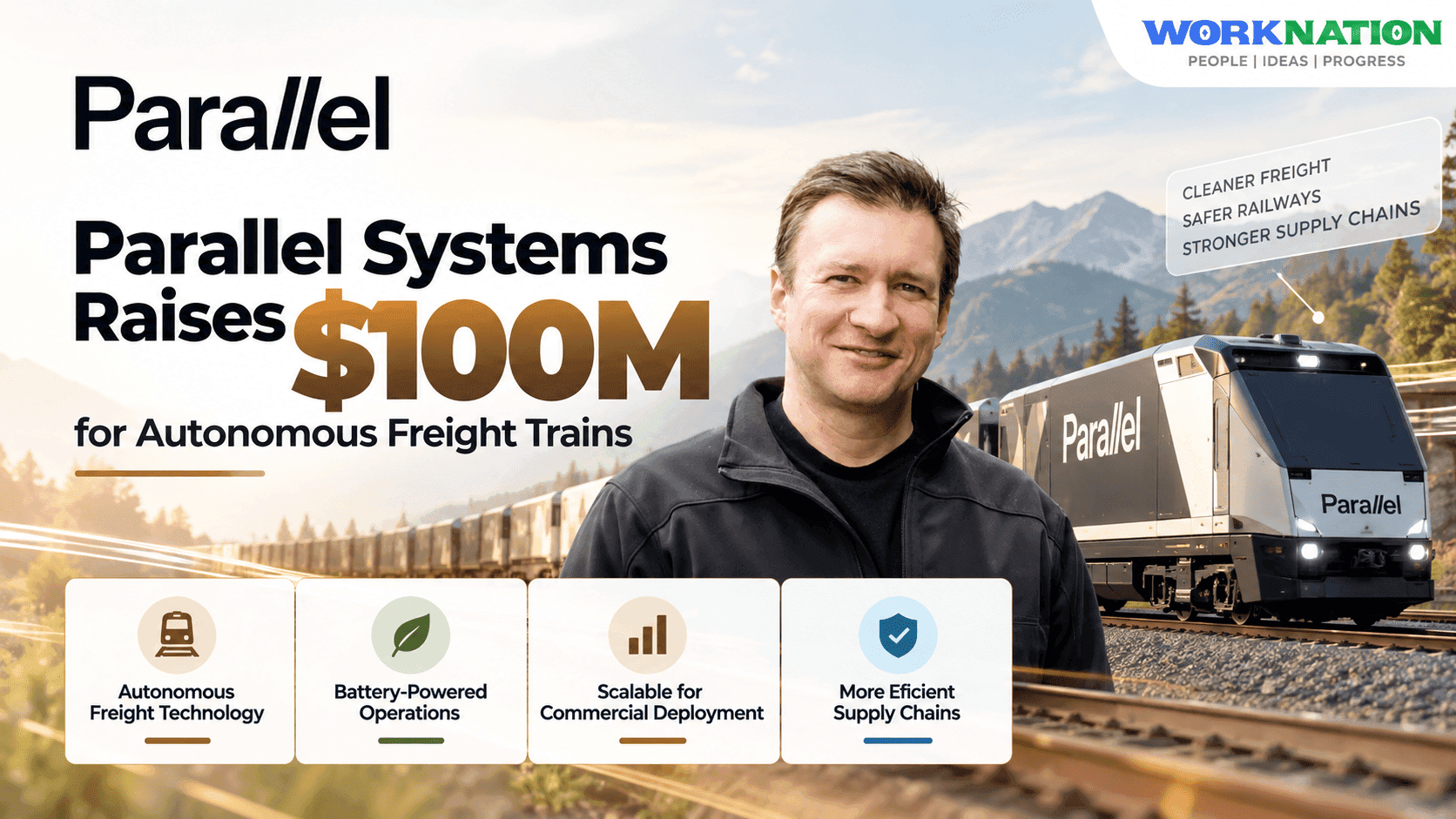
Parallel Systems Raises $100M to Scale Autonomous Freight Trains
Top Picks
Submit PR
Stay Ahead of the Market
Get the latest startup funding, hiring trends and global opportunities delivered to your inbox every week.
Parallel Systems has closed a $100 million Series C funding round to move its autonomous freight rail technology from pilot operations toward full commercial deployment.
The Los Angeles-based company develops battery-electric autonomous rail vehicles designed to make shorter freight routes more competitive with trucking. The new funding will support production of its third-generation Panther rail vehicle, commercial expansion in the United States, and entry into international markets.
AVP led the round. New investors include Hillspire, Agility Global, and Cobalt Capital. Existing investors Anthos Capital, Congruent Ventures, Riot Capital, and Collaborative Fund also participated.
Parallel Systems says it has now raised more than $200 million in total funding.
Targeting the Short-Haul Freight Market
Parallel Systems is focused on a segment of freight transportation that traditional railroads have struggled to serve efficiently.
Routes under 500 miles represent about 60% of the U.S. surface freight market, according to the company, but much of that freight is transported by trucks. Railroads have historically been better suited to long-distance, high-volume shipments, leaving shorter and lower-density routes increasingly dependent on trucking.
Parallel wants to change that equation.
Its autonomous rail system is designed to operate on existing rail infrastructure while giving shippers some of the flexibility associated with trucking. Instead of depending on a traditional locomotive and large train formation, the company's Panther vehicles can move freight in smaller units.
The company describes the approach as an on-demand freight movement system that combines the flexibility of trucking with the cost and environmental benefits of rail.
Building the Panther Vehicle
The new funding will help Parallel scale production of its third-generation Panther rail vehicle.
The company is positioning Panther as a battery-electric and autonomous alternative for short-haul freight. Its system combines hardware and software into a single freight transportation platform, allowing railroads to operate smaller freight movements without relying on traditional train configurations.
The goal is not simply to automate existing trains.
Parallel is attempting to create a different operating model for freight rail, one that makes smaller shipments and shorter routes economically viable.
That could give railroads a way to recapture freight currently moving by truck while making greater use of existing rail infrastructure.
From Pilot to Commercial Deployment
Parallel says it has moved beyond early-stage prototyping since its Series B round in 2025.
The company is now operating its technology in a regulatory testing environment in Georgia, where its pilot is being conducted in partnership with short-line railroad operator Genesee & Wyoming under Federal Railroad Administration supervision.
The company says its FRA-approved pilot has allowed it to validate the system in real-world freight corridors.
Parallel also says several major railroads are now under contract to deploy its technology for commercial freight transportation.
That marks a significant change for the company. The focus is shifting from proving that autonomous freight rail can work to determining how quickly it can be deployed at scale.
A SpaceX Connection
Parallel Systems was founded in 2020 by Matt Soule, who spent 13 years at SpaceX.
Soule is now the company's founder and CEO, leading a team that combines engineering expertise with rail operations experience.
The company has built its technology around autonomy, battery-electric propulsion and rail-specific sensing systems.
Its broader goal is to make freight transportation safer, cheaper and less dependent on trucking for shorter routes.
The company also argues that shifting some freight from roads to rail could reduce congestion and pollution, particularly around major ports and heavily trafficked freight corridors.
Expanding Beyond the U.S.
The $100 million Series C is also intended to support international expansion.
Parallel says there is growing interest in its technology from markets looking for lower-cost and more resilient freight systems.
For now, the company is concentrating on scaling its Panther production and advancing commercial deployments in the United States. But the new capital gives Parallel the resources to begin expanding internationally as well.
The company believes autonomous freight rail could eventually become a new option between conventional rail and trucking, particularly for shorter routes where traditional rail economics have historically been difficult.
With more than $200 million raised and major railroads already showing commercial interest, Parallel Systems is now entering a much different phase of its development.
The central question is no longer whether autonomous freight rail can operate in the real world. It is how quickly the technology can move from supervised pilots to widespread commercial use.
Have a Funding Round or Exciting Update to Share?
Submit your press release to get featured on WorkNation and reach founders, investors, and tech leaders.