Sennder Secures €228M in Equity and Debt Financing as Revenue Targets Reach €1B
Top Picks
Submit PR
Stay Ahead of the Market
Get the latest startup funding, hiring trends and global opportunities delivered to your inbox every week.
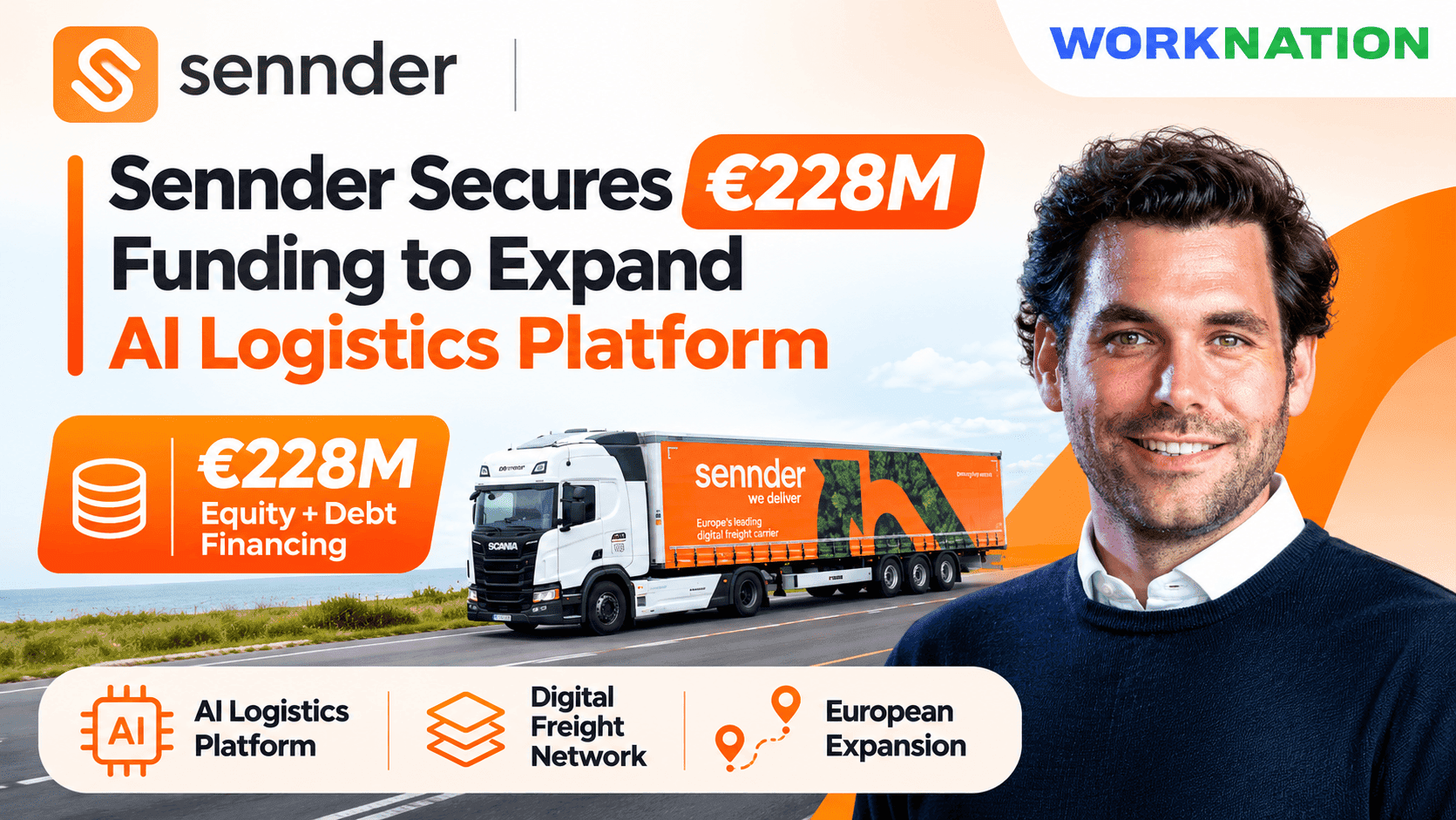
Sennder has secured €228 million in combined equity and debt financing to expand its digital road freight platform, strengthen its technology capabilities and support its next phase of growth across Europe. The German logistics technology company received €73 million in new equity and €155 million through financing facilities from investors and financial institutions.
The equity investment was led by existing shareholders Scania and Poste Italiane, with participation from Accel, Baillie Gifford, HV and Lakestar. The financing facilities include a €100 million non-recourse factoring facility from Coface, a €40 million facility from the European Investment Bank (EIB), and a €15 million supply chain finance facility provided through CFLOX and Deutsche Bank.
The announcement comes as sennder reports positive monthly EBITDA under IFRS and expects to generate approximately €1 billion in revenue in 2026. The company currently handles more than 150,000 shipments per month through a network of over 40,000 vetted carriers.
How Sennder's €228M financing is structured
The funding package combines equity investment with working capital facilities. This distinction matters because the entire €228 million is not new equity available for general expansion.
The two components are:
Financing type | Amount | Providers
New equity | €73 million | Scania, Poste Italiane, Accel, Baillie Gifford, HV and Lakestar
Non-recourse factoring | €100 million | Coface
Venture debt facility | €40 million | European Investment Bank
Supply chain finance | €15 million | CFLOX and Deutsche Bank
Total | €228 million |
The €73 million equity investment came entirely from existing shareholders. According to the announcement, €47 million was contributed over the two years before 2026, while €26 million was contributed during 2026.
The remaining €155 million consists of financing facilities designed to support the company's working capital requirements.
Freight forwarders often need to pay carriers before receiving payment from customers. Factoring and supply chain finance can help bridge this timing gap, allowing businesses to maintain operations without relying entirely on equity capital.
Coface's €100 million facility is structured as non-recourse factoring, while the EIB's €40 million facility provides venture debt financing. The additional €15 million facility comes through CFLOX and Deutsche Bank.
From coach parcel deliveries to 150,000 shipments a month
Sennder was founded in 2015 by David Nothacker, Julius Köhler and Nicolaus Schefenacker.
The company initially experimented with transporting parcels through long-distance coaches and courier networks. After that model failed to gain traction, the founders shifted their focus to full truckload freight in 2016.
Its platform connects businesses that need to transport goods with vetted trucking carriers. Through its sennOS operating system, sennder aims to improve freight allocation, reduce empty truck miles and make transport operations more efficient.
The company has since expanded through strategic partnerships and acquisitions.
In 2020, sennder merged with French freight technology company Everoad and acquired Uber Freight's European business in an all-stock transaction.
In 2021, it secured two major funding rounds, including a $160 million round in January and an $80 million round in June, which helped establish its position among Europe's logistics technology unicorns.
One of its most significant expansion moves came through the acquisition of C.H. Robinson's European Surface Transportation business. Announced in July 2024 and completed in February 2025, the transaction was expected to add more than 6,500 shippers and 15,000 carriers to its network.
Scania and Poste Italiane lead the equity investment
The latest equity financing came entirely from existing shareholders, highlighting continued backing from investors and strategic partners already connected to sennder.
Scania has been a partner of the company since 2017, while Poste Italiane has worked with sennder through their Italian joint venture since 2020.
The other participating shareholders include Accel, Baillie Gifford, HV and Lakestar.
The strategic relationships are important to sennder's operating model. Its partnership with Poste Italiane, for example, has supported freight operations in Italy. In 2021, sennder reported that its joint venture had helped reduce Poste Italiane's annual transport spending by 6%.
The latest investment provides additional equity capital while the financing facilities support the working capital requirements of its expanding freight network.
Positive monthly EBITDA and €1B revenue target
Sennder reports that it has achieved positive monthly EBITDA under IFRS on an unadjusted basis. The company expects to remain EBITDA-positive for the full year 2026.
It also expects to reach approximately €1 billion in revenue during 2026.
Its current operating scale includes:
More than 150,000 shipments handled per month.
Over 40,000 vetted carriers in its network.
A reported positive monthly EBITDA position under IFRS.
A 2026 revenue target of approximately €1 billion.
These milestones indicate a shift in the company's priorities from expansion through scale alone toward maintaining profitability while continuing to develop its network and technology.
However, positive monthly EBITDA does not automatically mean the company is profitable for the full year. Sennder's ability to maintain positive results across different months and market conditions will be an important measure of its financial performance.
AI and sennOS: The next phase of logistics technology
Sennder plans to invest in its technology platform, network expansion and AI capabilities.
Its sennOS platform is central to this strategy. The company is also looking to make its operating system and AI agents available to other freight forwarders.
This creates an additional opportunity beyond its own freight operations: providing technology to other logistics businesses.
The strategy also introduces a competitive challenge. Sennder will be positioning its software against specialist logistics technology providers and AI-native companies developing automation tools for freight operations.
Companies such as HappyRobot and Cargofy are pursuing AI-powered logistics workflows, while European platforms including MyDello and Qargo are developing digital solutions for freight management.
Sennder's advantage could come from combining an established freight network with operational software and AI capabilities. But it will need to demonstrate that external forwarders can adopt its platform while maintaining their own customer relationships and operating models.
What the €228M financing means for Sennder
Sennder's latest financing package gives it two forms of financial support: new equity for strategic growth and financing facilities to manage the cash-flow requirements of freight operations.
The €73 million equity investment supports its longer-term ambitions, including technology development, AI capabilities and network expansion. The €155 million in financing facilities provides additional working capital capacity.
The company now faces the challenge of maintaining profitability while scaling its operations and turning sennOS into a broader technology platform for the logistics industry.
Sennder's €228 million financing marks another major step in its development as a European digital freight company. With positive monthly EBITDA, more than 150,000 monthly shipments and a €1 billion revenue target for 2026, its next test will be sustaining profitable growth while expanding its AI-powered logistics platform.
Have a Funding Round or Exciting Update to Share?
Submit your press release to get featured on WorkNation and reach founders, investors, and tech leaders.