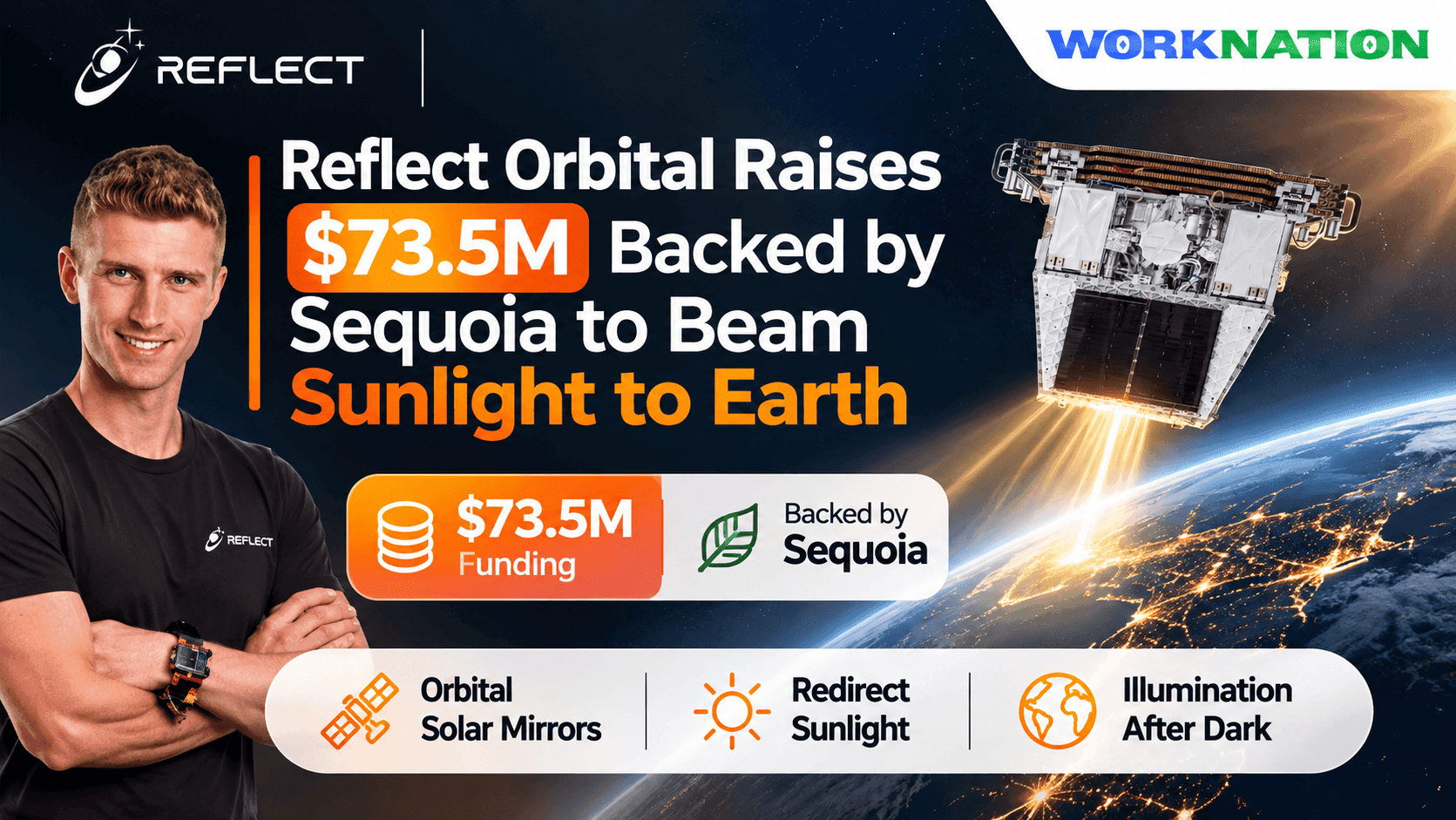
Reflect Orbital Raises $73.5 Million in Funding Backed by Sequoia and Lux Capital to Beam Sunlight to Earth
Top Picks
Submit PR
Stay Ahead of the Market
Get the latest startup funding, hiring trends and global opportunities delivered to your inbox every week.
Reflect Orbital, a California-based space technology startup, has raised $73.5 million in new funding to develop satellites equipped with large deployable mirrors that redirect sunlight towards locations on Earth after dark.
Announced on November 10, 2026, the investment takes the company's total funding beyond $100 million. Existing investors Sequoia Capital, Lux Capital and Starship Ventures participated, alongside new backers including Buckley Ventures, Convective Capital, The Uncommon Group and Salesforce Ventures.
Founded by Ben Nowack and Tristan Semmelhack, Reflect Orbital aims to make sunlight available on demand by deploying mirror-equipped satellites in low Earth orbit. Potential applications include extending solar farm operations after sunset and illuminating disaster zones for emergency responders.
How Reflect Orbital's Space Mirrors Work
Reflect Orbital is developing satellites that carry large, lightweight mirrors. Each satellite is designed to launch with its mirror folded before deploying a square reflective surface approximately 60 feet across in orbit.
The system is intended to redirect sunlight towards a target area on Earth. According to investor Convective Capital, a satellite could illuminate an area roughly five kilometres wide at approximately the brightness of a full moon. A single satellite would provide around four minutes of illumination while passing overhead.
The company sees potential applications across several industries:
Emergency response: Providing additional illumination for disaster areas and search-and-rescue operations at night.
Solar energy: Extending the availability of sunlight for solar farms after sunset.
Construction and industrial operations: Supplying temporary lighting without requiring conventional ground-based infrastructure.
These are proposed applications rather than established commercial services. The technology will need to demonstrate its performance, reliability and operational feasibility in orbit.
Reflect Orbital's Satellite Manufacturing Ambitions
Reflect Orbital says it is developing its manufacturing capabilities alongside its satellite technology.
The company reports that it can produce a large reflector quadrant, described as 28 times thinner than a human hair, every 3.5 days. It also says it delivers a four-boom deployable structure each week and builds a satellite containing approximately 12,000 parts from scratch every two months.
These figures are company-reported manufacturing claims. If sustained, they could support the company's ambition to build a large satellite constellation rather than operate only a small number of demonstration spacecraft.
Reflect Orbital has said it ultimately aims to deploy as many as 50,000 satellites by 2035.
First Demonstration Mission Planned for 2027
Reflect Orbital plans to launch its first demonstration mission in the second quarter of 2027. The mission is intended to test the deployment and performance of its orbital reflectors.
The company's first demonstration satellite, Eärendil-1, received a licence from the Federal Communications Commission (FCC). Reflect Orbital has also filed for approval of a developmental satellite intended to test its spacecraft and communications payload.
In October 2026, the company announced that it had purchased two dedicated launches from India's Skyroot Aerospace. The first is planned to use the Vikram-1 rocket, while the second is planned to use the larger Vikram-1U vehicle.
The 2027 demonstration will be an important milestone because the company has yet to establish the commercial performance of its sunlight-redirection system through an operational mission.
Astronomy and Environmental Concerns
Reflect Orbital's plans have also attracted criticism from the astronomical community.
The American Astronomical Society expressed concern about the FCC's approval of the first demonstration satellite. Astronomers have raised questions about the potential effects of artificial reflected light on astronomical observations and the night sky.
The FCC's decision addressed the proposed single-satellite demonstration rather than approving the company's wider 50,000-satellite ambition. The larger constellation would require further regulatory consideration.
Reflect Orbital says it is engaging with the dark-sky community and intends to offer a permission-based service. However, the long-term effects of operating a large constellation of reflective satellites remain an important issue for the company to address.
The Growing Space-Based Energy Market
Reflect Orbital is entering an emerging market where startups are exploring ways to use space infrastructure to deliver energy-related services.
Luxembourg-based TerraSpark is developing technology to transmit clean energy from orbit to Earth, while Turin-based ORiS is working on laser-based power transmission to recharge satellites in orbit. US-based Star Catcher Industries is also developing an orbital power network.
These companies are pursuing different approaches. TerraSpark and ORiS focus on transmitting energy, while Reflect Orbital intends to redirect naturally occurring sunlight using orbital mirrors.
The broader opportunity comes as terrestrial solar energy continues to expand. The International Energy Agency reported that global solar photovoltaic additions exceeded 600 GW in 2025, accounting for more than three-quarters of new renewable capacity worldwide.
Reflect Orbital's approach seeks to extend the availability of sunlight rather than replace conventional solar panels. Whether that service can become commercially viable will depend on its technology, launch costs, customer demand and regulatory acceptance.
How Reflect Orbital Plans to Move Forward
Reflect Orbital has raised $73.5 million as it moves towards its first demonstration mission and further satellite launches. The company has not disclosed a detailed allocation of the latest funding.
Its immediate priorities include preparing the 2027 demonstration, advancing satellite manufacturing and developing the infrastructure required for future launches.
The company has attracted substantial investor backing, but its central proposition remains unproven at commercial scale. The planned demonstration will help establish whether orbital mirrors can deliver useful, reliable illumination and whether the concept can eventually support a large constellation.
Reflect Orbital's $73.5 million funding marks another major investment in space-based energy infrastructure, but its 2027 mission will be the first significant test of the technology.
Have a Funding Round or Exciting Update to Share?
Submit your press release to get featured on WorkNation and reach founders, investors, and tech leaders.