Gama Raises €15 Million Seed Round Led by Transition, Planet A and Draper Associates to Scale Satellite Solar Arrays
Top Picks
Submit PR
Stay Ahead of the Market
Get the latest startup funding, hiring trends and global opportunities delivered to your inbox every week.
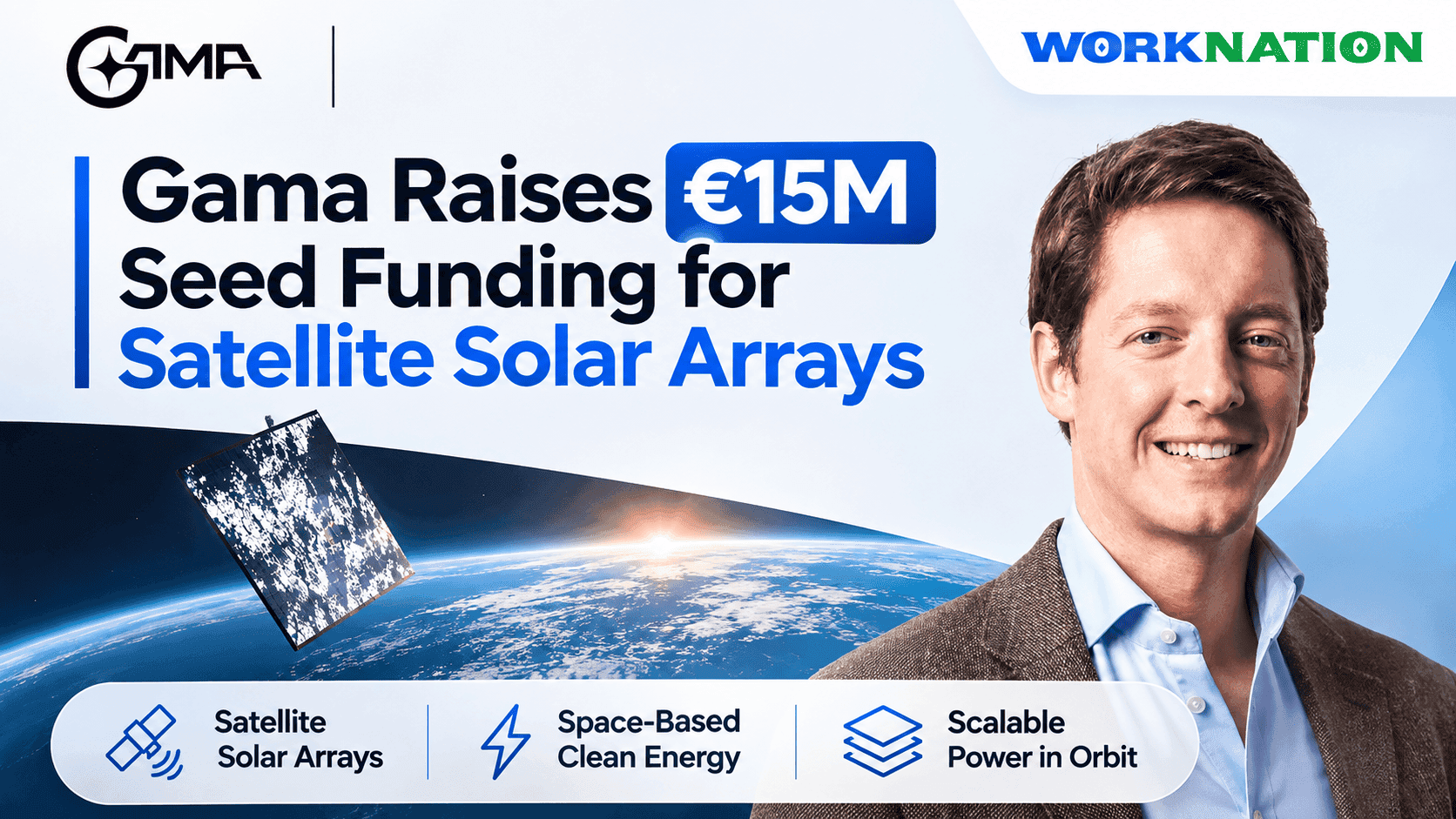
Gama, a Paris-based space technology startup, has raised €15 million in seed funding to develop and manufacture deployable solar arrays for satellites. The round was backed by Transition, Planet A, Draper Associates and Manta Ray.
Founded in 2022, Gama is shifting its commercial focus from solar sails to satellite power systems. The new funding will support the construction of its first production line for Wing, a deployable solar array designed to provide satellites with greater power while fitting inside a rocket fairing.
The company plans to establish the production line at its facility in Ivry-sur-Seine, near Paris. It also intends to expand its workforce from approximately 30 employees by hiring around 60 additional people.
From Solar Sails to Satellite Solar Arrays
Gama was founded by Andrew Nutter, Louis de Gouyon Matignon and Thibaud Elziere. Its early work focused on solar sail technology, which uses the pressure of sunlight for spacecraft propulsion.
The company's first mission, Gama Alpha, launched in 2023. Gama previously raised €2 million in an earlier funding round backed by Bpifrance, CNES and angel investors.
However, securing sufficient capital to scale its solar sail business proved challenging. The company subsequently redirected its experience in deployable space structures towards a more immediate commercial opportunity: satellite solar arrays.
Gama believes its engineering experience with solar sails can be applied to building larger deployable power systems. The company says satellite manufacturers face supply-chain constraints, particularly when sourcing specialised solar cells and deployable hardware.
Why Satellite Power Is Becoming a Critical Challenge
As satellite constellations expand, power generation is becoming an increasingly important engineering constraint.
Solar arrays must generate enough electricity to support satellite communications, onboard computing and other equipment, while remaining compact enough to fit inside a rocket's payload fairing during launch.
Gama's Wing system is designed to address this challenge through a deployable solar array and an integrated power architecture. The system includes:
A deployable solar array.
An array rotator.
Power management capabilities.
Optional energy storage.
Control software that interfaces with the customer's flight computer.
The company uses high-volume silicon solar cells originally developed for the rooftop solar market rather than relying exclusively on specialised III-V cells commonly used in space applications.
This approach could help reduce component costs and improve manufacturing scalability. However, silicon cells generally offer lower efficiency than the highest-performance space-grade alternatives. The commercial case will therefore depend on whether Gama can deliver competitive overall performance, weight and cost per watt.
Gama's Wing Platform and Competitive Landscape
Gama is entering a market that already includes established suppliers and space technology companies.
Rocket Lab, through its ownership of SolAero, manufactures high-efficiency space solar cells and solar power systems. Redwire also supplies deployable space hardware, including its ELSA solar array.
These competitors give satellite manufacturers existing options for sourcing solar power systems. Gama's opportunity is to differentiate through its manufacturing approach, integrated system design and ability to deliver deployable arrays at higher volumes.
The company says its production model could offer a lead time of approximately six months once manufacturing begins. This is a company-reported target and should not be treated as a demonstrated delivery record from an established production line.
Eclipse Space Partnership and First Demonstration Target
Gama has announced a partnership with Eclipse Space, a US-based satellite company founded by former SpaceX Starlink engineers.
Under the partnership, Eclipse Space will develop the satellite bus, while Gama will supply the large deployable solar arrays. The companies plan to deliver their first demonstration unit in summer 2027.
Eclipse Space is the only named customer in the supplied announcement. Gama says it is also in discussions with potential customers in Europe and the United States, but these discussions should not be treated as confirmed contracts.
The partnership provides Gama with an opportunity to demonstrate its technology in a customer application. Successful testing and delivery will be important steps towards securing additional satellite manufacturers.
How Gama Plans to Use the €15 Million Funding
The seed funding will support three main priorities:
Production capacity: Establishing the first Wing production line at its Ivry-sur-Seine facility.
Product development and testing: Expanding in-house testing capabilities and accelerating development of the deployable solar array.
Hiring: Adding approximately 60 employees to its current team of around 30, with the aim of supporting manufacturing and commercial expansion.
The planned expansion represents a significant increase in the company's size. Building a production line, scaling testing and converting customer discussions into orders will be important execution milestones.
What Gama's Funding Means for Europe's Space Industry
Gama's €15 million seed round highlights investor interest in the infrastructure supporting the expanding satellite economy. As satellite constellations become more capable, demand for reliable, scalable power systems is likely to become increasingly important.
The company's use of high-volume silicon cells could offer a different manufacturing route from traditional space-grade solar technologies. But lower component costs alone will not establish a competitive advantage. Gama will need to demonstrate that its complete system can meet satellite operators' requirements for efficiency, reliability, weight and cost.
The planned summer 2027 demonstration with Eclipse Space will be an important test. For now, Gama's €15 million funding provides the capital to move from technology development towards industrial production, with commercial validation still ahead.
Have a Funding Round or Exciting Update to Share?
Submit your press release to get featured on WorkNation and reach founders, investors, and tech leaders.