triPica Raises €12.4 Million to Modernise Energy Billing Software Across Europe
Top Picks
Submit PR
Stay Ahead of the Market
Get the latest startup funding, hiring trends and global opportunities delivered to your inbox every week.
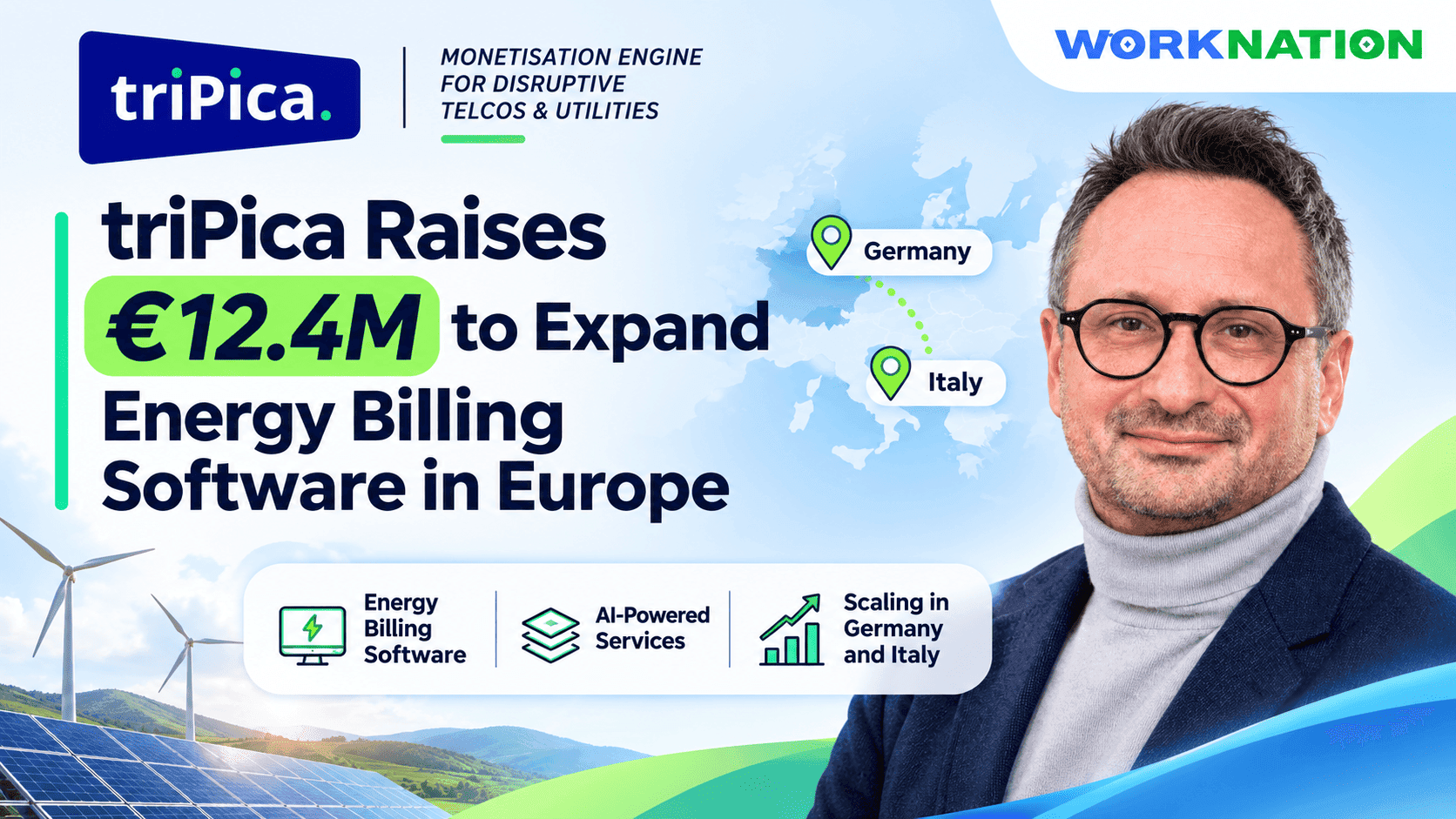
triPica has raised €12.4 million from TiLT Capital Partners to expand its energy billing software across Europe, targeting mid-sized energy suppliers that need modern systems to manage customers, subscriptions, payments and increasingly complex energy tariffs.
The Paris-based technology company develops cloud-based customer management and billing software for energy suppliers and telecommunications operators. The investment will support expansion in Germany and Italy, product development, AI integration, sales and marketing, and the development of its partner ecosystem.
Founded in 2016 by Mathieu Horn, Walid Bounar and Christophe Ruzé, triPica is betting that the energy transition will require a fundamental change in how suppliers manage customer relationships and calculate consumption-based charges.
TiLT Capital Partners, the energy transition investment platform of private equity group Sipare, is backing the company's next phase of European growth.
What Is triPica and How Does Its Energy Billing Software Work?
triPica provides cloud software that brings several essential business functions into one platform:
Customer information and account management.
Subscription and energy offer management.
Consumption-based billing.
Payment management.
Customer service and support.
The platform is designed for both energy suppliers and telecom operators. Its central proposition is to replace fragmented or outdated customer and billing systems with a modern, integrated alternative.
For energy suppliers, this matters because electricity products are becoming more complicated. Companies increasingly need to manage dynamic tariffs, solar self-consumption arrangements, electric vehicle charging plans and demand flexibility programmes.
Each new offering creates additional requirements for customer records, pricing calculations, consumption data and billing.
triPica says its platform can help suppliers launch new offers in weeks rather than months.
Why Energy Suppliers Need More Flexible Billing Systems
Traditional billing infrastructure was generally designed around relatively straightforward customer relationships and pricing structures.
The energy transition is changing that model.
A household might consume electricity from the grid, generate solar power, charge an electric vehicle and participate in a flexibility programme. Each activity can involve different pricing arrangements and billing requirements.
A supplier needs software capable of combining these services into an understandable customer account.
This is where triPica sees its opportunity: applying the flexibility of telecommunications billing infrastructure to the increasingly complex energy market.
From Telecommunications to Energy: The Founders' Strategy
triPica was founded in 2016 by Mathieu Horn, Walid Bounar and Christophe Ruzé.
CEO Mathieu Horn previously founded Joe Mobile, a virtual mobile operator that he led between January 2012 and June 2015.
His experience in telecommunications shaped triPica's business model. Horn believes telecom operators and energy suppliers face similar operational challenges: customers select an offer, consume a service and receive a bill based on that consumption.
Telecommunications companies have spent years developing systems capable of managing complex subscriptions, usage-based pricing and customer relationships.
Horn believes energy suppliers can benefit from applying similar technology as electricity products become more varied.
The company's experience in both sectors also gives it a broader commercial base than a software provider focused exclusively on energy.
triPica's Customers Include Energy and Telecom Operators
The company already works with customers across telecommunications and energy.
Its telecommunications customers include Digicel and CelcomDigi. Horn also referenced Orange and Carrefour Mobile as brands that triPica helped launch.
In the energy sector, German utility Enercity migrated from SAP IS-U to triPica's platform.
According to the company's case study, the migration covered hundreds of thousands of electricity customers.
This is an important example because replacing a legacy billing system at an established utility involves more than installing new software. The migration must account for customer records, existing contracts, billing histories and operational continuity.
Enercity's migration provides evidence that triPica's technology has been used in a large-scale utility environment, rather than remaining at the pilot stage.
Why triPica Is Targeting Mid-Sized Energy Suppliers Instead of Kraken
The energy software market already has major competitors, with Kraken serving as one of the most prominent examples.
Kraken, originally developed by Octopus Energy, provides technology for managing energy customers, billing and related operations. Its business has attracted substantial investment and supports more than 70 million accounts, according to the source report.
However, Horn does not consider Kraken a direct competitor.
triPica is targeting the long tail of mid-sized suppliers, particularly operators with up to one million delivery points.
The distinction is strategic. Large utilities may have the scale and resources to adopt major enterprise platforms, while smaller suppliers may need more flexible systems without the complexity of a large-scale implementation.
There is also a question of vendor independence. Energy retailers may be uncomfortable purchasing critical software from a company that also competes with them directly in the retail energy market.
triPica positions itself as an independent technology provider rather than an energy retailer.
How the competitive landscape is evolving
Several companies are developing technology for energy billing, customer management and flexible electricity services.
Kraken: A major utility software platform spun out of Octopus Energy.
VertexOne: Provides utility customer information and billing technology.
Nomos: Developing software for energy suppliers and the energy market.
Solarize: Operating in the energy technology ecosystem.
Ostrom and Rabot Energy: Focus on consumer-facing dynamic energy tariffs and related services rather than exactly the same white-label software model.
The distinction between infrastructure providers and energy retailers is important. They may serve the same broader market without offering identical products.
How AI Could Change Energy Billing and Customer Support
A significant part of triPica's funding strategy involves integrating artificial intelligence into its platform.
The company plans to use AI to improve billing and customer support processes, where energy suppliers often spend considerable time handling complex customer queries and operational tasks.
triPica has already developed an MCP server that allows external AI agents to connect to its platform.
MCP, or Model Context Protocol, provides a standardised way for AI applications to interact with external tools and data sources.
This could allow AI agents to access relevant customer and billing information and support workflows within the existing software environment.
However, the funding announcement does not disclose detailed AI product capabilities, customer deployment numbers or measurable productivity improvements. These should be treated as development priorities rather than proven commercial outcomes.
Why TiLT Capital Partners Invested €12.4 Million
TiLT Capital Partners led the €12.4 million investment.
The investor focuses on companies supporting the energy transition. Its investment thesis around triPica is that energy suppliers need more advanced customer and billing infrastructure to introduce new electricity products.
Nicolas Lepareur, co-founder and managing partner at TiLT, highlighted the importance of enabling suppliers to offer dynamic tariffs, self-consumption and electric mobility services.
According to Lepareur, the software systems behind these offerings are an overlooked but important part of the energy transition.
The funding will support three main priorities:
1. Product development: Expanding the platform to address market requirements and integrating AI into billing and customer support.
2. Sales and marketing: Growing the company's presence in Germany, Italy and France, while continuing to pursue telecommunications opportunities.
3. Partner ecosystem: Building relationships with technology and industry partners to support customer acquisition and product deployment.
Five Insights That Explain triPica's Growth Opportunity
1. The energy transition creates a software problem as well as an infrastructure problem
Investment in renewable generation, batteries and electric vehicles receives significant attention. But suppliers also need software capable of managing the commercial relationships and billing arrangements created by these technologies.
Without flexible billing systems, launching new energy products can become operationally difficult.
2. Mid-sized utilities represent a distinct customer segment
Large utilities can invest in extensive technology programmes, but smaller and mid-sized suppliers may need a more adaptable solution.
triPica's focus on suppliers with up to one million delivery points gives it a defined market segment rather than requiring it to compete directly for every large utility transformation project.
3. Its telecommunications experience provides a practical advantage
triPica is not entering energy billing without relevant operational experience. Its telecommunications background provides experience with subscriptions, consumption-based charges and customer account management.
That experience could help the company adapt established billing concepts to more complex electricity products.
4. Large-scale migrations are more valuable evidence than product demonstrations
Enercity's migration from SAP IS-U, covering hundreds of thousands of electricity customers according to the company case study, is an important commercial reference.
For other utilities considering a change of platform, evidence that a supplier can handle large customer migrations may matter more than a long list of software features.
5. AI adoption depends on access to reliable operational data
AI-powered customer support and billing automation are only useful if the underlying customer records, consumption data and billing information are accurate.
triPica's existing customer and billing platform could provide the operational foundation for AI applications. Its MCP integration is an early indication of how it intends to connect external AI agents to those systems.
The commercial test will be whether these capabilities reduce processing time, improve customer service or lower operational costs.
What Comes Next for triPica?
The €12.4 million investment gives triPica resources to expand across European energy markets, strengthen its product and build a larger partner network.
Germany and Italy are immediate expansion priorities, while France and telecommunications remain part of the company's commercial strategy.
Its main challenge will be adapting to different national energy regulations, billing requirements and supplier operating models. A platform that works in one country cannot automatically be deployed everywhere without local integrations and adjustments.
The company must also demonstrate that its AI capabilities deliver measurable benefits beyond the existing billing platform.
As energy suppliers introduce more dynamic tariffs, electric vehicle charging products and self-consumption services, demand for flexible customer and billing infrastructure could increase.
triPica's opportunity is to make energy billing software flexible enough for the next generation of electricity services, while giving mid-sized suppliers an alternative to complex legacy systems.
Have a Funding Round or Exciting Update to Share?
Submit your press release to get featured on WorkNation and reach founders, investors, and tech leaders.