Nebuly Raises $21 Million Series A Led by Planven to Measure Enterprise AI Agent ROI
Top Picks
Submit PR
Stay Ahead of the Market
Get the latest startup funding, hiring trends and global opportunities delivered to your inbox every week.
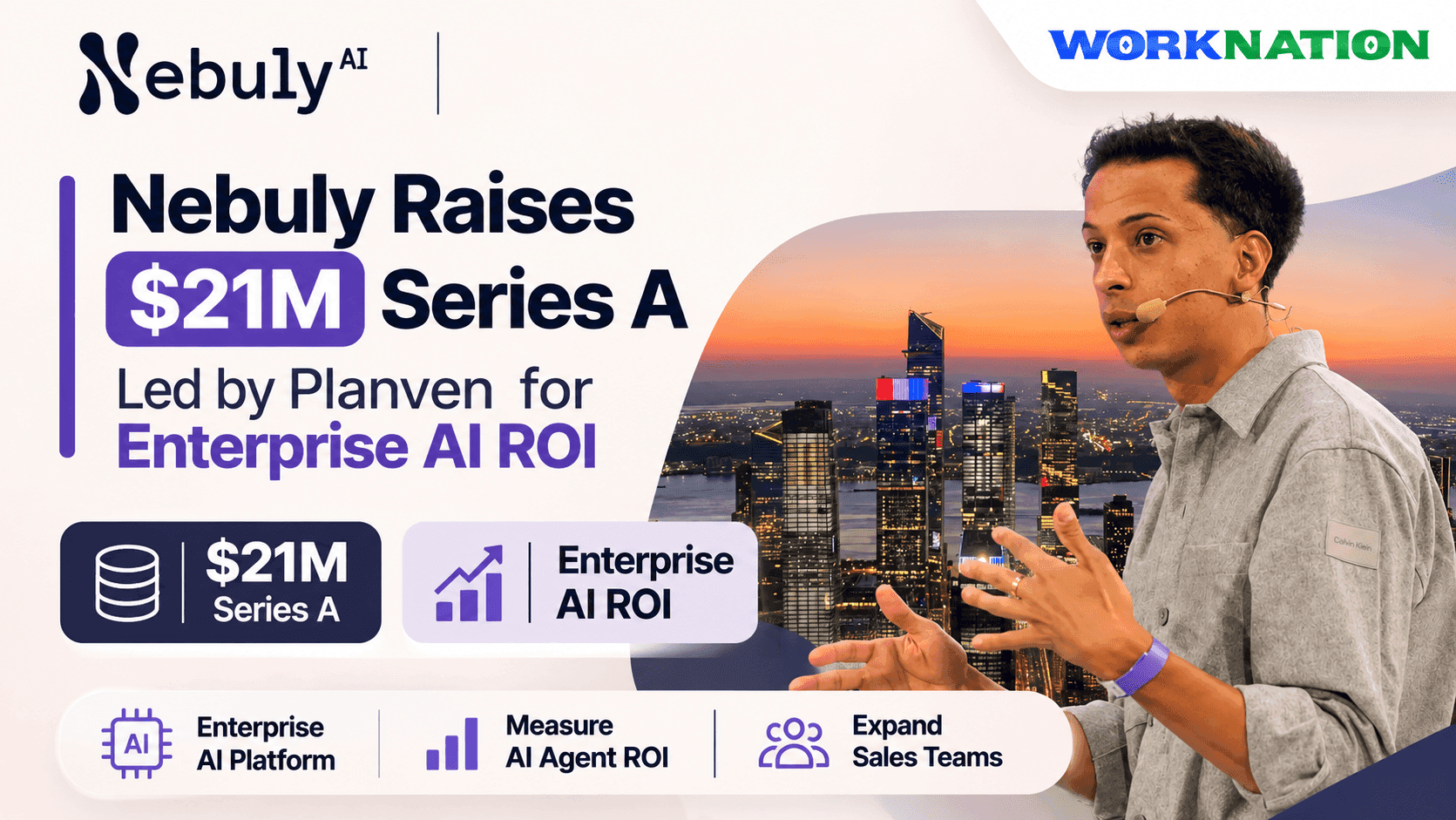
Nebuly, an enterprise AI analytics company, has raised $21 million in Series A funding led by Planven. The Turin- and New York-based startup plans to use the capital to expand its platform and strengthen its commercial teams across the United States and Europe.
The round also included participation from Exor Ventures, Tenacity Capital, TGVG Capital, Fastweb+Vodafone through Founders Factory, and CDP Venture Capital SGR through its AI Fund and Digital Transition Fund. Returning investors and angel investors also participated.
Founded in 2022, Nebuly focuses on a growing challenge for large organisations: understanding whether their investments in artificial intelligence and AI agents are generating measurable business value.
Why Enterprises Need to Measure AI Agent ROI
Businesses are increasing their AI spending, but many still struggle to demonstrate what that investment delivers.
Nebuly argues that traditional AI usage metrics, such as the number of prompts, users or tokens consumed, do not adequately explain the business impact of AI. Its platform aims to connect AI activity with measurable outcomes, including time saved, tasks automated, revenue impact and customer retention.
The distinction matters as companies deploy AI agents across multiple departments and use tools from different providers. Without a consolidated view, management teams may struggle to determine which applications are producing value and which are simply adding costs.
How Nebuly Measures the Value of AI Agents
Nebuly evaluates AI activity at the task level. Its approach considers the value and complexity of individual tasks, how much work AI agents automate, and what employees can accomplish with the time saved.
For example, if an activity that previously required three hours takes an employee just 15 minutes with AI assistance, the platform can help quantify the time released. The broader question is whether that time is redirected towards more valuable work.
The platform analyses both internal employee tools and customer-facing AI assistants. For employee applications, it can help organisations understand which teams are benefiting from AI, which tasks are being automated and where additional training may improve adoption.
For customer-facing assistants, Nebuly evaluates potential effects on revenue, customer churn risk and upselling opportunities. The company says its calculations are configurable, with assumptions made visible to customers.
Nebuly's platform supports custom-built tools and assistants using technologies from Anthropic's Claude, OpenAI's ChatGPT and Microsoft Copilot. It can also operate on-premises or in a private cloud.
Enterprise Customers and Commercial Model
Nebuly targets large enterprises rather than small businesses. According to CEO and co-founder Francesco Signorato, most of its customers generate more than $1 billion in annual revenue, while its smallest customers have revenues exceeding $100 million.
The company names Oura, Iveco Group, Fastweb+Vodafone, CNH and Zeiss among its customers. Its customer base spans telecommunications, automotive, manufacturing, luxury, healthcare and technology.
Contracts typically start at approximately $100,000 per year. Nebuly has not disclosed its revenue, so its annual contract value should not be interpreted as a measure of total revenue or the number of active contracts.
Founders and Competitive Landscape
Nebuly was founded in 2022 by Francesco Signorato, Diego Fiori and Julien Roux. Signorato serves as CEO, Fiori as CTO and Roux as CRO.
Before founding Nebuly, Signorato worked in AI research at MIT and later led an AI team at IBM. Fiori previously co-founded the Swiss AI lab Giotto.ai, while Roux worked as an investor at Exor.
The company operates in the broader AI observability and analytics market. Signorato distinguishes Nebuly's approach from developer-focused observability platforms, arguing that its emphasis is on connecting AI activity to business outcomes rather than simply monitoring model behaviour.
The competitive landscape includes established observability providers such as Datadog, alongside specialised AI companies such as Braintrust. Nebuly's positioning is to provide an additional layer focused on the business value generated by AI agents.
How Nebuly Plans to Use the $21 Million
The Series A funding will support product expansion and commercial growth. Nebuly plans to increase its workforce from approximately 40 employees to 60, with hiring focused on sales roles in New York, London and other European markets.
The company also intends to expand its platform as enterprise adoption of AI agents grows.
An important challenge remains: proving that AI-generated productivity gains translate into genuine financial value. Estimates of hours saved can be useful, but finance teams and auditors may require transparent assumptions and reliable evidence before accepting those calculations.
Nebuly's approach of making its assumptions configurable and visible addresses part of this challenge. Whether that level of transparency will satisfy enterprise audit requirements remains to be demonstrated.
What Nebuly's Funding Means for Enterprise AI
Nebuly's $21 million Series A reflects growing investor interest in the infrastructure needed to manage enterprise AI deployments. As organisations move beyond experimentation, measuring AI agent ROI is becoming a practical requirement for technology leaders and finance teams.
The opportunity is not simply to track how frequently employees use AI. It is to establish whether AI systems reduce costs, improve productivity, support revenue growth or create measurable business outcomes. Nebuly is using its new funding to build around that requirement.
Have a Funding Round or Exciting Update to Share?
Submit your press release to get featured on WorkNation and reach founders, investors, and tech leaders.