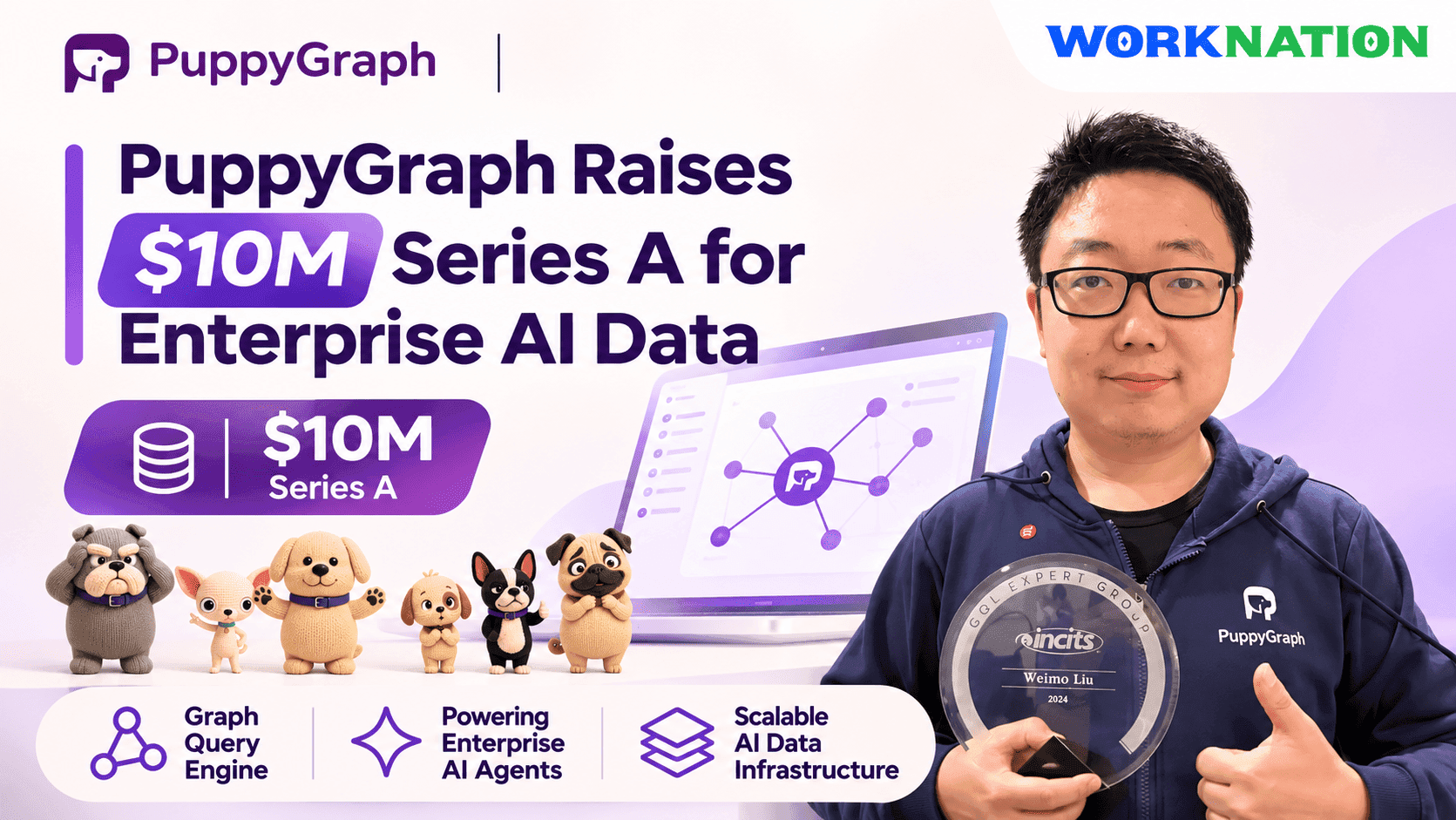
PuppyGraph Raises $10M Series A to Power AI Agents Across Enterprise Data
Top Picks
Submit PR
Stay Ahead of the Market
Get the latest startup funding, hiring trends and global opportunities delivered to your inbox every week.
PuppyGraph has raised $10 million in Series A funding to expand its graph query engine, which allows AI agents to explore connected enterprise data without moving information into a separate graph database. The round was led by Particle Future and defy.vc, bringing the company's total disclosed funding to $15 million.
Based in Santa Clara, California, PuppyGraph is targeting a growing challenge in enterprise AI: helping agents retrieve information across thousands of interconnected database tables without requiring companies to rebuild their existing data infrastructure.
The investment follows the general availability of PuppyGraph 1.0, its latest platform release. The company plans to use the funding to expand engineering and enterprise go-to-market operations.
defy.vc, which led the latest round, also led PuppyGraph's $5 million seed round in November 2024.
What does PuppyGraph do?
PuppyGraph develops a graph query engine that connects existing enterprise database tables and presents their relationships as a unified graph.
This approach is designed to help AI agents answer questions that require information from multiple systems.
For example, a security team investigating a compromised account might need to understand which critical systems an attacker could potentially access. Answering that question could involve following relationships across identity records, applications, permissions and infrastructure data.
Traditional database queries can become complicated when they involve thousands of tables and multiple relationship paths. Moving information into a dedicated graph database can introduce additional data pipelines, migration work and maintenance requirements.
PuppyGraph aims to avoid that process by querying the existing data directly rather than creating another copy in a separate graph database.
How PuppyGraph 1.0 connects enterprise data
PuppyGraph 1.0 allows organisations to connect data sources and query their relationships through a unified graph structure.
Its AI-assisted schema builder generates a proposed graph schema from existing database tables. Teams can review and approve that structure before AI agents use it to explore connected information.
The platform also supports natural-language interaction through its built-in AI agent and integrations with compatible tools using the Model Context Protocol (MCP).
According to the company, PuppyGraph 1.0 connects directly to several data platforms, including:
Apache Iceberg
Databricks
Snowflake
ClickHouse
DuckDB
PostgreSQL
Its distributed query engine is designed to support large-scale graph queries, including workloads involving billions of relationships.
PuppyGraph reports that it completed a 10-hop query across billions of edges in 2.26 seconds using a four-machine cluster. This is a company-reported benchmark rather than an independently verified comparison across competing platforms.
Security and performance for enterprise AI agents
Enterprise AI agents need more than access to large datasets. They must also retrieve relevant information quickly while respecting the permissions and security controls already established by organisations.
PuppyGraph includes several capabilities intended to address these requirements:
Row-level permissions: Access restrictions apply throughout graph traversals, helping prevent users or agents from retrieving data they are not authorised to access.
Role-based controls: Enterprises can manage access through role-based permissions, user impersonation and single sign-on.
Audit logs: Organisations can track activity and maintain visibility into how the platform is being used.
Query feedback: The engine rejects undefined relationship references and returns feedback, allowing agents to correct queries rather than guess how data is connected.
These features are particularly relevant for applications involving cybersecurity, financial services and other environments where data access needs to be controlled.
Three founders with experience in enterprise infrastructure
PuppyGraph was co-founded by Weimo Liu, Danfeng Xu and Lei Huang.
CEO Weimo Liu previously worked on Google's F1 team and at graph database company TigerGraph. Danfeng Xu spent nine years working on LinkedIn's infrastructure team, while Lei Huang is a three-time Google Code Jam world finalist.
The founding team's experience spans database infrastructure, large-scale systems and engineering, areas closely related to PuppyGraph's focus on querying complex enterprise data.
Enterprise customers and reported 7x ARR growth
PuppyGraph says its customers include AMD, Palo Alto Networks, Datadog, Netskope, Coinbase and Trend Micro.
The company also reports that its annual recurring revenue grew sevenfold over the past year. However, it has not disclosed its absolute ARR, so the growth figure does not reveal its current revenue scale.
Customer examples in the announcement illustrate how the platform is being used.
Palo Alto Networks engineering director Ran Xia said the technology allows the company to run multi-hop graph traversals directly on its existing data platform without moving or duplicating data.
At Coinbase, senior staff software engineer Xinyu Liu described how teams can define a graph schema and query data already maintained in Snowflake and Databricks without building separate data pipelines.
These examples highlight the product's central proposition: organisations can explore relationships across existing data infrastructure without maintaining another copy of their information.
Competition in the enterprise graph technology market
PuppyGraph operates in a market that includes established graph database companies such as Neo4j and TigerGraph.
These platforms provide graph database technology for storing and querying connected information. PuppyGraph takes a different architectural approach by allowing enterprises to query existing tables as a unified graph without first migrating their data into a separate graph database.
Other startups are addressing related challenges from different directions. Tentris is developing graph database technology for complex queries, while Dataline Labs focuses on querying business data through natural language. Prevalent AI is expanding the use of knowledge graphs beyond cybersecurity.
The distinction matters because PuppyGraph is not simply competing to become another database where companies store their information. Its proposition is that enterprises can retain their existing data platforms while adding graph-based querying capabilities.
Why the $10M funding matters for AI infrastructure
As enterprises move AI agents from demonstrations into production environments, the ability to access reliable information across disconnected systems becomes increasingly important.
PuppyGraph is targeting this infrastructure challenge rather than developing another general-purpose AI assistant.
Its approach offers several potential advantages:
Less data duplication: Querying existing tables could reduce the need to maintain separate copies of enterprise information.
Faster connected-data investigations: Graph-based queries can help agents explore relationships across multiple systems.
Simpler infrastructure adoption: Organisations may be able to introduce graph querying without rebuilding their existing database architecture.
More controlled AI access: Permissions and audit capabilities are important when agents interact with sensitive enterprise information.
Broader enterprise applications: Security investigations, financial analysis and operational intelligence could benefit from connected-data queries.
The commercial opportunity will depend on whether PuppyGraph can deliver reliable performance across different enterprise environments and demonstrate that its architecture is easier and more economical to operate than alternatives.
What comes next for PuppyGraph?
The $10 million Series A gives PuppyGraph additional resources to expand engineering and enterprise sales following the general availability of version 1.0.
The company is positioning its platform for a future in which AI agents need to navigate complex enterprise information rather than operate only within predefined workflows.
Its reported customer adoption and sevenfold ARR growth suggest commercial momentum, although absolute revenue and customer-level financial details remain undisclosed.
PuppyGraph's $10 million funding round highlights the growing importance of data infrastructure for enterprise AI. Its next challenge is to prove that AI agents can query thousands of interconnected tables reliably, quickly and securely without requiring companies to move their data into another database.
Have a Funding Round or Exciting Update to Share?
Submit your press release to get featured on WorkNation and reach founders, investors, and tech leaders.