Kindo Raises $30 Million to Scale Enterprise AI Agent Control Platform
Top Picks
Submit PR
Stay Ahead of the Market
Get the latest startup funding, hiring trends and global opportunities delivered to your inbox every week.
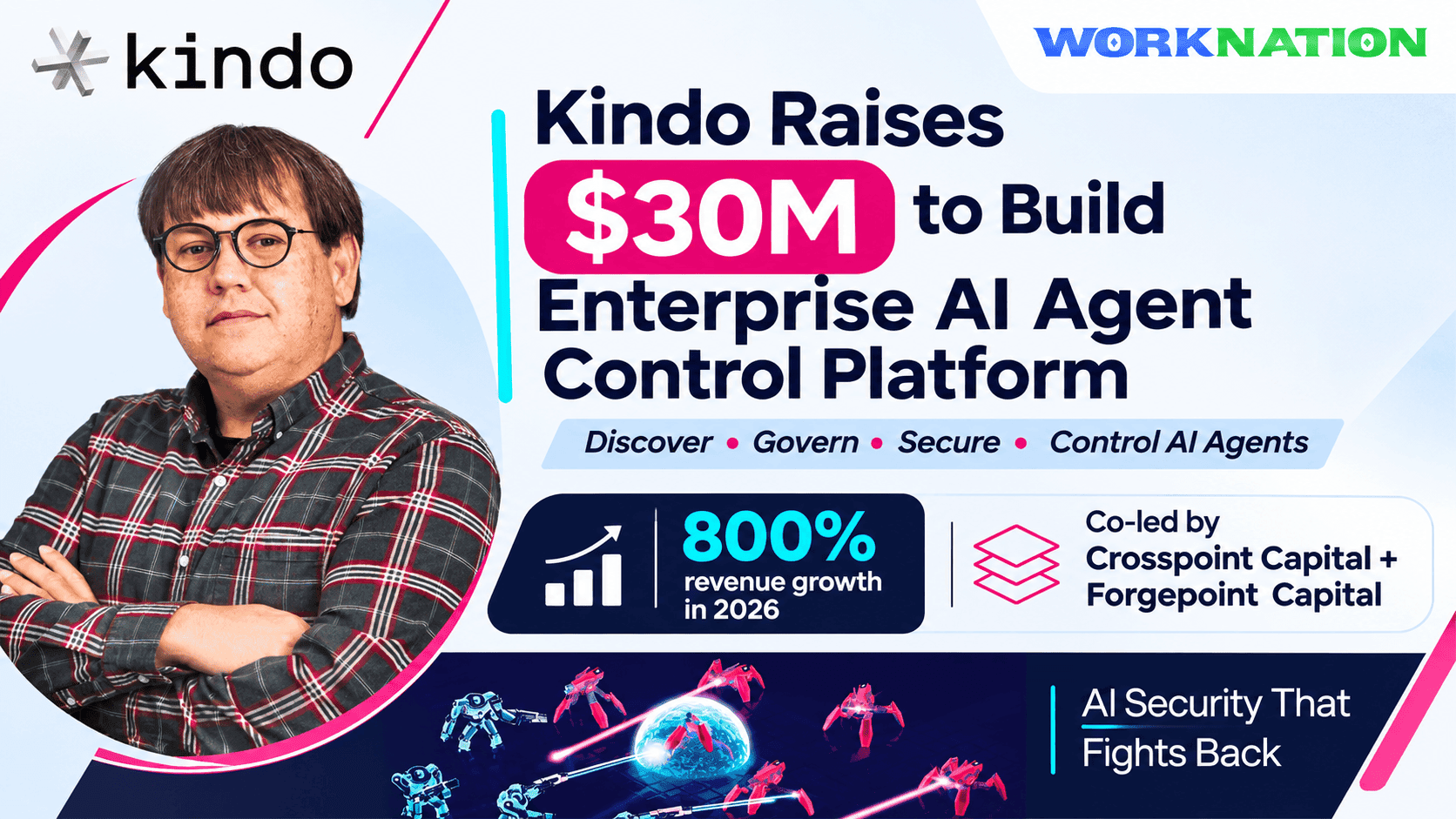
Kindo has raised $30 million in new funding to expand its enterprise AI agent management platform, helping businesses monitor, secure and control autonomous AI systems across their organisations.
The funding round was co-led by Crosspoint Capital and Forgepoint Capital, with participation from TFX Capital and CircleRock Capital. Existing investors Drive Capital, Riot Ventures, RRE Ventures, Eniac Ventures, Marlinspike Partners, New Era Ventures, Marlinspike Partners and Sunset Venture also participated. The company says the investment brings its total capital raised to $57.6 million. The round's formal stage was not disclosed.
Kindo reported approximately 800% year-on-year revenue growth in 2026. It plans to use the new capital to expand its go-to-market organisation and accelerate development of its AI Control Center and Deep Hat products.
Founded to solve enterprise AI agent management
Founded in 2022, Kindo is led by CEO and co-founder Ron Williams. He previously held technology and security leadership positions, including CIO and CISO roles at Riot Games, Clover Health and Bird.
Its founding team also includes co-founder and CTO Bryan Vann, who was one of the original architects of Google Drive and later managed a large part of its engineering organisation at Google.
As companies deploy AI agents across departments, managing their access to internal systems, data and business tools is becoming increasingly complex. Kindo is positioning its platform as a central control layer for these deployments.
Kindo AI Control Center brings agent visibility and governance together
Kindo's AI Control Center is designed to help enterprises discover and manage AI agents operating across their environments, including systems introduced without formal IT approval.
The platform provides visibility into agent activity, data access, costs and outcomes. Its gateways govern and audit calls made by agents to connected data sources, tools and approved AI models.
Identity controls extend existing organisational permissions to AI agents, allowing administrators to manage access centrally. For critical applications, Kindo also provides continuous monitoring and support tools that allow human teams to intervene or take control when an agent encounters a problem.
An important part of its approach is compatibility with existing infrastructure. Businesses can connect agents and models already in use instead of rebuilding their AI systems around Kindo.
The platform supports deployment on-premises, in customer cloud environments, through Kindo's own cloud and in air-gapped environments.
Enterprise adoption and reported customer results
Kindo says its platform is running in production at large and mid-market enterprises across financial services, professional services, healthcare, aviation and transportation.
One cited customer is Aireon, a provider of global aviation in-flight data. Aireon reported in May 2026 that using Kindo for threat hunting and Tier 1 and Tier 2 security operations centre work helped it save more than $2 million annually.
This is a customer-reported outcome, rather than an independently audited performance figure. Still, it illustrates the type of operational and financial impact Kindo is seeking to demonstrate to enterprise buyers.
The company's reported 800% year-on-year revenue growth also points to rising commercial demand, although Kindo has not disclosed its revenue base or absolute revenue figures.
Deep Hat targets AI operating costs
Beyond security and governance, Kindo is targeting the growing cost of running AI agents.
Its AI Control Center provides visibility into token consumption, agent runs and task outcomes. Businesses can track spending by employee, agent, department or project, set budgets and spending alerts, and enforce limits.
Kindo's Deep Hat products are designed to reduce unnecessary AI usage:
Deep Hat Sift: Filters repetitive events from alert and ticket queues after human approval, while logging activity and sending samples for evaluation.
Deep Hat Tune: Adapts smaller, less expensive models to specific tasks, reducing dependence on larger models.
Deep Hat Shrink: Converts repeatable workflow steps into code, avoiding model costs for those operations while routing exceptions back to AI models.
Deep Hat Attack: Provides private, lower-cost offensive security testing.
Together, these products address two enterprise concerns: controlling what AI agents can do and understanding how much they cost to operate.
Competition in enterprise AI agent security and governance
Kindo is entering a competitive market as companies develop tools to monitor, secure and govern autonomous AI systems.
London-based Geordie AI raised $30 million in Series A funding in May 2026 to build a security layer for AI agents. Barcelona-based NeuralTrust raised $20 million in seed funding in June 2026 to support enterprise agent governance.
Israel-based Zenity raised $125 million in a Series C in August 2026 to secure AI agents. GitGuardian raised $50 million in February 2026 to expand its non-human identity security capabilities, including credentials used by AI agents. FriskAI raised $3.6 million in pre-seed funding in August 2026 to monitor and review agent activity.
These companies overlap with Kindo in AI security and governance, but their approaches differ. Kindo's positioning combines agent discovery, access controls, operational intervention and cost management within a central platform.
Investors back the enterprise AI control opportunity
The latest financing brings additional support from investors focused on cybersecurity and enterprise technology.
Crosspoint Capital managing director Andre Fuetsch and Forgepoint Capital managing director Ernie Bio will join Kindo's board.
The investment reflects a broader enterprise challenge: as AI agents move from experimentation into business-critical workflows, organisations need ways to monitor their behaviour, restrict access, manage costs and maintain human oversight.
Kindo's next challenge is proving that enterprises will adopt a unified control platform across their AI deployments, rather than relying on separate products for security, identity and cost management.
With $30 million in fresh funding and reported revenue growth of approximately 800%, the company is betting that enterprise AI adoption will create demand for a dedicated control layer.
Have a Funding Round or Exciting Update to Share?
Submit your press release to get featured on WorkNation and reach founders, investors, and tech leaders.