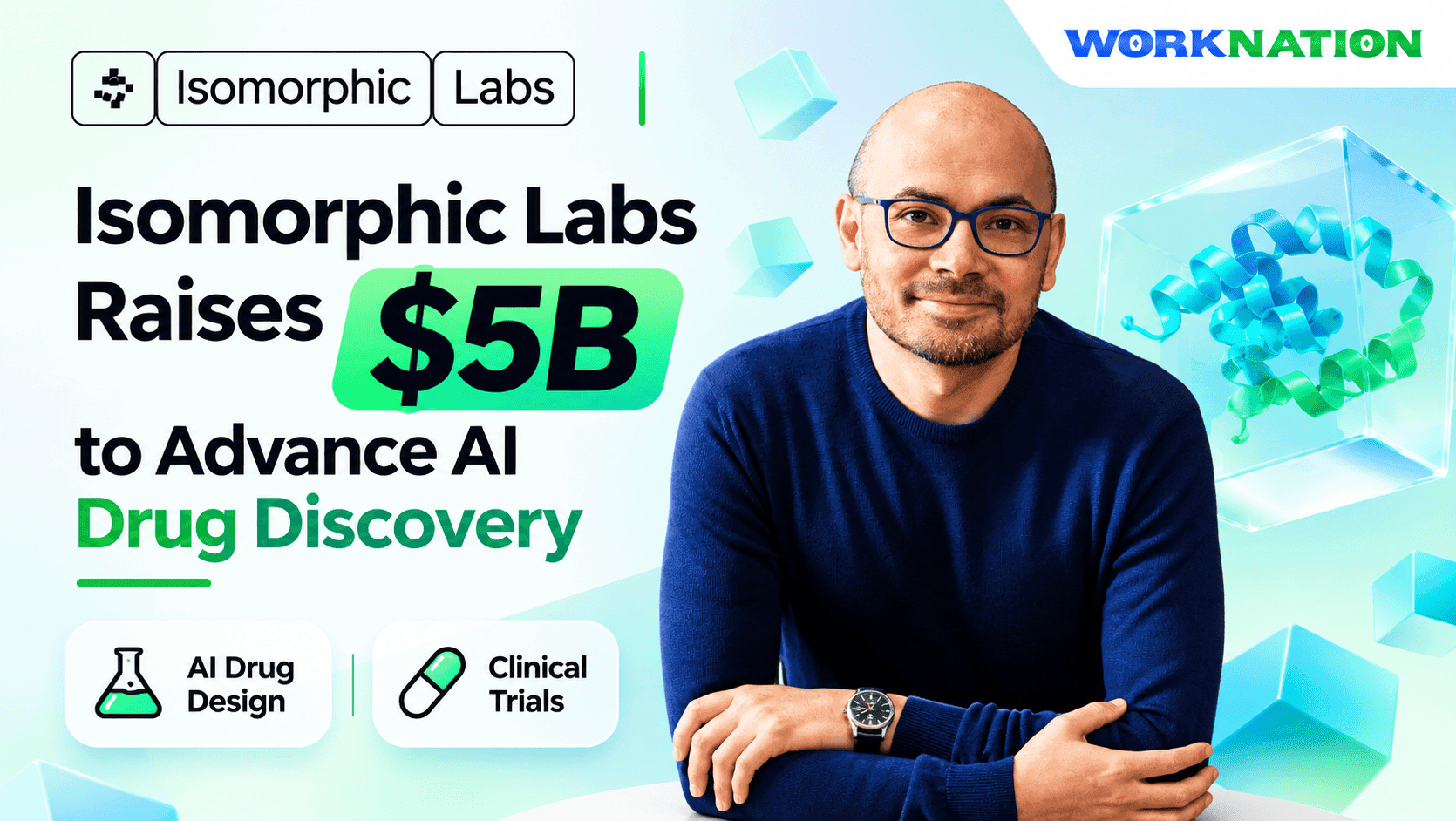
Isomorphic Labs Raises $5B to Move AI-Designed Drugs Towards Clinical Trials
Top Picks
Submit PR
Stay Ahead of the Market
Get the latest startup funding, hiring trends and global opportunities delivered to your inbox every week.
London-based Isomorphic Labs has raised $5 billion in Series C funding to scale its AI-driven drug discovery platform and move its first therapeutic candidates closer to clinical trials.
The round was co-led by Greenoaks and Sequoia Capital, with participation from Andreessen Horowitz (a16z) and several other new investors. Alphabet also made a significant investment, while all existing investors participated, including Thrive Capital, MGX, GV, CapitalG, Temasek and the UK Sovereign AI Fund.
The financing comes just six months after the company's $2.1 billion Series B in May 2026. Including its $600 million first external funding round in March 2025, Isomorphic Labs has now raised approximately $7.7 billion in external funding.
The company did not disclose a valuation. Bloomberg had previously reported that the financing could value Isomorphic Labs at around $50 billion, but that figure has not been confirmed by the company.
Founded in 2021 by Google DeepMind CEO Sir Demis Hassabis, Isomorphic Labs is developing AI systems designed to understand biological processes and help scientists design new medicines. Its latest funding is intended to accelerate the development of its proprietary Isomorphic Drug Design Engine (IsoDDE), expand its research capabilities and build infrastructure for clinical development.
Building an AI engine for drug discovery
At the centre of Isomorphic Labs' strategy is its Isomorphic Drug Design Engine (IsoDDE), a proprietary platform that brings together foundational AI models to simulate and predict complex biological interactions.
Traditional drug discovery involves identifying biological targets, finding molecules that interact with them and testing those candidates through extensive laboratory experiments. The process can be expensive, time-consuming and uncertain.
IsoDDE aims to improve this process by using AI models to explore chemical spaces, predict molecular behaviour and help researchers design potential drug candidates with desired properties.
The platform is being developed to work across multiple therapeutic areas and drug modalities, rather than being limited to one disease or type of medicine. Isomorphic says its engine combines foundational simulation models with AI capabilities that can reason across complex biological systems.
The company's ambition builds on advances in protein structure prediction associated with DeepMind's AlphaFold research. However, predicting biological structures and designing a medicine that proves safe and effective in humans are different scientific challenges. The latter requires extensive experimental and clinical validation.
Moving from preclinical research towards human trials
Isomorphic Labs says its internal oncology and immunology programmes have generated positive preclinical results. It is also advancing research programmes with pharmaceutical partners, including Eli Lilly, Novartis and Johnson & Johnson.
The company has more than 20 programmes underway, according to reporting based on comments from Hassabis. These programmes span its internal pipeline and partnered drug discovery work.
Its immediate priority is to advance selected candidates towards clinical testing. In January 2026, Hassabis said the company expected its first clinical trials by the end of the year. However, in reporting around the Series C announcement, he did not provide a new firm start date. He indicated that regulatory submissions for the first oncology programme were progressing as planned, with further news expected in 2027.
That distinction matters. Positive preclinical findings do not establish that a candidate will succeed in human trials. A drug must still demonstrate acceptable safety and efficacy through the clinical development process.
The Series C gives Isomorphic substantial resources to take on that next stage, but clinical evidence will ultimately determine whether its AI-led approach can produce medicines that benefit patients.
Pharmaceutical partnerships provide a route to validation
Isomorphic Labs is developing its own drug pipeline while collaborating with established pharmaceutical companies.
Its partnership with Eli Lilly and Novartis, announced in January 2024, focuses on discovering small-molecule therapeutics against multiple undisclosed targets. The Novartis collaboration was expanded in February 2025 to include up to three additional research programmes.
In January 2026, Isomorphic announced a multi-target, cross-modality research collaboration with Johnson & Johnson. The work extends beyond small molecules to include areas such as antibodies, peptides and other biologic approaches.
These partnerships give Isomorphic access to pharmaceutical expertise in disease biology, experimental research and drug development. They also create opportunities to test whether AI-designed molecules can progress through established discovery and development processes.
The commercial structures and progress of individual programmes vary, and the existence of a partnership should not be interpreted as proof that a resulting medicine has reached clinical development or secured regulatory approval.
Competition in AI-led drug discovery
Isomorphic Labs is part of a growing group of companies seeking to apply AI across pharmaceutical research and development.
San Francisco-based Chai Discovery raised $400 million in July 2026 at a reported $3.8 billion valuation. Its work focuses on AI models for molecular design and biological interactions.
Xaira Therapeutics, launched in 2024 with more than $1 billion in initial funding, is also developing AI-based approaches to drug discovery. Meanwhile, London-based Basecamp Research is working on AI-designed biological systems and cell therapies, and raised a $140 million Series C in September 2026, according to Reuters.
Isomorphic's approach combines foundational simulation models, AI-driven drug design and an expanding pipeline of internal and partnered therapeutic programmes. Its scale of funding gives it substantial capacity to invest in computing infrastructure, scientific talent and the expensive process of moving candidates towards clinical testing.
But the competitive advantage will not be measured by funding or model performance alone. It will depend on whether the platform can consistently identify viable candidates, reduce experimental cycles and improve the probability of successful drug development.
Scaling AI-first drug development
The $5 billion Series C will support the continued development of IsoDDE, expansion of Isomorphic's partner ecosystem and investment in global AI-led bioengineering infrastructure.
The company also plans to build translational and clinical development capabilities. These functions connect laboratory research with human studies, helping determine whether a potential medicine can be developed into a viable treatment.
For Isomorphic, this marks an important shift from demonstrating what AI can achieve in molecular design towards showing that its systems can contribute to actual medicines.
The funding round is a major vote of confidence from investors, but it also raises expectations. Drug development remains a long, uncertain process, and even promising candidates can fail during clinical trials.
Have a Funding Round or Exciting Update to Share?
Submit your press release to get featured on WorkNation and reach founders, investors, and tech leaders.