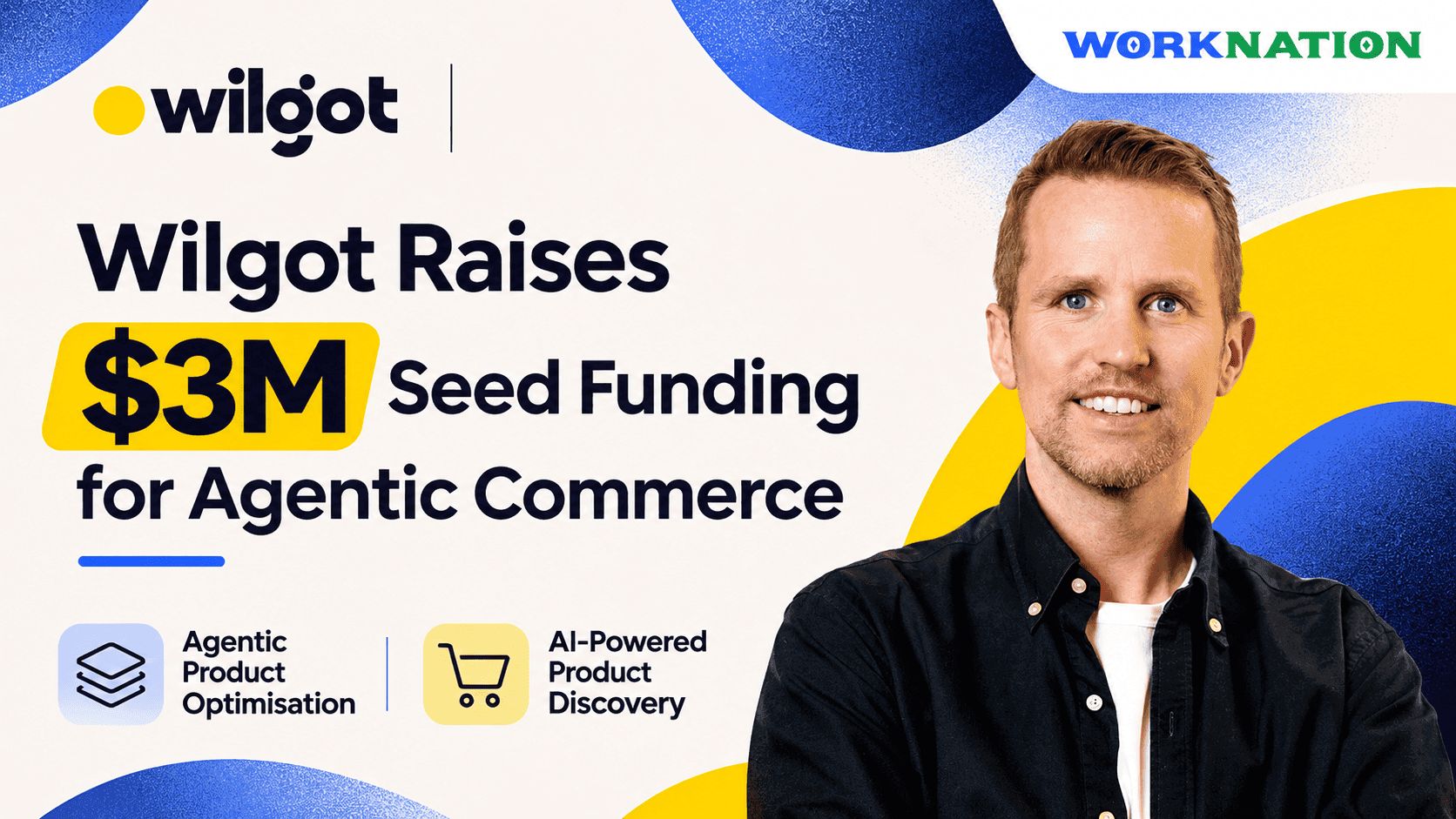
Wilgot Raises $3 Million Seed Round to Help Brands Win in AI Commerce
Top Picks
Submit PR
Stay Ahead of the Market
Get the latest startup funding, hiring trends and global opportunities delivered to your inbox every week.
Wilgot has raised $3 million in seed funding to help brands make their products easier for AI assistants to understand, compare and recommend. The Stockholm-based startup is developing Agentic Product Optimisation (APO), a platform that improves product information for AI-powered shopping and discovery.
The round was led by Industrifonden, with participation from Luminar Ventures, Foundry Ventures, Ventures Together and Inovexus, alongside angel investors. The funding will support platform development, hiring and the company's go-to-market expansion.
Founded in 2024, Wilgot is taking a different approach to the emerging market for generative engine optimisation (GEO). Instead of focusing primarily on tracking whether AI assistants mention a brand, the company wants to improve the product information that AI systems use to make recommendations.
Wilgot's $3 Million Seed Round: Investors and Funding Details
Wilgot's $3 million seed round was led by Swedish venture capital firm Industrifonden. Other participating investors include:
Industrifonden
Luminar Ventures
Foundry Ventures
Ventures Together
Inovexus
The angel investors include Johan Bäckarlin and Johan Hjelte, co-founders of Voyado, and Niclas Mollin, co-founder of inriver and Occtoo.
The round also brings investor representation onto Wilgot's board. Anders Nygren from Foundry Ventures and Andreas Söneby from Industrifonden are joining the board.
How will Wilgot use the funding?
The company plans to use the capital to strengthen its position in AI-powered product discovery, develop its APO platform and expand its commercial operations.
Hiring is a major priority. Wilgot currently has a team of 12 people, with its core team based in Stockholm and other employees spread across the UK and Europe.
The funding comes as retailers and consumer brands evaluate how AI assistants could influence product discovery, comparison and purchasing decisions.
What Is Agentic Product Optimisation (APO)?
Agentic Product Optimisation is Wilgot's approach to preparing product information for AI-powered shopping.
Traditional e-commerce product pages are generally designed for human visitors. They often rely on lifestyle photography, marketing descriptions and brand storytelling to communicate product value.
AI assistants need more specific information to understand whether a product matches a shopper's request. This can include product specifications, materials, intended use, sizing, compatibility, pricing, customer feedback and other attributes.
Wilgot's APO platform aims to bridge that gap by turning a brand's existing customer and product information into structured, useful content that AI systems can interpret.
How Wilgot's APO platform works
The platform follows a process that starts with a brand's own data and turns it into continuously optimised product information.
1. Analyse first-party customer data
Wilgot uses information such as search queries, product reviews, customer service tickets and product returns to understand what customers are looking for, what influences purchases and why products are returned.
2. Identify missing product information
The platform uses these signals to identify questions and product attributes that existing product pages may not adequately address.
For example, a footwear product page might describe a shoe's colour and material but fail to explain its fit, suitability for particular weather conditions or comfort for extended walking.
3. Generate and optimise product content
Wilgot transforms these insights into product pages, product feeds, FAQs and structured data. According to the company, its platform supports more than 100 languages.
4. Continuously improve using reinforcement learning
The platform uses reinforcement learning to refine product information over time, based on performance data and changing customer needs.
The objective is to make product catalogues more useful to both human shoppers and AI assistants.
Why Wilgot Is Challenging Traditional GEO Strategies
Generative Engine Optimisation, or GEO, focuses on improving how brands appear in answers generated by AI systems.
A growing category of software attempts to measure brand mentions across AI assistants, track visibility and identify opportunities to improve those results.
Wilgot CEO and co-founder Erik Wikander argues that tracking chatbot mentions alone is not a reliable way to measure performance. The same question can produce different AI responses depending on the user, conversation context and model behaviour.
His argument is that brands should focus less on measuring individual AI answers and more on improving the underlying product information that influences recommendations.
Wilgot's Customers and Early Commercial Results
Wilgot says its customer base includes international brands such as Signify, alongside fashion and consumer brands including Daniel Wellington and J.Lindeberg.
The company has shared early results from its work with Daniel Wellington and Myrqvist.
Daniel Wellington reports a 20% increase in net sales
According to Wilgot, net sales increased by 20% across Daniel Wellington product pages optimised through its platform.
The company's published case study provides additional detail. It says that after 12 weeks, the optimised pages recorded:
20% higher net sales
150% higher organic visibility
32% higher conversion rate
11% lower bounce rate
Wilgot says these results were measured against a control group. They are company-published case study figures rather than independently audited financial results.
Myrqvist receives customers through ChatGPT
Wilgot also reports that 7% of Myrqvist's customers came through ChatGPT in Q1 2026, compared with Q4 2025 as the case study's comparison period.
The company says Myrqvist's improved product information helped make its catalogue more accessible to AI assistants and traditional search.
These results are relevant because they connect product-content optimisation with commercial outcomes. However, the ChatGPT attribution figure is based on customer-reported acquisition information, rather than a complete independent measurement of AI-driven sales.
Why Agentic Commerce Is Becoming Important for Retail Brands
Agentic commerce refers to shopping experiences in which AI assistants help consumers discover, evaluate, compare and potentially purchase products.
Instead of manually searching through multiple websites, a consumer might ask an AI assistant to find a waterproof jacket for cycling, compare options under a specific budget or recommend a gift based on someone's interests.
The assistant then needs product information that allows it to evaluate which items fit the request.
This creates a new challenge for brands: having a good product and a strong website may not be enough if the information describing that product is incomplete or difficult for AI systems to interpret.
AI assistants are changing product discovery
McKinsey has estimated that AI agents could facilitate between $3 trillion and $5 trillion in global consumer commerce by 2030. Its more recent research also highlights the growing influence of AI search on consumer purchase decisions.
Bain & Company has separately reported that around 60% of traditional search engine searches end without a click to another website.
Together, these developments point to a potential shift in how brands attract customers. Product discovery may increasingly happen inside AI-generated answers and conversational interfaces rather than exclusively through conventional search results.
For retailers, that makes accurate product information, structured catalogues and clear descriptions increasingly important.
Five Key Insights From Wilgot's $3 Million Funding Round
Wilgot's funding is not simply another investment in AI marketing software. It reflects a developing shift in how products are represented, discovered and evaluated online. These five takeaways are editorial analysis based on the company's strategy, customer examples and the wider agentic commerce market.
1. Product data could become a competitive advantage, not just an operational requirement
Retailers have traditionally treated product catalogues as infrastructure for running an online store. In AI-assisted shopping, catalogue quality could influence whether a product is considered at all.
A brand with detailed information about materials, fit, compatibility, use cases and customer preferences may be easier for an AI assistant to evaluate than a competitor with generic descriptions. This creates a potential competitive advantage that is not necessarily tied to advertising budgets.
2. First-party customer data may be more valuable than generic AI-generated descriptions
Wilgot's approach starts with search queries, reviews, service tickets and returns rather than simply rewriting existing product descriptions.
That distinction matters. Generic AI-generated copy can make product pages longer without making them more useful. First-party customer data can reveal the actual questions, objections and purchase considerations that a brand's customers have.
The commercial opportunity is in converting those signals into accurate product information, not just producing more text.
3. APO and GEO monitoring may become complementary categories
Wilgot positions APO as an alternative to tracking AI mentions. However, brands may ultimately need both capabilities.
Monitoring can help identify where products appear in AI answers and where competitors are being recommended. Product optimisation can address gaps in the information available to AI systems.
The strongest long-term platforms may combine visibility measurement, catalogue enrichment and conversion analysis rather than treating these as mutually exclusive approaches.
4. International localisation could be a major scaling challenge
Wilgot says its platform can produce optimised content in more than 100 languages. But translating product descriptions is only one part of localisation.
Customer expectations, sizing systems, product terminology, regulations and buying preferences vary between markets. A product description that works for Swedish shoppers may not answer the questions asked by customers in Germany, the UK or the United States.
The ability to adapt product information to local buying behaviour could become an important differentiator as Wilgot expands internationally.
5. Measuring AI-driven commerce will remain difficult
The Myrqvist example illustrates a measurement challenge. The reported 7% of customers arriving through ChatGPT relies on customer-reported acquisition information.
That is useful evidence, but it does not capture every interaction in which AI influenced a purchase. A shopper may discover a product through an AI assistant, research it later through Google and complete the purchase directly on the brand's website.
Brands will need better attribution methods to distinguish AI-assisted discovery from directly attributable AI referrals. Without that, it will be difficult to compare the return on investment of different agentic commerce strategies.
Wilgot's Competitive Position in the AI Commerce Market
Wilgot is entering a market where several companies are trying to help brands adapt to AI-powered discovery.
The company is taking a product-data-first approach, while other platforms focus more heavily on monitoring AI search visibility and brand mentions.
The opportunity is significant, but the category is still developing. AI assistants are changing rapidly, and their methods for retrieving, ranking and recommending products may evolve. Wilgot will need to demonstrate that its platform can deliver consistent results across different AI systems, product categories and markets.
Its customer examples provide an early indication of commercial traction. The next challenge is proving that those results can be repeated across a much larger customer base.
Frequently Asked Questions About Wilgot and Agentic Commerce
What does Wilgot do?
Wilgot is a Stockholm-based technology startup that helps brands optimise product information for AI-powered shopping and discovery. Its platform uses first-party customer data to improve product pages, feeds, FAQs and structured product information.
How much funding has Wilgot raised?
Wilgot raised $3 million in a seed funding round announced on November 19, 2026. Industrifonden led the round, with participation from Luminar Ventures, Foundry Ventures, Ventures Together and Inovexus, alongside angel investors.
What is Agentic Product Optimisation?
Agentic Product Optimisation, or APO, is Wilgot's approach to improving product information so AI assistants can better understand, compare and recommend products. It uses customer and product data to optimise catalogue content and continuously refine it.
What is the difference between GEO and APO?
Generative Engine Optimisation generally focuses on improving a brand's visibility in AI-generated answers. Wilgot's Agentic Product Optimisation focuses on improving the underlying product information that AI assistants use to understand and recommend products.
Which brands use Wilgot?
Wilgot identifies brands including Daniel Wellington, J.Lindeberg, Myrqvist and Signify among its customers. Its published case studies include results from Daniel Wellington and Myrqvist.
How does Wilgot use AI to improve product pages?
Wilgot analyses first-party data such as search queries, customer reviews, service tickets and returns. It uses those insights to create or improve product pages, feeds, FAQs and structured data, with reinforcement learning used to refine content over time.
Who invested in Wilgot?
Industrifonden led Wilgot's $3 million seed round. Luminar Ventures, Foundry Ventures, Ventures Together and Inovexus also participated, alongside angel investors Johan Bäckarlin, Johan Hjelte and Niclas Mollin.
Conclusion: Wilgot's $3 Million Funding Puts Product Data at the Centre of Agentic Commerce
Wilgot's $3 million funding gives the Stockholm startup additional capital to develop Agentic Product Optimisation and expand its position in AI-powered product discovery.
Its strategy focuses on a practical problem: AI assistants can only make useful product recommendations when they have sufficiently detailed and accurate information to evaluate products.
The early results shared by Daniel Wellington and Myrqvist provide encouraging signals, although broader customer adoption and independently measurable commercial outcomes will be important tests.
As agentic commerce develops, brands may need to rethink how their products are described, structured and presented across digital channels. Wilgot is betting that the next competitive advantage in e-commerce will come not just from being visible to shoppers, but from making products understandable to the AI systems increasingly helping them decide what to buy.
Have a Funding Round or Exciting Update to Share?
Submit your press release to get featured on WorkNation and reach founders, investors, and tech leaders.