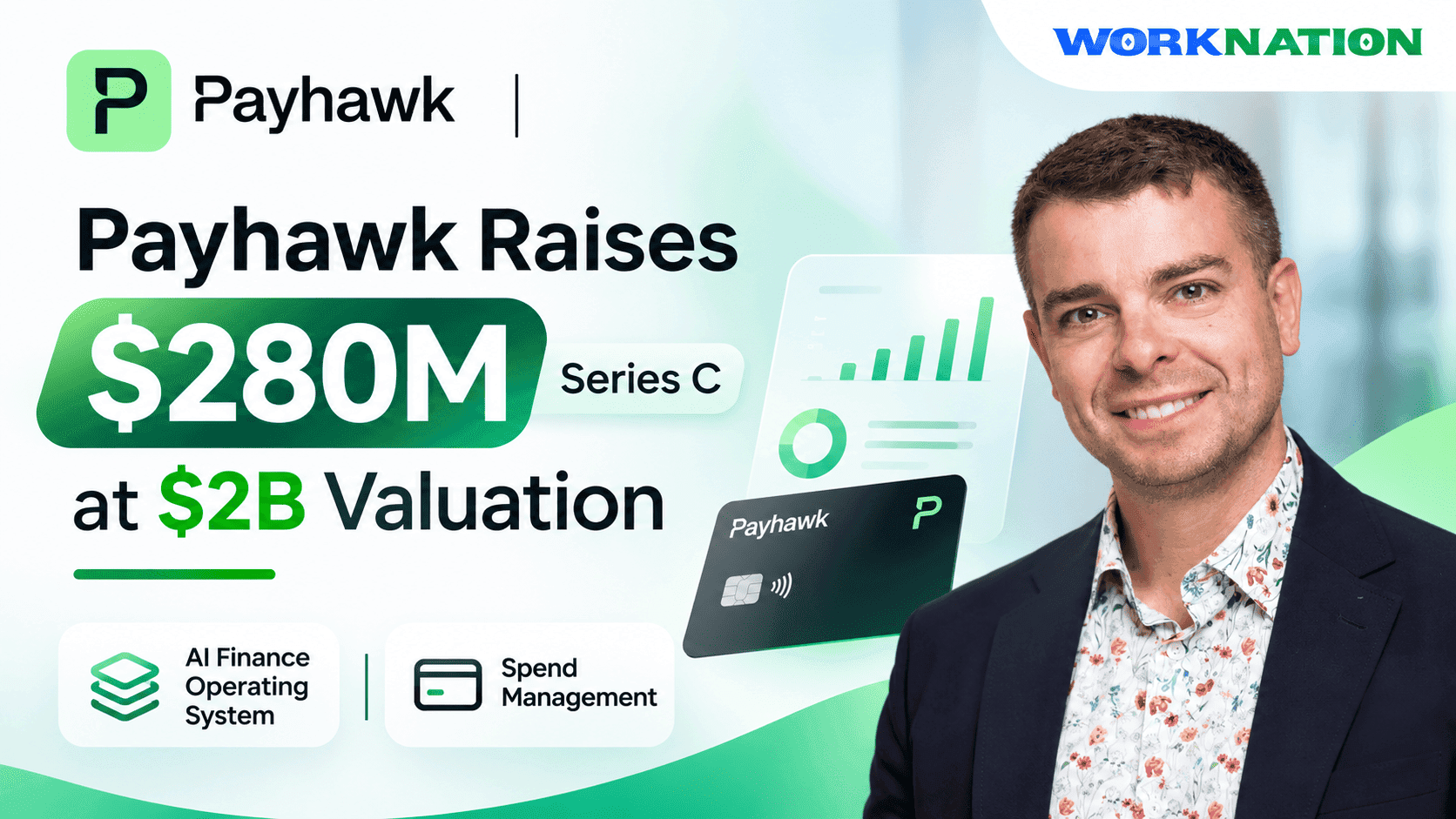
Payhawk Raises $280M Series C at $2B Valuation to Build AI-Powered Finance OS
Top Picks
Submit PR
Stay Ahead of the Market
Get the latest startup funding, hiring trends and global opportunities delivered to your inbox every week.
Payhawk has raised $280 million in an all-equity Series C funding round led by Growth Equity at Goldman Sachs Alternatives, valuing the Bulgarian-founded fintech at $2 billion. The London-headquartered company says the financing takes its total funding to more than $515 million.
The round includes participation from all existing investors, including QED, Greenoaks, Lightspeed, Hedosophia and Bek Ventures. New investors include Galdana Ventures, Cogito Capital, Inveready and Invus, alongside European entrepreneurs Tomas Okmanas and Didac Lee. James Hayward, Managing Director at Goldman Sachs Alternatives, will join Payhawk's board.
Founded in Sofia in 2018 by Hristo Borisov, Boyko Karadzhov and Konstantin Dzhengozov, Payhawk began with corporate cards and expense management before expanding into invoice payments, procurement, travel and financial controls. It now operates across 33 countries and 12 offices.
The company plans to use the new capital to develop what it calls a global Finance Operating System for the AI era, combining AI agents, payment infrastructure and enterprise controls in a single financial platform.
From spend management to an AI-powered Finance OS
Payhawk's strategy goes beyond adding AI assistants to existing expense and procurement software. Its proposed Finance OS is built around three connected layers.
AI agents are designed to handle financial tasks across areas such as financial control, procurement, travel and reporting. Payhawk says 77% of its customers use its agents daily.
Payment infrastructure allows those agents to interact with money and execute financial workflows, rather than simply recommend actions or retrieve information.
Enterprise controls define which actions agents can take, the budgets and policies they must follow, and when human approval is required.
The company argues that these components need to work together. Connecting software systems or making company data accessible to AI assistants does not, by itself, give those assistants the authority and controls required to carry out financial operations.
Payhawk also offers a Model Context Protocol (MCP) server that connects its platform with AI assistants such as Claude and ChatGPT. The company sees this as one part of a broader shift towards software that can execute tasks within defined permissions.
Why payments and financial controls matter
As AI agents move from answering questions to performing actions, financial software faces a different challenge: allowing automated systems to move money without losing oversight.
Payhawk's approach is to connect procurement requests, employee spending, supplier payments and financial reporting under a shared set of company policies and approval rules. This could reduce the manual work involved in coordinating separate finance tools, while keeping organisations in control of what their agents are permitted to do.
The company is also positioning itself as card-independent. Its subscription-based pricing model does not rely on interchange revenue from card transactions. Payhawk says this allows it to build products that work with customers' existing payment providers rather than requiring them to adopt its own cards.
One example is its US Financial Controller Agent, which is designed to work with customers' existing business cards.
Payhawk says it reached positive cash flow in the third quarter of 2026 and still holds 70% of the capital it raised in 2022. These are company-reported financial figures; the company has not disclosed revenue in its funding announcement.
From Bulgaria's first unicorn to a $2B valuation
The latest round doubles Payhawk's $1 billion valuation in March 2022, when a $100 million Series B extension made it Bulgaria's first unicorn.
That extension followed a $112 million Series B round in November 2021, which valued the company at approximately $570 million. With the new Series C, Payhawk's valuation has reached $2 billion and its disclosed funding has exceeded $515 million.
Goldman Sachs Alternatives' James Hayward said the company's engineering capabilities, international footprint and approach to modern spend management were key to its growth potential. He will join the company's board as part of the investment.
The new financing also gives Payhawk additional resources to compete for a broader role in enterprise finance, beyond its original corporate card and expense management market.
Competition in AI-powered spend management
Payhawk faces competition from fintech platforms that are expanding their products into automated financial operations.
Denmark's Pleo offers corporate cards and expense management, while Berlin-based Moss has expanded from spend management into AI-supported finance workflows. In the United States, Ramp has built a broader platform covering corporate cards, bill payments, procurement and financial automation.
The competitive landscape is shifting as providers seek to move beyond tracking business spending towards managing more of the financial workflow itself.
Payhawk's differentiation rests on combining AI agents with payment capabilities and enterprise-level permissions. Whether that becomes a meaningful advantage will depend on how reliably its agents can execute complex workflows, integrate with existing finance systems and operate within the controls required by large organisations.
What comes next for Payhawk?
Payhawk plans to invest the new capital in developing its Finance OS and expanding its international reach. Its stated ambition is to make AI agents an operational layer across business finance, rather than a feature added to individual software products.
The company is making that move from a position of established international operations, with customers across 33 countries and reported daily AI-agent usage among 77% of its customer base.
The next challenge is to demonstrate that this model can deliver secure, measurable automation across complex enterprise finance operations. The $280 million round gives Payhawk significant resources to pursue that ambition, as the competition to define AI-native financial infrastructure accelerates.
Have a Funding Round or Exciting Update to Share?
Submit your press release to get featured on WorkNation and reach founders, investors, and tech leaders.