Genesis AI Raises $500M Series A at $3.5B Valuation to Build General-Purpose Robots
Top Picks
Submit PR
Stay Ahead of the Market
Get the latest startup funding, hiring trends and global opportunities delivered to your inbox every week.
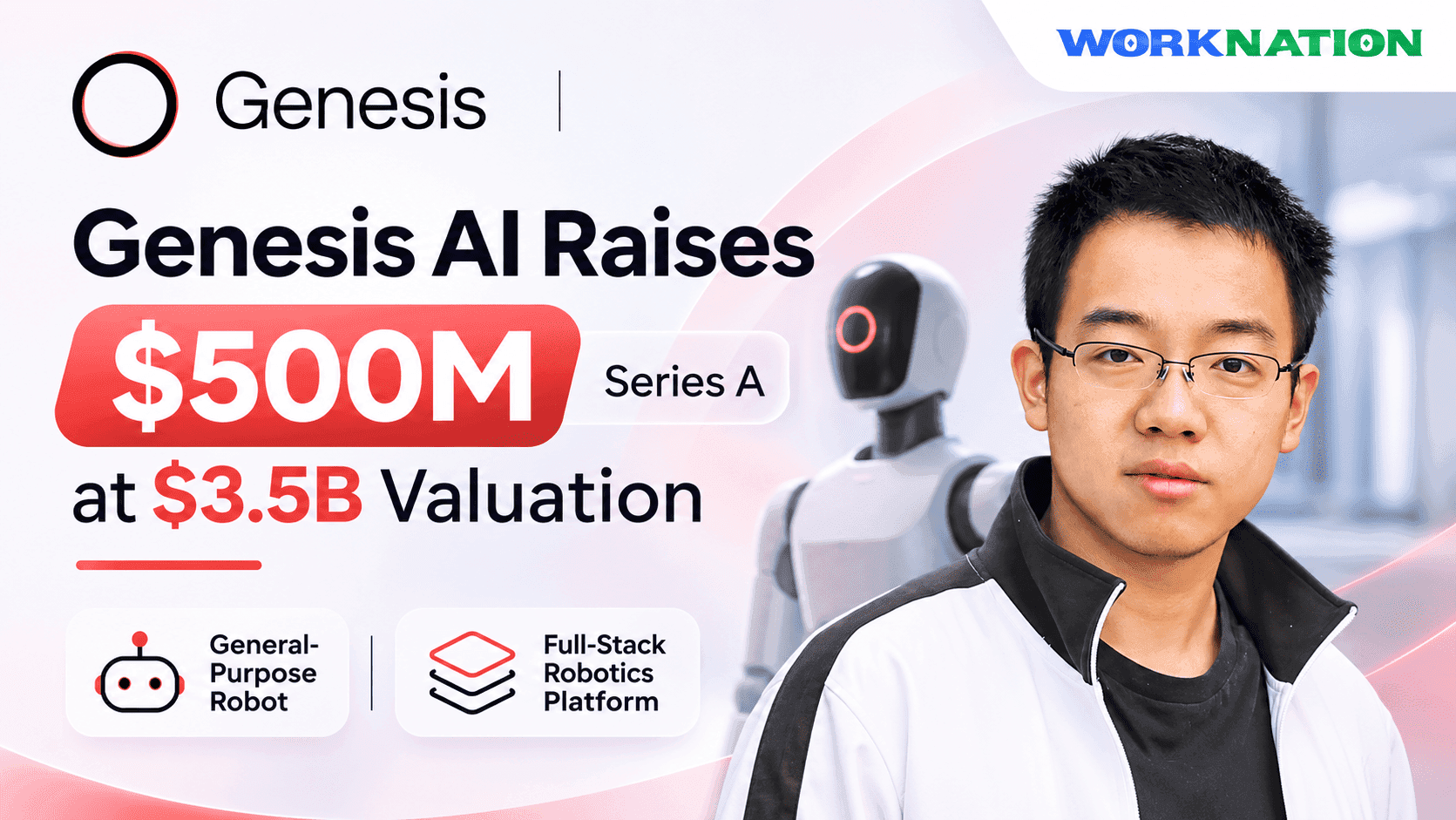
Genesis AI has raised $500 million in Series A funding at a $3.5 billion post-money valuation, positioning the Paris- and California-based robotics company among the most heavily funded startups developing general-purpose robots.
The round was co-led by Premji Invest, Khosla Ventures and Eclipse. Other participants include Durable Capital Partners, T. Rowe Price Associates, Bpifrance, HSG, NVIDIA, AMD Ventures, Zoom, Samsung Next and Ericsson. Individual investors include former Google CEO Eric Schmidt, Zoom CEO Eric Yuan, former Yahoo CEO Jerry Yang, French entrepreneur Xavier Niel and former Tesla CFO Zach Kirkhorn.
Founded in 2024 by Zhou Xian and Théophile Gervet, Genesis is developing a full-stack robotics platform that combines artificial intelligence, robotic hardware, simulation and real-world training data. Its latest financing follows a $105 million seed round announced in July 2025.
The company's immediate objective is to advance and deploy Eno, its first general-purpose robot, while expanding the data and training infrastructure needed to make robots more adaptable across physical tasks.
Building robots that can handle more than one task
Genesis is targeting a central challenge in robotics: enabling machines to perform complex, multi-step physical work reliably rather than repeating a narrow set of pre-programmed actions.
Its flagship robot, Eno, is designed initially for manufacturing, logistics and laboratory environments. Instead of following the conventional humanoid design, Eno uses a wheeled mobile base, an articulated body and two arms with dexterous robotic hands. The design prioritises mobility and manipulation capabilities for practical work settings rather than human appearance.
Genesis argues that reliability becomes increasingly difficult as tasks involve more steps. In the company's example, a robot with a 99% success rate at each individual step has only about an 82% chance of completing a 20-step workflow without an error.
The company is therefore developing the robot, its intelligence and its training systems together. This full-stack approach is intended to let improvements in one part of the system feed directly into the others.
Four connected technologies behind its robotics platform
Genesis' approach brings together four main components.
GENE is the company's robotic foundation model. It is designed to learn manipulation skills and apply them across different tasks, reducing the need to train a robot separately for every workflow. Genesis says the model is being developed to improve dexterity and general-purpose physical capabilities.
Dexterous robotic hands and human-data collection are central to its training strategy. The company uses sensor-equipped gloves and data collection systems to capture human movements and touch-related information. Its approach is designed around a one-to-one mapping between human hands, gloves and robotic hands, helping transfer demonstrated physical skills into robotic actions.
Genesis World is its simulation platform, which allows robotic systems to be tested across large numbers of virtual scenarios. The aim is to identify failures, evaluate behaviour and improve the model before deploying it in physical environments.
Eno brings the model and hardware into real-world operations. Data gathered during deployments can then be used to improve the model, simulation and robot design, creating a continuous learning cycle.
A growing race to develop general-purpose robots
Genesis is entering a competitive market as robotics companies seek to build machines capable of performing a wider range of physical tasks.
Generalist AI is developing foundation models intended to help robots perform complex tasks across different hardware platforms. Humanoid is working on general-purpose robots for industrial and commercial environments. Agile Robots develops robotic arms, mobile robots, humanoids and AI software, while Dream Labs is building a shared AI system designed to operate robots from different manufacturers.
These companies are pursuing different technical approaches, but they share a broader ambition: moving robotics beyond fixed automation towards systems that can adapt to changing tasks and environments.
The opportunity extends across manufacturing, logistics, healthcare, hospitality and other service industries. However, successful demonstrations are only an early milestone. Reliability, deployment costs, safety and the ability to operate consistently in unpredictable environments will determine whether general-purpose robots can achieve widespread commercial adoption.
What comes next for Genesis AI?
Genesis says the new capital will support expanded data acquisition, large-scale model training, advances in physical manipulation and wider deployment of Eno. The company also plans to grow its research and engineering capabilities.
Its initial focus is on industrial and logistics applications, with longer-term ambitions to expand into services, hospitals, homes and outdoor environments.
The company now faces the challenge of translating its integrated robotics technology into dependable products that customers can use at scale. The $500 million round provides substantial resources for that effort, but commercial success will depend on how reliably Eno performs outside controlled demonstrations and how economically Genesis can manufacture and deploy it.
Have a Funding Round or Exciting Update to Share?
Submit your press release to get featured on WorkNation and reach founders, investors, and tech leaders.