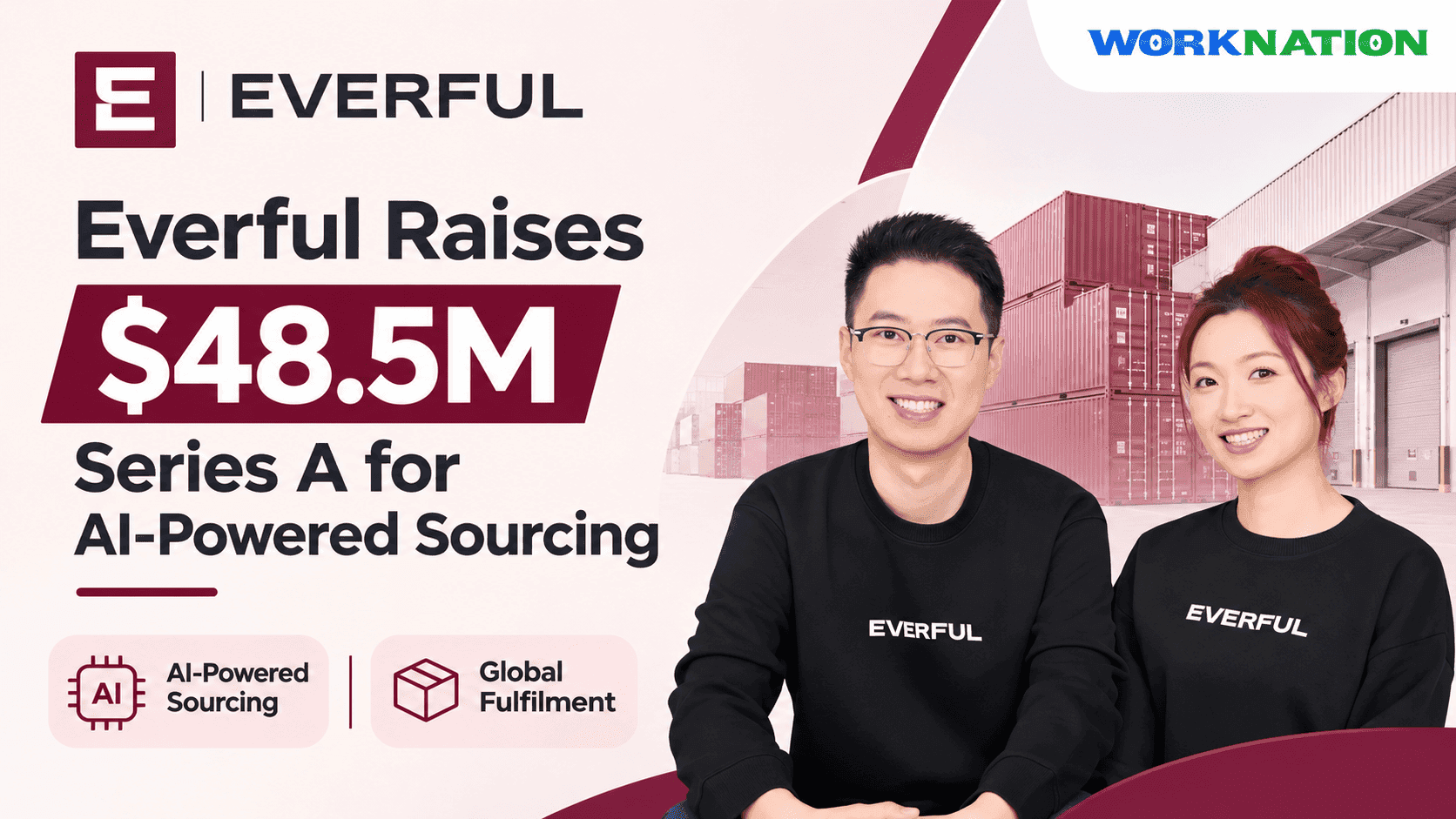
Everful Raises $48.5 Million Series A to Scale AI-Powered Global Sourcing
Top Picks
Submit PR
Stay Ahead of the Market
Get the latest startup funding, hiring trends and global opportunities delivered to your inbox every week.
Everful has raised $48.5 million in Series A funding to help retailers and brands source products directly from Chinese factories through an AI-powered wholesale and fulfilment platform. The San Francisco- and Singapore-based startup manages sourcing, order consolidation, quality control and logistics, aiming to make factory-direct procurement more accessible to smaller businesses.
The round was co-led by Vertex Ventures Southeast Asia & India and January Capital, with existing investors Square Peg and Lightspeed also participating.
Founded in 2024 by former Alibaba executive Sisi Song and entrepreneur Kevin Han, Everful has evolved from a jewellery wholesale business into a multi-category sourcing platform. The company says it works with more than 30,000 factory partners, lists over 20 million products and ships more than 5 million items every month to customers in over 60 countries.
Its next phase is focused on expanding across the United States and Europe while investing further in AI agents and fulfilment infrastructure.
Everful's $48.5 Million Series A: Investors and Funding Details
Everful's $48.5 million Series A round brings together investors with experience in technology, commerce and businesses operating across Asia-Pacific.
Lead investors:
Vertex Ventures Southeast Asia & India
January Capital
Existing investors participating:
Square Peg
Lightspeed
The funding announcement identifies Square Peg and Lightspeed as existing investors returning for the Series A.
How will Everful use the new funding?
Everful plans to allocate the capital across three broad priorities:
1. Expand in the United States and Europe
The company intends to deepen its presence in the United States, which it identifies as its largest market, and expand in Europe, particularly the United Kingdom, France and Italy.
2. Invest in AI-powered sourcing
Everful plans to develop AI capabilities for product customisation and other labour-intensive sourcing workflows. The aim is to automate more of the work involved in identifying products, coordinating suppliers and managing orders.
3. Build end-to-end global commerce infrastructure
The company also plans to deepen integrations with e-commerce platforms, building on its existing Shopify integration. Its longer-term ambition is to become an infrastructure layer connecting product discovery, factory sourcing, purchasing and fulfilment.
What Does Everful Do? An AI-Powered Factory Sourcing Platform
Traditional wholesale sourcing can be difficult for smaller retailers. Finding reliable manufacturers, negotiating minimum order quantities, checking product quality and coordinating international shipments often require dedicated procurement teams.
Smaller businesses may not have the purchasing volume or resources to manage these processes independently. They can end up relying on intermediaries, accepting higher sourcing costs or committing to inventory before demand is clear.
Everful aims to bring these activities into one managed platform.
Rather than simply connecting buyers with suppliers, the company takes responsibility for parts of the purchasing process, including factory sourcing, order consolidation, quality control and logistics.
How Everful's sourcing platform works
1. Product discovery and trend identification
AI agents help track consumer trends and identify products that retailers may want to source. The company's catalogue contains more than 20 million products, according to its announcement.
2. Factory identification and verification
The platform connects retailers with a network of more than 30,000 factory partners. Everful says it verifies the factories it works with, helping smaller buyers navigate supplier selection.
3. Sourcing and order coordination
AI agents support the process of identifying suppliers and coordinating orders across factories. This is intended to reduce the manual communication and administration involved in sourcing from multiple manufacturers.
4. Order consolidation and quality control
Everful manages order consolidation and quality checks as part of its end-to-end service. This is particularly relevant when retailers source different products or product categories from multiple factories.
5. Logistics and delivery
The company coordinates delivery to customers across its international markets, connecting factory procurement with the final fulfilment process.
This integrated approach is central to Everful's positioning: it wants to manage the operational work between a retailer's product requirements and the arrival of inventory, rather than leaving buyers to coordinate every supplier themselves.
Everful's Growth: 30,000+ Factories and 5 Million Monthly Shipments
Everful's reported operating scale is a major part of its Series A story.
According to co-founder Sisi Song, the company:
Works with more than 30,000 factory partners.
Offers over 20 million products in its wholesale catalogue.
Ships more than 5 million items per month.
Serves customers in more than 60 countries.
Has around 70 full-time employees globally.
Employs approximately 45 people in research and development.
The company also says it is on track to reach $100 million in annualised revenue by the end of 2026, approximately two and a half years after launch.
Annualised revenue is a projection based on the current revenue pace. It should not be interpreted as $100 million already earned during the year.
Why the scale of the factory network matters
A large supplier network can make it easier to offer a wider range of products and sourcing options. However, the number of factories alone does not establish supplier reliability or product quality.
The more important question is whether Everful can consistently verify suppliers, manage production requirements and deliver orders to the specifications retailers expect.
Its quality-control and fulfilment operations will therefore be central to maintaining trust as the business expands.
Why Everful Is Targeting Small Retailers and Independent Brands
Large retailers often have procurement departments, sourcing offices and established relationships with manufacturers. Smaller businesses typically have fewer resources to manage the same process.
Everful is targeting this gap.
The platform is designed for retailers and brands that want factory-direct sourcing but do not have dedicated teams to handle supplier discovery, product checks, negotiations and international logistics.
The problem with traditional wholesale sourcing
Smaller retailers can face several operational constraints:
High minimum order quantities: Factories may require buyers to purchase more inventory than a smaller retailer can confidently sell.
Fragmented supplier relationships: Sourcing from several manufacturers creates separate communication, payment and delivery processes.
Quality uncertainty: Buyers need reliable inspections and clear product specifications before committing to large orders.
Working-capital pressure: Long sourcing cycles and large inventory commitments can tie up cash before products reach customers.
Limited procurement expertise: Smaller retailers may not have employees with experience in international manufacturing, customs and logistics.
Everful's proposition is to reduce this operational burden by bringing multiple sourcing activities into one managed service.
Why order consolidation could be commercially important
Order consolidation is more than a convenience feature. It can help retailers manage purchases across different suppliers without having to coordinate every shipment independently.
For a small retailer building a varied product catalogue, this could reduce administrative complexity and make factory-direct sourcing more practical.
However, the actual savings depend on product type, order size, freight arrangements, customs costs and the service fees involved. Factory-direct purchasing does not automatically guarantee a lower landed cost.
Everful vs Alibaba and Faire: What Makes Its Model Different?
Everful operates in a competitive wholesale and sourcing market that includes established platforms such as Alibaba and Faire.
Alibaba connects international buyers with manufacturers, suppliers and trading companies.
Faire helps independent retailers discover and purchase wholesale products from brands.
Everful positions itself around managing the sourcing process, including factory identification, order consolidation, quality control and logistics.
The distinction is not simply where products are listed. It is how much operational responsibility the platform assumes after a retailer identifies what it wants to buy.
From supplier marketplace to managed sourcing partner
A supplier marketplace generally helps buyers discover manufacturers and initiate transactions. Buyers may still need to handle supplier verification, product specifications, inspections, shipping and other steps themselves.
Everful is attempting to combine those activities into a more integrated service.
That positioning could appeal to retailers that value reduced procurement complexity over having complete control of every supplier relationship. It also means Everful takes on more operational responsibility, making execution and service quality important to its business model.
How AI Agents Are Changing Global Wholesale Sourcing
Everful uses AI agents to automate several tasks that traditionally require manual coordination.
According to co-founder Kevin Han, these include tracking consumer trends, identifying suppliers, coordinating orders across factories and managing logistics.
The company is also investing in AI to automate product customisation and connect its engineering and business operations through a dedicated AI operations team.
Why AI matters beyond product recommendations
In wholesale sourcing, identifying a product is only the beginning. A retailer still needs to find a manufacturer, confirm specifications, coordinate production, check quality and arrange delivery.
AI agents could help manage these connected workflows rather than simply recommend products.
For example, a retailer looking to launch a new product line might need to identify emerging consumer demand, shortlist factories, compare product options and coordinate orders. Automating parts of that sequence could reduce the time and manual effort required.
The larger opportunity is to turn sourcing knowledge and repeated supplier interactions into software-driven processes.
US-China Trade Policy: A Key Risk for Everful's Expansion
Everful's reliance on Chinese factories exposes its business to changes in international trade policy, import duties and cross-border logistics.
The company has acknowledged that geopolitical developments have influenced its strategy since its founding.
One important policy change is the suspension of the US de minimis exemption. Previously, eligible shipments valued at $800 or less could enter the United States without the usual duties under that exemption.
However, this treatment has been suspended for imports across countries, not just China. US Customs and Border Protection guidance in 2026 confirms that the suspension applies across transport modes, subject to specific exceptions and applicable entry procedures.
Why the change matters for factory-direct sourcing
The suspension changes the economics of low-value cross-border shipments. Retailers and sourcing platforms need to account for applicable duties, taxes, customs processing and shipping costs when calculating the final cost of imported inventory.
Everful's approach combines overseas B2B sourcing with local retail sales. That distinction matters because it is not simply a direct-to-consumer parcel model. The retailer can source inventory through a managed procurement platform and sell through its own local business.
But this does not eliminate tariff exposure. The actual duty treatment depends on the product, country of origin, customs classification, shipment structure and applicable trade rules.
For Everful, the challenge is to make factory-direct sourcing commercially attractive even when import costs and trade policies change.
Five Key Insights From Everful's $48.5 Million Funding Round
Everful's funding points to a broader opportunity in AI-powered supply chains. These five insights are editorial analysis based on its business model, reported operating scale and expansion plans.
1. The next wholesale platform may compete on execution, not catalogue size
A catalogue of 20 million products can attract retailers, but product discovery alone is not a strong operational advantage if buyers still have to manage factories, inspections and shipping independently.
Everful's more important differentiator may be its willingness to manage the work after product discovery. If it can deliver consistent quality and reliable fulfilment, execution could become more defensible than simply offering a large supplier directory.
2. Supplier verification could become a valuable data asset
Every factory interaction can generate information about product quality, production reliability, pricing, lead times and fulfilment performance.
If Everful systematically captures and learns from this information, its supplier network could become more valuable over time. Better supplier-performance data could improve factory matching and reduce the likelihood of poor sourcing decisions.
This is a potential advantage of the model, not a confirmed proprietary capability beyond the company's stated factory-verification and AI ambitions.
3. Order consolidation may unlock smaller retailer purchasing power
Smaller retailers often lack the volume to negotiate favourable terms with multiple factories. A platform that coordinates purchases across suppliers could make sourcing more manageable and potentially improve shipping efficiency.
The opportunity is not necessarily to make every order cheaper. It is to reduce the operational overhead that makes international procurement difficult for smaller businesses.
4. Annualised revenue growth will depend on more than transaction volume
Everful's reported trajectory towards $100 million in annualised revenue is notable. But a sourcing and fulfilment business must manage costs associated with quality checks, logistics, customer support, supplier verification and working capital.
The important metric to watch will be how much contribution margin the company retains after delivering the full service. High shipment volumes do not automatically translate into strong profitability.
5. Trade-policy uncertainty makes operational flexibility more important
Everful's expansion across the US and Europe comes with exposure to different customs systems, import requirements and product regulations.
A sourcing platform that can help retailers understand landed costs, coordinate compliant documentation and adapt supplier choices could become more useful as trade rules change.
Its ability to support multiple markets without allowing operational complexity to grow faster than revenue will be a major test of the model.
What Everful's Expansion Means for Global Sourcing
Everful plans to deepen its presence in the United States and expand across the United Kingdom, France and Italy.
These markets offer opportunities to serve independent retailers and growing brands that want access to international manufacturers without building their own sourcing teams.
The company also plans to deepen its Shopify integration and develop additional AI-powered product customisation workflows.
Could Everful become infrastructure for global commerce?
The company's long-term ambition goes beyond wholesale product listings. It wants to connect product discovery, supplier sourcing, purchasing, quality control and fulfilment through one technology-enabled platform.
If successful, this could make Everful part of the operating infrastructure behind smaller retail businesses.
However, becoming an infrastructure platform requires more than expanding the catalogue and factory network. It requires reliable integrations, predictable delivery, strong supplier standards and the ability to manage complex transactions across countries.
Frequently Asked Questions About Everful and Factory-Direct Sourcing
What does Everful do?
Everful is an AI-enabled global sourcing platform that connects retailers and brands with factories, primarily in China. It manages sourcing, order consolidation, quality control and logistics.
How much funding has Everful raised?
Everful raised $48.5 million in Series A funding in November 2026. Vertex Ventures Southeast Asia & India and January Capital co-led the round, with existing investors Square Peg and Lightspeed participating.
Who founded Everful?
Everful was founded in 2024 by Sisi Song, a former Alibaba executive and Bessemer Venture Partners investor, and Kevin Han, an entrepreneur whose previous company was acquired by Amazon.
How many factories work with Everful?
Everful reports a network of more than 30,000 factory partners and a wholesale catalogue containing over 20 million products.
Does Everful use AI for sourcing?
Yes. The company says its AI agents help track consumer trends, identify suppliers, coordinate orders across factories and manage logistics. It is also investing in AI-powered product customisation.
What is the difference between Everful and Alibaba?
Alibaba primarily connects buyers with suppliers and manufacturers through a marketplace. Everful positions itself as a managed sourcing partner that also coordinates order consolidation, quality control and logistics.
Can small retailers buy directly from Chinese factories?
Yes, but the process can involve supplier verification, minimum order quantities, product sampling, quality inspections, international shipping and customs requirements. Platforms such as Everful aim to manage more of these steps for smaller retailers.
Where does Everful operate?
Everful is based in San Francisco and Singapore and serves customers in more than 60 countries. It plans to expand its presence in the United States and Europe, particularly the UK, France and Italy.
Conclusion: Everful's $48.5 Million Funding Targets the Operational Gap in Global Sourcing
Everful's $48.5 million funding gives the company capital to expand its international footprint and build AI-powered infrastructure for factory-direct procurement.
Its approach addresses a problem that goes beyond finding manufacturers. Smaller retailers need help coordinating suppliers, managing quality, consolidating orders and getting products delivered without building large procurement teams.
Everful is betting that AI can automate much of this operational work while its managed sourcing model handles the physical movement of goods.
The company's reported network of more than 30,000 factories and monthly shipments exceeding 5 million items provide an early indication of scale. Its next challenge is to maintain supplier reliability, manage cross-border trade risks and demonstrate sustainable economics as it expands.
If it can execute on those priorities, Everful could become more than a wholesale marketplace. It could develop into an important technology and fulfilment layer connecting independent retailers with global manufacturing.
Have a Funding Round or Exciting Update to Share?
Submit your press release to get featured on WorkNation and reach founders, investors, and tech leaders.