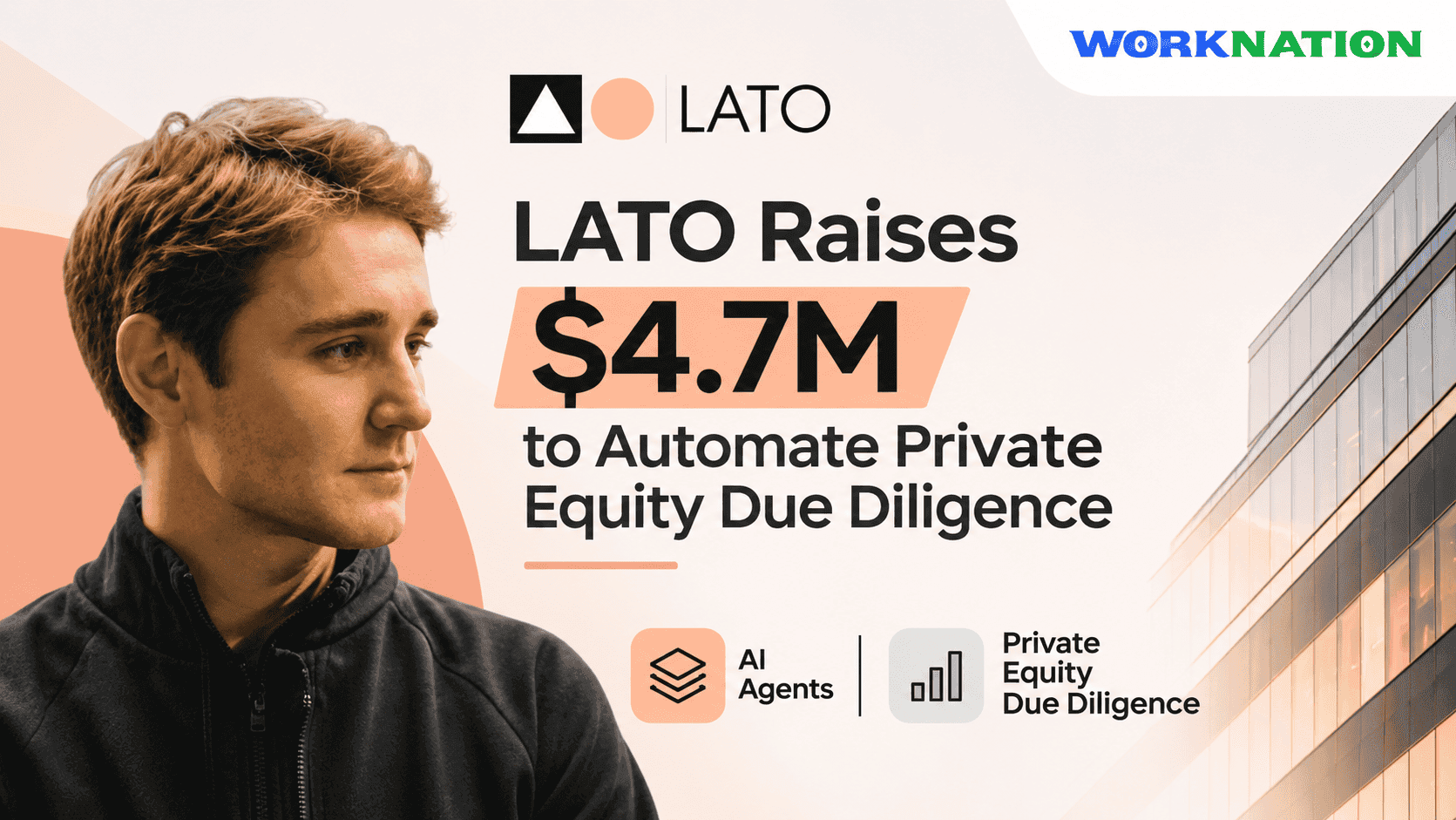
LATO Raises $4.7 Million Seed Funding to Automate Private Equity Due Diligence
Top Picks
Submit PR
Stay Ahead of the Market
Get the latest startup funding, hiring trends and global opportunities delivered to your inbox every week.
LATO's $4.7 million funding will help the Y Combinator-backed startup scale AI agents that interview customers and industry experts for private equity investors. The platform is designed to accelerate commercial due diligence by collecting primary research across markets, analysing responses and combining them with investors' internal data and published information.
The seed round was co-led by Air Street Capital and Axiom Partners, with participation from Y Combinator, Montis VC and Inception Fund. Angel investors include Paul Graham and co-founders of ElevenLabs, Vercel, Snowflake and Rogo.
Founded by Tymek Staniszewski and Tien Chu, LATO is targeting a time-consuming part of investment research: understanding what customers, buyers and industry participants actually think about a business before an investor commits capital.
The company says its AI agents have conducted more than 1,000 expert interviews across over 35 countries since its first research project in July 2026. It also reports an annualised revenue run rate above $1 million approximately 100 days after that first study. These are company-reported operating figures, not independently audited results.
LATO's $4.7 Million Seed Funding: Investors and Round Details
LATO's $4.7 million seed round brings together venture capital firms, an accelerator and prominent technology founders.
The round was co-led by:
Air Street Capital
Axiom Partners
Other participating investors:
Y Combinator
Montis VC
Inception Fund
The angel investor group includes Paul Graham and founders or co-founders associated with ElevenLabs, Vercel, Snowflake and Rogo.
SMOK Ventures also publicly confirmed that it participated in the round, although it was not included in the investor list in the supplied Tech Funding News report. Its investment announcement describes how it backed the company after following its progress through the Y Combinator programme.
How will LATO use the new funding?
LATO plans to expand three key areas of the business:
Engineering: Strengthen the technology behind its AI research agents and platform.
Research: Expand the range of studies its agents can conduct independently.
Sales: Grow its commercial team and reach more institutional investors.
The company initially focused on private equity and institutional investment firms. It is also exploring applications for consulting firms and businesses that need to evaluate demand before entering new markets.
What Does LATO Do? AI Agents for Commercial Due Diligence
Commercial due diligence is the process investors use to understand a company's market, customers, competitive position and growth prospects before completing an investment.
Financial statements can show revenue, margins and historical performance. However, they cannot fully explain why customers choose a product, whether buyers would accept a price increase or how likely they are to switch to a competitor.
That requires primary research, often involving interviews with customers, suppliers, industry specialists and other market participants.
LATO uses AI agents to automate parts of this research process. Its platform identifies relevant participants, conducts interviews in their own languages and analyses the responses alongside public information and the investment fund's internal data.
How LATO's AI due diligence platform works
1. Finding relevant customers and experts
The platform sources people who can provide evidence about a company's market, products, competitors and customers.
2. Conducting multilingual interviews
AI agents interview customers and industry experts in their own languages. This can help investment teams collect perspectives across multiple countries without coordinating every conversation manually.
3. Combining primary and secondary research
The platform analyses interview responses alongside published research and the fund's proprietary information. This gives investment teams a broader view of the market and the assumptions behind a potential investment.
4. Providing access to recordings and transcripts
Investors can review interview recordings and transcripts to examine what participants actually said and the context behind individual findings.
5. Reusing research across investment workflows
Each interview and study remains in the fund's workspace. Teams can revisit earlier research, compare findings and use the information during later investment or portfolio-management decisions.
The distinction is important: LATO is not simply generating market research summaries. It is attempting to automate the collection of primary evidence while retaining access to the underlying interviews.
How Private Equity Firms Can Use LATO's AI Agents
LATO's platform is designed to support investment teams at different stages of the investment process.
Before an investment: Understanding the market
Investors can use interviews to assess market demand, customer behaviour, competitor positioning and the potential size of an opportunity before entering detailed negotiations.
During due diligence: Testing investment assumptions
A fund may believe a target company can increase prices without losing customers. LATO's agents can interview buyers to understand which alternatives they might consider, what would make them switch suppliers and how they perceive the company's offering.
This can help investors test whether a growth forecast is supported by customer evidence.
After an investment: Supporting portfolio decisions
The same research process can be used with portfolio companies to understand customer needs, competitive changes and potential expansion opportunities.
This creates an opportunity for LATO to become part of a fund's ongoing research workflow rather than a tool used only during an individual acquisition.
LATO Reports 1,000+ Expert Interviews Across 35 Countries
LATO ran its first research project in late July 2026. Since then, the company says its AI agents have conducted more than 1,000 expert interviews across over 35 countries.
Its named customers include investment funds Verdane, Blume Equity and North Island.
The company's early commercial figures have also attracted attention. LATO reports that its annualised revenue run rate exceeded $1 million around 100 days after its first research project.
An annualised revenue run rate is a projection based on the company's current revenue pace. It does not mean LATO generated more than $1 million in actual revenue during those first 100 days.
Why the early traction matters
The figures suggest that LATO has moved beyond a product demonstration and secured early usage from institutional investors.
However, the next test is whether it can convert early projects into repeatable customer relationships. Private equity firms need reliable research across multiple transactions, and a platform's long-term value will depend on whether investment teams continue using it after their initial studies.
Why AI-Powered Due Diligence Is Attracting Investment
Private equity due diligence often involves compressed timelines, multiple markets and large volumes of information. Research teams need to understand not only what a target company reports, but also how customers and competitors behave.
AI agents could reduce the time spent sourcing interview participants, arranging calls, collecting responses and preparing initial analysis.
The wider market is also moving towards automated research. The Business Research Company estimates that the global market research services market will grow from $96.77 billion in 2026 to $116.02 billion by 2030, representing a projected compound annual growth rate of 4.6%.
This broader market includes many types of research services, not just AI-powered private equity due diligence. It provides context for the industry opportunity rather than a direct estimate of LATO's addressable market.
From research summaries to evidence-backed investment decisions
One of LATO's central product propositions is that investment teams can inspect the original interviews behind the analysis.
This matters because a summary alone may conceal conflicting opinions, weak evidence or important qualifications. Access to recordings and transcripts gives investors a way to challenge the findings and examine the reasoning themselves.
For high-value investment decisions, the ability to trace conclusions back to primary evidence could be as important as the speed of generating a report.
LATO's Competitors in AI Research and Due Diligence
LATO is entering a growing category of companies using AI to automate customer interviews, qualitative research and investment analysis.
Some relevant competitors and adjacent companies include:
Qualitate: Uses AI-moderated expert interviews and research tools for private equity firms, including customer diligence and portfolio intelligence.
Listen Labs: Uses AI agents to conduct and analyse customer interviews. The company signed a definitive acquisition agreement with Salesforce in September 2026, according to Tech Funding News.
Conveo: Develops an AI-powered video interview platform for qualitative research.
Metaforms: Builds AI agents for automating market research workflows.
Simile: Uses AI to simulate human behaviour and support research and decision-making.
These companies do not all compete with LATO in exactly the same way. Some focus on customer research, while others target investment workflows or behavioural simulation.
What differentiates LATO?
LATO's positioning centres on combining three elements:
Primary interviews with customers and industry experts.
The investment fund's internal research and proprietary data.
Published information and access to the underlying interview evidence.
Its focus on private equity gives it a defined initial customer segment, where commercial due diligence is directly connected to investment decisions and deal timelines.
The challenge will be to prove that AI-led interviews can deliver sufficiently reliable evidence for decisions involving substantial capital.
Five Key Insights From LATO's $4.7 Million Funding Round
The funding announcement points to several important developments in AI research and investment technology. These are original editorial insights drawn from LATO's business model, early traction and competitive environment.
1. The real bottleneck in due diligence may be access to primary evidence
Investment firms already have access to financial databases, market reports and company information. But understanding why customers buy, switch suppliers or reject a product often requires direct conversations.
LATO is targeting this research bottleneck. If AI agents can source relevant participants and conduct credible interviews at scale, they could reduce the time between an investment question and the evidence needed to evaluate it.
2. Interview volume is not the same as research quality
More than 1,000 interviews across 35 countries is an indicator of operational activity, but it does not automatically establish research quality.
For investment decisions, the relevance of the interviewee, the quality of the questions, the representativeness of the sample and the accuracy of the analysis matter more than raw interview counts.
LATO's ability to demonstrate these dimensions will be central to building trust with institutional investors.
3. Traceability could become a stronger selling point than AI-generated summaries
Investment teams need to defend their decisions internally. A polished report is useful, but decision-makers also need to understand where a conclusion came from.
By retaining recordings and transcripts, LATO can give users a route from a reported finding back to the original interview. That could make its research more useful in investment committee discussions, where assumptions and contradictory evidence are challenged.
4. The former-investor founder background creates a specific product advantage
Tymek Staniszewski spent six years in growth equity and private equity, including at Verdane. That experience gives the founding team direct exposure to the research workflows it is trying to automate.
Verdane is also named as a LATO customer. This founder-market connection may help the company understand how investment teams work, although it does not by itself prove that the product will scale across different funds.
5. Expansion beyond private equity could significantly change the business
LATO is exploring use cases for consulting firms and businesses evaluating new markets.
That creates a potential path beyond transaction-led research. Consulting firms may need repeated customer interviews for client projects, while companies may use the platform to test demand before launching products or entering new geographies.
However, these markets have different buyers, workflows and procurement requirements. Expanding beyond institutional investors will require more than simply offering the same product to a wider audience.
Risks and Challenges LATO Will Need to Address
LATO's proposition is compelling, but automating primary research for investment decisions creates demanding requirements.
Interview reliability and participant quality
The platform needs to ensure that interviewees have relevant experience and provide credible responses. Poor participant selection can undermine an entire research study, regardless of how sophisticated the AI analysis appears.
Accuracy and interpretation
AI systems can misinterpret context, miss nuance or overstate patterns in qualitative responses. Investment teams will need clear methods for checking findings and identifying uncertainty.
Confidentiality and sensitive information
Private equity research can involve commercially sensitive information. Secure handling of recordings, transcripts and fund-level data is essential, particularly when multiple studies and investment teams use the platform.
Proving repeatable commercial value
The reported $1 million annualised revenue run rate is an encouraging early signal, but investors will want to see repeat usage, customer retention and a sustainable revenue model. The quality of research and its impact on investment workflows will matter more than initial interview volume alone.
Frequently Asked Questions About LATO and AI Due Diligence
What does LATO do?
LATO develops AI agents that find and interview customers and industry experts. Its platform combines interview responses with public research and investors' internal data to support commercial due diligence and market analysis.
How much funding has LATO raised?
LATO raised $4.7 million in a seed funding round co-led by Air Street Capital and Axiom Partners. Y Combinator, Montis VC and Inception Fund also participated, alongside angel investors.
Who founded LATO?
LATO was co-founded by Tymek Staniszewski, its CEO, and Tien Chu, its technical co-founder. Staniszewski previously spent six years in growth equity and private equity, including at Verdane.
What is commercial due diligence in private equity?
Commercial due diligence is the process of assessing a company's market, customers, competitors, growth opportunities and commercial risks before an investment. It helps investors test whether a company's business prospects support the investment thesis.
How do AI agents help with due diligence?
AI agents can help source interview participants, conduct customer and expert interviews, analyse responses and organise findings alongside other research. They can reduce manual work, but investment teams still need to assess the quality and reliability of the evidence.
Which investment funds use LATO?
LATO has named Verdane, Blume Equity and North Island as customers. The company says its platform has been used for more than 1,000 expert interviews across over 35 countries.
Who led LATO's seed funding round?
Air Street Capital and Axiom Partners co-led LATO's $4.7 million seed round.
Conclusion: LATO's $4.7 Million Funding Targets a Critical Investment Research Bottleneck
LATO's $4.7 million funding gives the startup resources to expand its AI research platform, strengthen its engineering and research teams, and reach more institutional investors.
Its approach addresses a specific challenge in private equity: gathering credible customer and industry evidence within tight investment timelines. By combining AI-led interviews with internal fund data and published research, LATO aims to make commercial due diligence faster while preserving access to the evidence behind its conclusions.
The early interview activity and reported revenue run rate suggest initial market interest. But long-term success will depend on research quality, customer retention, data security and the ability to demonstrate that AI-led interviews can support high-stakes investment decisions.
Have a Funding Round or Exciting Update to Share?
Submit your press release to get featured on WorkNation and reach founders, investors, and tech leaders.