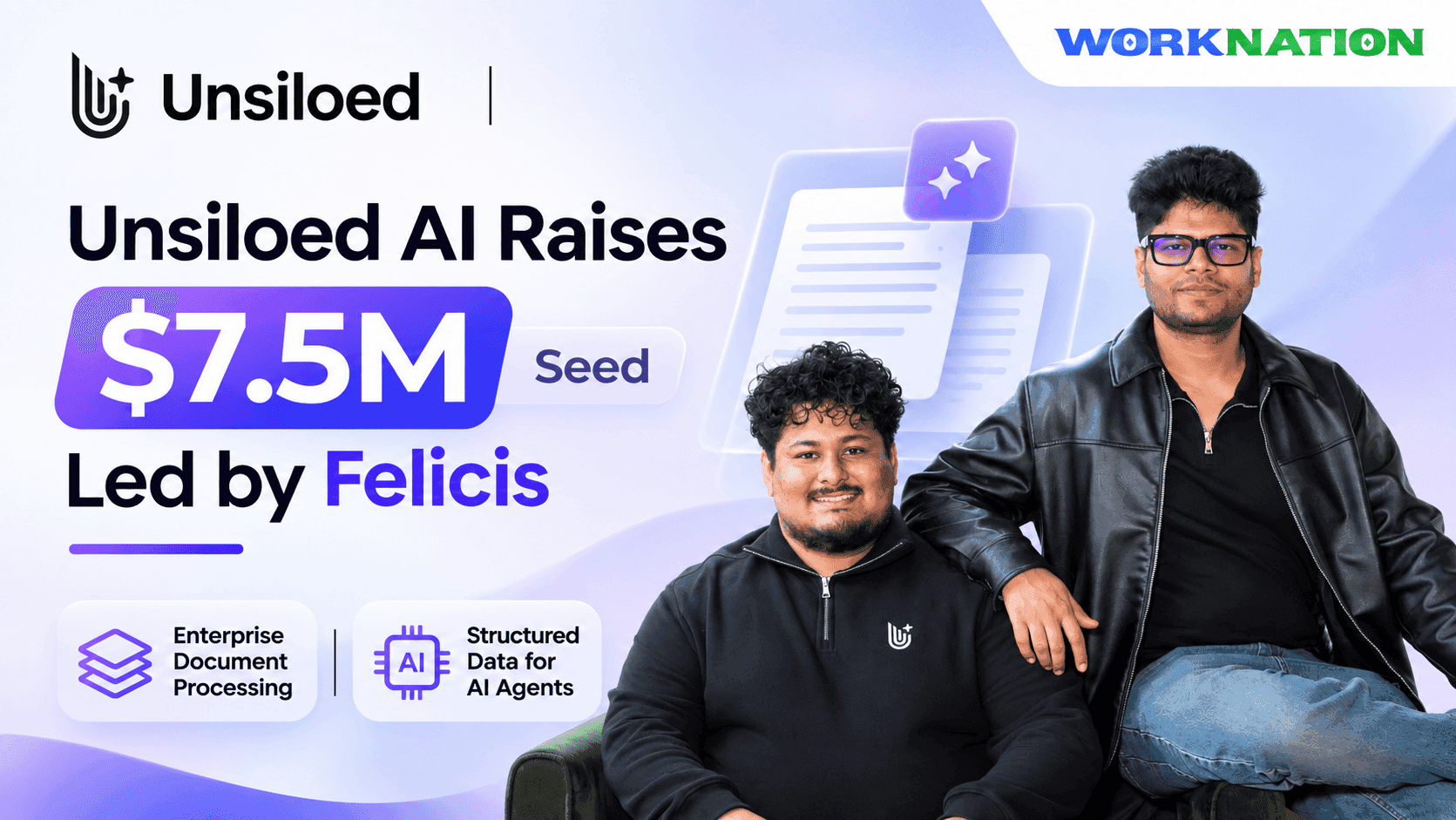
Unsiloed AI Raises $7.5M Seed Round Led by Felicis to Make Enterprise Documents AI-Ready
Top Picks
Submit PR
Stay Ahead of the Market
Get the latest startup funding, hiring trends and global opportunities delivered to your inbox every week.
Unsiloed AI has raised $7.5 million in seed funding led by Felicis to help enterprises turn complex business documents into structured information that AI agents can reliably process. The round also included Y Combinator, Orange Collective and Uncorrelated Ventures, alongside angel investors Aarthi Ramamurthy and Beth Turner.
The San Francisco-based startup is targeting a growing problem as businesses adopt AI agents: much of the information they need is still stored in PDFs, contracts, financial statements, clinical records and other documents containing tables, charts and complex layouts.
Founded by Aman Mishra and Adnan Abbas, Unsiloed is developing document-processing technology that extracts information from these files, converts it into structured data and preserves links to the original document locations. This allows users and AI systems to trace extracted information back to its source rather than relying on an answer without supporting evidence.
The founders met while studying at the Indian Institute of Technology (IIT) Kharagpur and joined Y Combinator's Fall 2025 batch. The new funding will support research and engineering recruitment, sales expansion and the development of proprietary datasets.
Making complex documents usable by AI agents
Enterprise documents are not always straightforward for AI systems to interpret. A financial report may combine figures, footnotes, tables and charts, while a legal contract can contain nested clauses, references and industry-specific terminology.
If a model misreads a figure or loses the relationship between a table and its surrounding text, the resulting error can affect decisions further down the workflow. This is particularly important in sectors such as banking, healthcare and legal services, where documents contain information that must be interpreted accurately.
Unsiloed aims to address this by converting document content into structured information that AI agents can query and use. Its system also identifies where extracted information appears in the source document, giving enterprises a way to verify the output.
The company is already working with customers in financial services, legal services and healthcare, according to CEO Aman Mishra. One bank is using the technology to process documents, while a law firm has deployed it on its own servers to work with contracts and archived case files. Voice AI startup Bolna AI was also identified as a customer, using Unsiloed to ingest knowledge bases for voice agents.
Dual-stream vision models and heat-map-based processing
Unsiloed's technical approach centres on what it calls dual-stream vision models. One stream processes text tokens, while the other handles the corresponding visual information from the document. This is intended to preserve both textual content and the layout relationships that can be lost when a document is treated as plain text.
The company also uses heat-map-based chunking to identify important sections of a page, directing more computing resources towards elements such as tables, figures, numbers and charts.
A specialised decoder accounts for industry-specific terminology, helping the system interpret words and figures in their business context.
Mishra says this architecture helps reduce extraction errors and makes the output more useful for downstream AI agents. The company says its pricing starts at one cent per page, although actual costs may vary with document complexity and usage.
Performance claims and document-processing benchmarks
Unsiloed has shared performance results from tests designed to demonstrate its document-processing capabilities.
In one evaluation involving 542 financial documents provided by an enterprise customer, the company reported 99.78% accuracy across approximately 84,000 extracted data points. The comparison included major AI models, Microsoft's Azure Document Intelligence and the customer's internal extraction tool. These results were shared in a technical brief from the startup and have not been independently verified.
The company has also reported a score of 88.0 on the public olmOCR-Bench benchmark developed by Allen AI. In its published comparison, Unsiloed scored ahead of Reducto's agentic system at 66.0 and Unstructured at 39.9. The benchmark evaluates document-processing performance across scanned pages, tables, mathematical expressions and complex layouts.
These results are company-reported benchmark claims, not proof that the system will achieve the same accuracy across every enterprise document type or production environment.
Competing in a crowded document AI market
Unsiloed is entering a market that includes specialised document-processing companies such as Reducto and Unstructured, as well as document intelligence offerings from Microsoft and Amazon. Enterprises can also use general-purpose AI models to extract information from files, creating another layer of competition.
Its differentiation rests on combining visual and textual document understanding with source-level traceability and processing techniques designed for complex layouts.
That focus could be relevant as AI agents take on more operational work. Agents need more than access to documents: they need structured information, context and a way to verify the data behind their actions. For businesses operating in regulated or high-stakes environments, traceability may be as important as extraction speed.
What comes next for Unsiloed AI?
Unsiloed currently has a team of seven. The company plans to use its $7.5 million seed funding to recruit more researchers and engineers, expand sales and build proprietary datasets to improve its models.
Its longer-term opportunity is to become an infrastructure layer between enterprise documents and AI agents, making information stored in complex files easier to search, verify and act upon.
The challenge will be to demonstrate consistent accuracy across different industries, document formats and real-world workflows. If it can do that, Unsiloed could help address one of the practical barriers to enterprise AI adoption: making the information businesses already have usable by the systems they are beginning to deploy.
Have a Funding Round or Exciting Update to Share?
Submit your press release to get featured on WorkNation and reach founders, investors, and tech leaders.