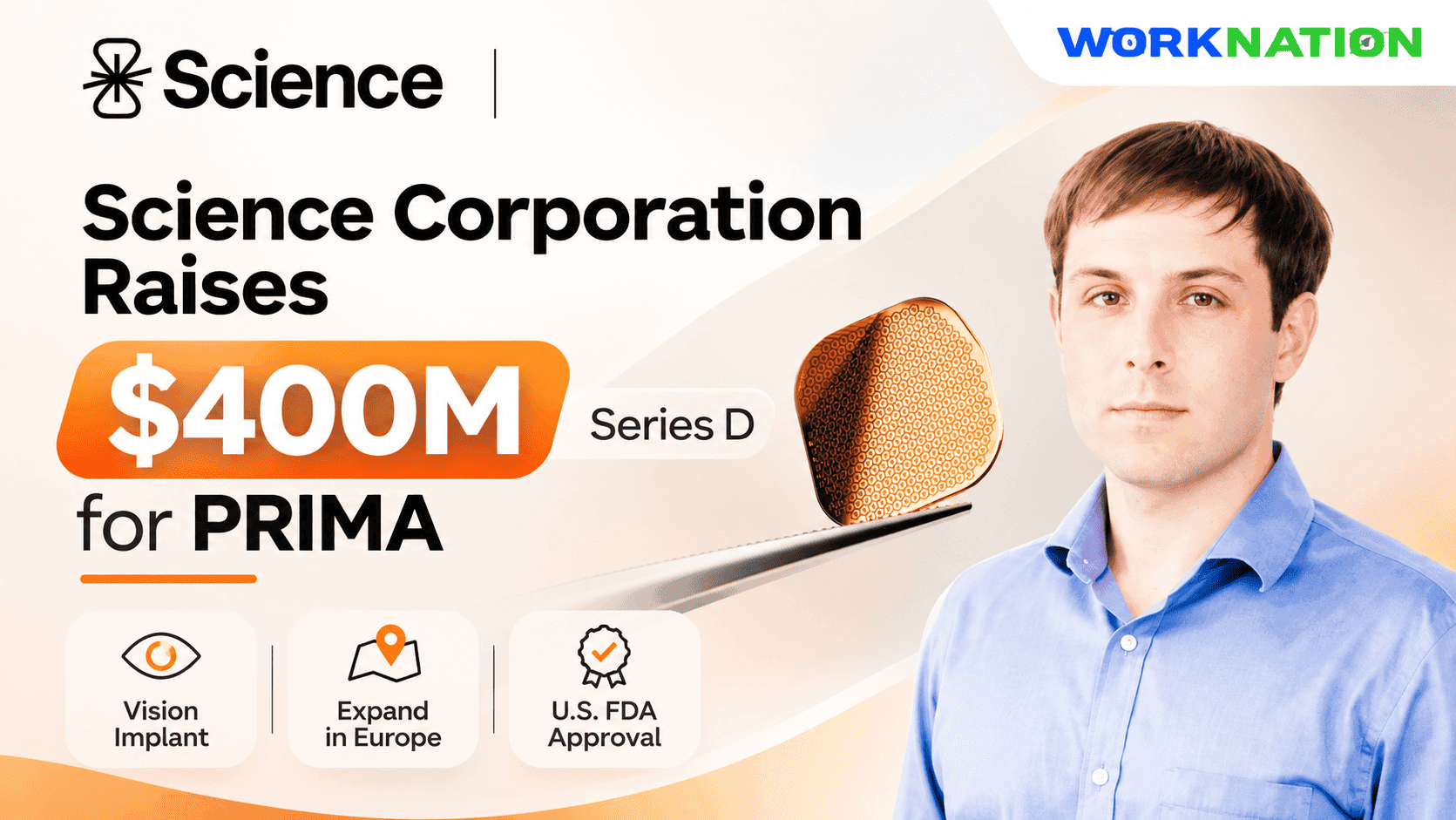
Science Corporation Raises $400M Series D to Expand PRIMA Vision Implant
Top Picks
Submit PR
Stay Ahead of the Market
Get the latest startup funding, hiring trends and global opportunities delivered to your inbox every week.
Science Corporation has raised $400 million in a Series D funding round to accelerate the European rollout of its PRIMA retinal implant and prepare for a potential launch in the United States. The financing brings the company’s total funding to more than $900 million since it was founded in 2021.
The round included Khosla Ventures, the Ackman Oxman Institute, Tenet Healthcare, 885 Capital, Y Combinator and PLC Neurotech, among other investors. Science has not publicly identified a lead investor or disclosed the round’s valuation. However, TechCrunch reported that the financing values the company at approximately $3.5 billion, citing a person familiar with the deal.
Led by co-founder and CEO Max Hodak, the California-based company is focused on developing technologies that connect engineered systems with the human nervous system. Its immediate commercial priority is PRIMA, a brain-computer interface designed to restore a degree of functional central vision for people with advanced retinal disease.
PRIMA moves from European approval towards wider access
PRIMA is designed for people who have lost central vision because of geographic atrophy, an advanced form of dry age-related macular degeneration. The system combines a small photovoltaic implant placed beneath the retina with specialised glasses equipped with a camera.
The glasses capture visual information and project it onto the implant using near-infrared light. The implant converts that light into electrical stimulation, activating remaining retinal cells that transmit signals to the brain. The system is intended to help patients recover functional form vision, including the ability to recognise letters, numbers and words.
Science launched PRIMA commercially in Europe in July 2026 after receiving CE marking. The certification allows the device to be marketed across 30 European countries, although access, clinical-site activation and reimbursement processes are being handled country by country.
The new funding is intended to accelerate availability across Europe while supporting the company's US regulatory pathway. Science is pursuing approval through the US Food and Drug Administration's Humanitarian Device Exemption route. The device has received Humanitarian Use Device designations, but these designations are not equivalent to FDA marketing approval.
From Neuralink to a broader neural technology platform
Science was founded in 2021 by Max Hodak, Alan Mardinly and Emma Zhou. Hodak previously co-founded Neuralink and served as its president before launching Science. Mardinly, a neuroscientist and biotechnology executive, is the company's co-founder and Chief Scientific Officer.
While PRIMA offers a near-term commercial focus, Science is also developing a longer-term biohybrid neural interface. The programme aims to integrate engineered neurons with the brain's own circuits, creating a different approach to connecting electronic systems with biological neural networks.
The company is preparing for initial human trials of this technology in collaboration with Yale neurosurgery professor Murat Günel, according to TechCrunch. The programme remains a research effort, distinct from PRIMA's existing European commercial rollout.
The funding will also support expansion of Science's research, manufacturing and operational infrastructure, alongside further investment in the biohybrid programme.
Competition across the brain-computer interface market
Science is raising capital as investment and development activity across brain-computer interfaces continues to grow. Companies are pursuing different technical approaches, from minimally invasive implants to devices that communicate with the nervous system through blood vessels.
Precision Neuroscience is developing its Layer 7 brain-computer interface, while Synchron is working on an endovascular system designed to help people with paralysis control digital devices. Paradromics is developing high-bandwidth neural interfaces aimed at restoring communication for people with severe motor impairments.
These technologies address different medical needs and are not direct substitutes for PRIMA. However, they reflect the expanding range of approaches being developed to restore or extend communication between the brain and external devices.
Scaling a vision-restoration technology
The $400 million Series D gives Science additional capital to expand a medical device that has already reached commercial availability in Europe, while pursuing the regulatory steps required for a US launch. It also provides resources for a more ambitious research programme focused on biohybrid neural systems.
The next milestones will be practical ones: expanding patient access, navigating country-specific reimbursement processes, securing the necessary US regulatory approval and demonstrating the safety and effectiveness of its technologies across broader clinical use.
For Science, the challenge is to turn PRIMA's early progress into wider patient access while advancing a second generation of neural interfaces that could connect engineered biological systems more directly with the brain.
Have a Funding Round or Exciting Update to Share?
Submit your press release to get featured on WorkNation and reach founders, investors, and tech leaders.