hexafarms Raises €4.8M to Scale AI Greenhouse Sensors and Scouting Robots
Top Picks
Submit PR
Stay Ahead of the Market
Get the latest startup funding, hiring trends and global opportunities delivered to your inbox every week.
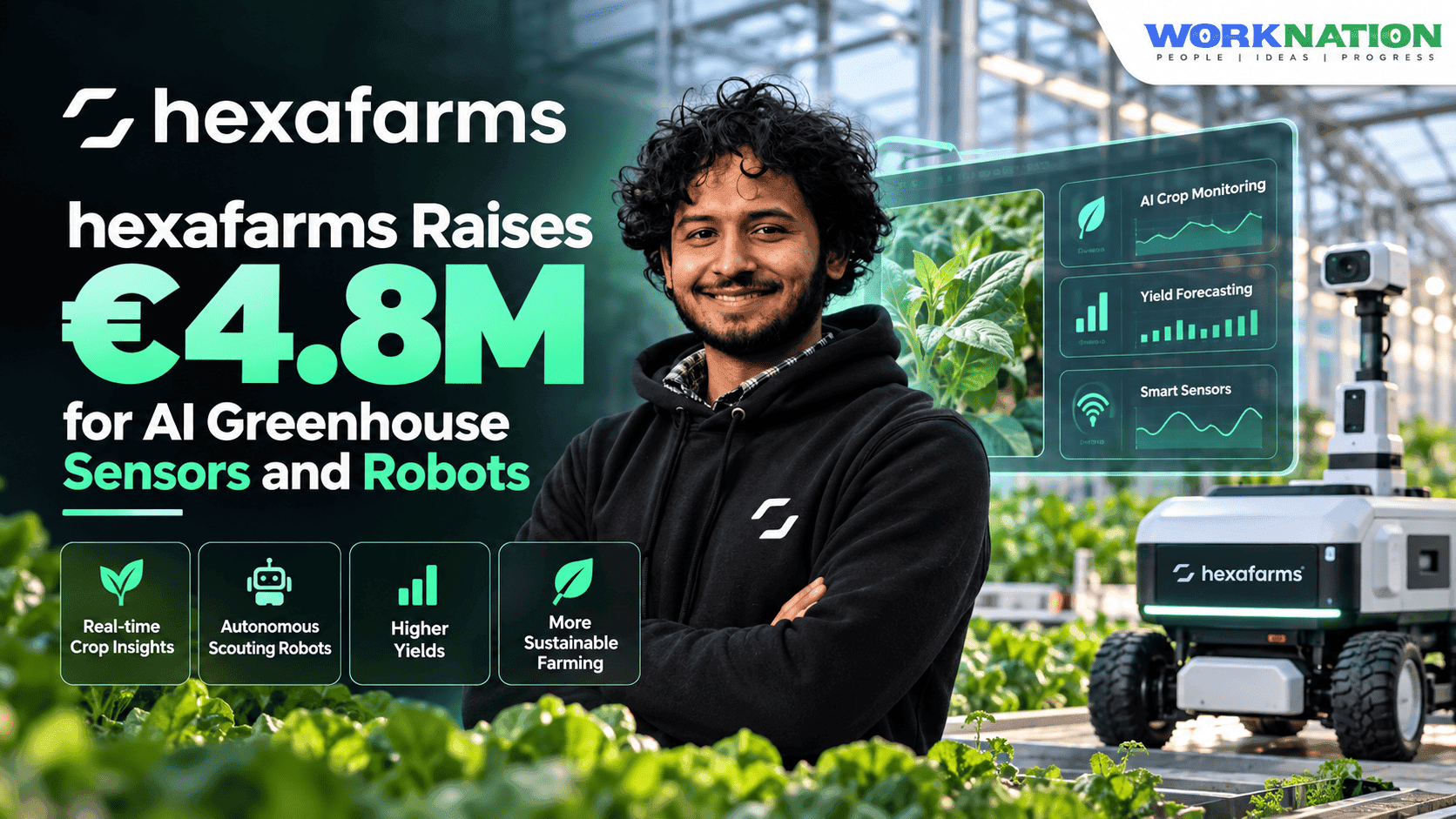
Berlin-based agtech startup hexafarms has raised €4.8 million in seed funding to expand its technology for commercial greenhouse and horticulture operations.
The company combines wireless crop sensors, AI-powered yield forecasting and scouting robots that inspect plants for early signs of pests and disease. Its subscription-based model allows growers to use the hardware and software without purchasing and owning the equipment themselves.
The seed round was led by Ananda Impact Ventures and Green Generation Fund, with participation from Grey Silo Ventures and better ventures. Existing investors Speedinvest, Mudcake and Techstars also participated.
hexafarms plans to use the funding to expand its wireless crop sensing and automated pest and disease scouting technology while growing across the DACH region, Benelux and Spain.
The company says more than 50 growers across 13 countries already use its technology, with customers managing more than €300 million worth of produce through the platform in 2026.
The problem hexafarms is trying to solve
Greenhouse farming is already highly automated compared with traditional agriculture, but growers still have to deal with uncertainty around crop conditions, yield forecasts, pests and disease.
hexafarms says its own analysis suggests greenhouse growers can leave up to 30% of potential yield unrealised.
Conditions inside a greenhouse can change gradually without immediately becoming visible. Temperature, humidity, irrigation, light, nutrients and substrate conditions can all affect crop performance.
Pests and diseases create another problem. By the time a problem becomes visible to workers walking through a greenhouse, the affected area may already be significant.
hexafarms is building technology designed to identify those changes earlier.
Its platform brings together data from wireless sensors, forecasting models and robots that scan plants directly.
The aim is to give growers a more complete view of what is happening inside a production environment and help them act before a problem affects harvest volumes.
From sensors to AI-powered scouting robots
hexafarms was founded in Berlin in 2021 by David Ahmed, Huijo Kim and Felix Kirschstein.
Ahmed serves as CEO and co-founder.
The company initially focused on software for greenhouses and vertical indoor farms. Since its €1.3 million pre-seed round in 2024, it has expanded its product into what it describes as an operating system for commercial horticulture.
Its wireless sensors collect data on climate, fertigation, substrate, drainage and light every five minutes.
The company's forecasting models use more than 70 parameters to generate rolling harvest forecasts for individual crops and production zones.
The hardware side of the platform includes robots that scan plants every day across two to three hectares. These robots look for early signs of pests and diseases.
The AI models currently cover around 50 cultivars, including tomatoes, peppers, cucumbers, aubergines and berries.
The combination of these data sources is one of hexafarms' main selling points.
A grower could, for example, identify a pest outbreak and then compare it with the climate and production history of the affected area.
That creates a link between what is happening to the plant and the environmental conditions surrounding it.
A subscription model for agricultural hardware
One of the more interesting parts of hexafarms' business model is that growers do not need to buy the hardware outright.
Instead, customers pay a subscription.
hexafarms designs, deploys and maintains the equipment while retaining ownership of the sensors and robots.
For growers, this changes the economics from a large upfront capital expenditure to an operating expense.
It also puts the hardware risk on hexafarms.
The company has to maintain the equipment, keep it working across different agricultural environments and make sure the recurring subscription remains valuable to customers.
The model could also make it easier for growers to adopt technology without committing significant capital to unfamiliar equipment.
hexafarms' platform works across greenhouses, foil tunnels and open-field production and can integrate with climate computers from providers including Priva, Hoogendoorn and Ridder.
More than 50 growers across 13 countries
hexafarms says more than 50 growers in 13 countries are already using its technology.
Customers include SanLucar and grower cooperatives Elo and Royal ZON.
According to hexafarms, customers managed more than €300 million worth of produce through the platform during 2026.
That gives the startup an early commercial base as it expands into additional European markets.
Max Seidl, head of go-to-market at hexafarms, said growers across the company's target markets are looking for answers to three basic questions: what is happening in the crop now, what will they likely harvest and where could they lose yield.
The company's expansion strategy is therefore focused on taking the technology already deployed with existing customers and introducing it to more growers.
The greenhouse technology market
The broader greenhouse market is expanding as growers look for ways to produce more food with limited land and greater control over growing conditions.
According to Grand View Research, the global greenhouse market was worth $32.8 billion in 2025 and is projected to reach $74.1 billion by 2033.
The smart greenhouse segment is smaller but growing faster. Grand View Research estimates it was worth $5.8 billion in 2025 and could reach $18 billion by 2033.
Europe is an important market for greenhouse technology, accounting for more than 31% of the overall greenhouse market in the cited research.
That gives hexafarms a sizeable addressable market as it expands across Germany, Austria, Switzerland, the Benelux region and Spain.
However, the company is entering a competitive market.
Competing with AI software and agricultural robots
Several agtech companies are approaching greenhouse automation from different directions.
Amsterdam-based Source.ag develops AI software for controlled-environment agriculture. The company raised $17.5 million in a Series B round in November 2025, bringing its total funding above $60 million, according to the source.
Source.ag's software is used across more than 300 greenhouses in 18 countries.
Spanish agtech company Grodi raised €2.5 million in February 2026 for VEGA 11, an autonomous robot designed to scan plants in Mediterranean greenhouses.
Cologne-based Eternal.ag raised €8 million in March 2026 to develop tomato-harvesting robots, targeting a different part of the greenhouse workflow.
In the US, Orchard Robotics raised $22 million in a Series A in September 2025 for AI-powered cameras used in orchards and vineyards.
hexafarms sits somewhere between the software and robotics categories.
It is not simply selling greenhouse management software, nor is it focused on a single autonomous farming task. Its system combines environmental sensing, crop forecasting and physical plant inspection.
That combination is central to the company's pitch to investors.
Why investors backed hexafarms
Ananda Impact Ventures and Green Generation Fund led the latest funding round.
Ananda is a Munich-based impact investor that focuses on businesses addressing environmental and social challenges. The firm closed a €73 million first close for its fifth fund in January 2026.
Bernd Klosterkemper, partner at Ananda, highlighted the combination of hardware and software in hexafarms' model.
According to Klosterkemper, many companies addressing food production focus on either hardware or software, while hexafarms combines both and connects its sensors, cameras and robots through the same models.
Green Generation Fund partner Peter Dorfner pointed to the company's physical AI approach.
Physical AI refers to AI systems that interact with the physical world through machines, sensors and robotics.
hexafarms already has more than 50 growers using its technology, giving the company a commercial base that can be tested as it expands.
Grey Silo Ventures, the corporate venture arm of Cereal Docks Group, also participated in the round.
Investment manager Matteo Leonardi said the firm looks for companies where it can contribute industrial expertise and partnerships alongside capital.
Agtech funding remains challenging
The new investment comes during a more difficult period for agricultural technology funding.
According to figures cited by the source, agrifood tech investment fell from $51.7 billion in 2021 to $16 billion in 2024.
That makes commercial traction increasingly important for startups raising capital.
hexafarms has both software and physical hardware to finance, which creates a different cost structure from software-only agtech companies.
The company's subscription model is intended to spread the cost of that hardware across recurring customer revenue.
The challenge is whether the data generated by each new greenhouse can create enough value to justify the cost of deploying and maintaining the physical equipment.
That is likely to be one of the most important tests for the company as it scales.
What comes next for hexafarms?
The €4.8 million seed round will fund expansion of wireless crop sensing, automated pest and disease scouting and the company's presence across several European markets.
The company is targeting the DACH region, Benelux and Spain.
Its existing base of more than 50 growers gives hexafarms a starting point, while the subscription model provides a way to sell the technology without requiring customers to purchase the hardware.
The next phase will test whether the model can scale beyond early adopters.
hexafarms needs to demonstrate that its sensors and robots can work reliably across different growing environments, that its AI models continue improving as more data is collected and that growers see enough value to maintain their subscriptions.
The company's core pitch is simple: identify what is happening inside a crop before the problem becomes visible and expensive.
If hexafarms can turn that promise into measurable improvements in yield, forecasting and crop protection, its combination of AI, sensors and robotics could become a useful layer of technology for commercial horticulture.
For now, the Berlin startup has raised €4.8 million to take that model into more greenhouses across Europe.
Have a Funding Round or Exciting Update to Share?
Submit your press release to get featured on WorkNation and reach founders, investors, and tech leaders.