Deepslate Raises €7.7M Seed to Build Europe's Speech-to-Speech AI Model
Top Picks
Submit PR
Stay Ahead of the Market
Get the latest startup funding, hiring trends and global opportunities delivered to your inbox every week.
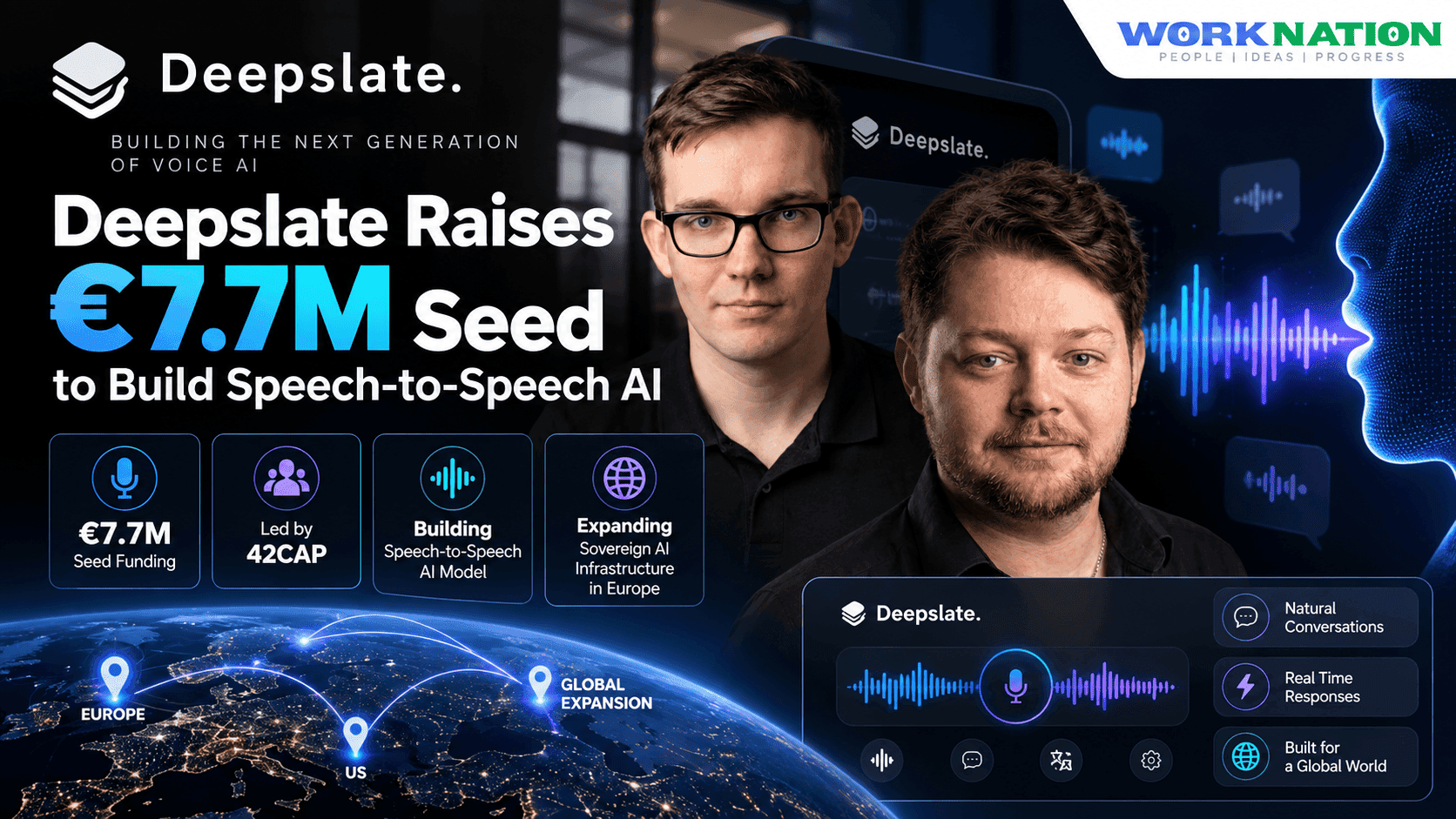
Berlin-based voice AI company Deepslate has raised €7.7 million in seed funding to develop its speech-to-speech AI technology and expand its presence in Europe.
The round was led by 42CAP, with Alstin Capital, SIVentures and several business angels also participating.
Founded in 2024, Deepslate is developing AI models that can understand and generate speech directly rather than converting speech into text before generating a response.
The company currently has 17 employees and runs its models on servers in Germany.
Building speech-to-speech AI
Most voice AI systems use a multi-stage process involving speech-to-text, a language model and text-to-speech.
Deepslate is taking a different technical approach.
Its models are designed to understand and generate speech directly without first converting the user's speech into text.
According to co-founder and CEO Paskal Paesler, traditional multi-stage systems can lose information such as sentiment, pronunciation, prosody and voice timbre as speech moves between different processing stages.
Deepslate's approach is built around a speech encoder, a reasoning core based on an open-weights language model and a speech decoder.
Trainable projectors connect these components.
The company says that if a better base model becomes available, it can retrain the projectors instead of rebuilding the entire system. Deepslate says this can reduce retraining time from months to days.
The company has not disclosed the base model it currently uses.
Opal and real-time voice interaction
Deepslate's speech-to-speech model is called Opal.
The company states that the system takes around 250 milliseconds from the end of a user's sentence to produce a reply.
Independent benchmarking company Artificial Analysis measured Opal's time to first audio at 0.44 seconds.
On the Big Bench Audio reasoning test, Deepslate says Opal achieves a score of around 85%.
The company also claims a strong CoVoST2 error rate, although the article notes that this claim is based on methodology published by Deepslate itself.
Deepslate describes Opal as the fastest speech-to-speech model in the world.
Competing in voice AI
Deepslate is entering a rapidly developing voice AI market that includes both specialised AI companies and large technology platforms.
According to Paesler, OpenAI, Google and Grok are among the company's main competitors because they have also introduced speech-to-speech models.
The broader voice AI landscape includes companies such as ElevenLabs, Gradium, Deepgram and Synthflow.
Deepslate's differentiation is its focus on a single model that processes audio directly rather than relying on a sequential speech-to-text, language-model and text-to-speech architecture.
Building European voice AI infrastructure
Data sovereignty is another important part of Deepslate's strategy.
The company runs its models through Deutsche Telekom's cloud infrastructure in Germany.
Customers can also deploy the model on their own infrastructure, including air-gapped environments, according to Deepslate.
The company has ISO 27001 certification.
This approach is designed for organisations such as insurers, banks and public authorities that may have requirements around where sensitive data is processed.
Deepslate is positioning local infrastructure and European hosting as part of its offering rather than treating them solely as deployment options.
From gaming infrastructure to voice AI
Deepslate's founders, Paskal Paesler and CTO Jan Brachthäuser, began programming at a young age and previously developed and operated large Minecraft servers in Europe.
Paesler later led a team of more than 10 people at Stromee.
The founders began working on Deepslate in 2024 after becoming interested in projection models and their potential for speech AI.
The company has since built its own speech-to-speech models with a relatively small team.
Early production use
Deepslate says insurers, contact centres and other platforms are already using its model in production.
The company has not publicly identified specific customers in the source.
Its ability to run models locally or in German cloud infrastructure is intended to make the technology suitable for organisations with data residency and security requirements.
The company says its model is the only European model represented in the benchmark it referenced, which includes six companies globally.
The next stage
The €7.7 million seed round will give Deepslate additional resources to continue developing its speech-to-speech models and expand its team.
The company's strategy is based on continuing to improve its models while using thin trainable layers on top of available open models, allowing it to adapt more quickly when better base models become available.
Its European positioning also gives the company a specific focus on data sovereignty, local deployment and real-time voice AI.
With 17 employees, production deployments and a speech-to-speech model that has recorded a 0.44-second time to first audio in Artificial Analysis' benchmark, Deepslate is now entering its next phase of development.
Have a Funding Round or Exciting Update to Share?
Submit your press release to get featured on WorkNation and reach founders, investors, and tech leaders.