Hadrian Raises $40M to Build an AI Hacker Watched by Another AI
Top Picks
Submit PR
Stay Ahead of the Market
Get the latest startup funding, hiring trends and global opportunities delivered to your inbox every week.
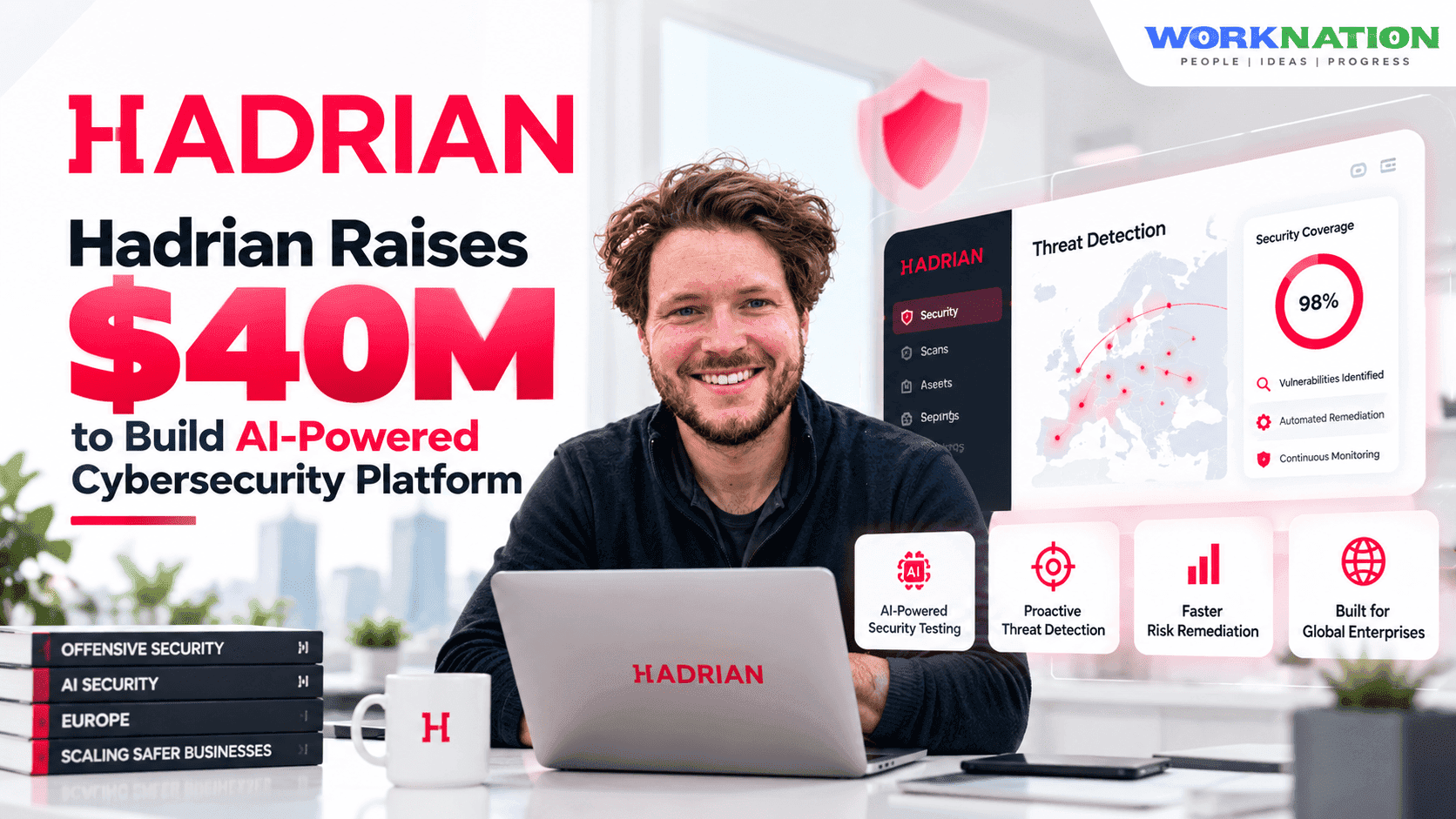
Amsterdam-based cybersecurity startup Hadrian has raised $40 million in new financing as it pushes further into autonomous offensive security, using AI agents to simulate how hackers could attack a company and a second AI agent to monitor those actions.
The round was led by Forgepoint Capital International and Smartfin, with participation from HV Capital, Motive Partners, Picus Capital, and Oetker Ventures. Hadrian says the new financing brings its total funding to $65 million.
The company plans to use most of the capital for research and development, while also putting a significant portion toward expanding its presence in the United States. Hadrian did not disclose its valuation or revenue.
Two teenagers who started by finding security flaws
Hadrian's story goes back well before the current wave of AI-powered cybersecurity startups.
Founders Rogier Fischer and Olivier Beg first connected through an online forum when they were both 13. Fischer started hacking at 12, while the pair later earned bug bounties by identifying security vulnerabilities in companies including PayPal, Yahoo, and major banks.
Fischer has said that they never carried out criminal activity and instead focused on identifying security weaknesses.
That experience eventually became the foundation for Hadrian.
The company was founded by Fischer, Beg, and Maurice Clin and began by trying to automate the type of offensive security work Fischer and Beg had performed manually as teenagers.
In November 2021, Hadrian secured a €2.5 million pre-seed round. At the time, Fischer described the company's goal as using language models to replicate real-world attacks and automate vulnerability management.
In June 2022, HV Capital led a €10.5 million seed round, bringing Hadrian's total funding at the time to $13.7 million.
The company has since grown to around 90 employees, with offices in Amsterdam, London, and New York.
An AI hacker with another AI watching it
Hadrian's current platform is built around two systems with different jobs.
Atlas determines what an attacker can observe about an organisation on the internet. The company's Nova system then performs AI-powered penetration tests when requested.
According to Fischer, Hadrian's platform now runs more than 100 million attack simulations each day.
The idea is to make offensive security continuous and scalable rather than relying entirely on human penetration-testing teams that conduct periodic assessments.
Hadrian says its platform emulates hacker attack paths, helping customers understand which vulnerabilities could actually be exploited and where security teams should focus their resources.
The company launched Nova on March 24.
But giving an AI the ability to behave like a hacker creates another problem: what happens when the AI itself makes a bad decision?
Hadrian's answer is another AI.
The company places strict limitations on its agents and has a second agent examine each action. The approach is designed to reduce the risk of an autonomous security agent going beyond the boundaries defined by the customer.
That architecture is becoming increasingly relevant as businesses experiment with AI agents that can independently interact with systems, execute tasks, and make decisions.
Enterprise customers are already using the platform
Hadrian's customer base includes large organisations such as McKesson, NBCUniversal, Francisco Partners, TotalEnergies, Amadeus, Leroy Merlin, and Damen Shipyards.
The company says its enterprise contract values are growing and points to its global customer base and enterprise retention as evidence of demand.
For Hadrian, the pitch is not simply that AI can find more vulnerabilities.
The larger argument is that AI can help security teams separate exploitable risks from the huge amount of vulnerability information that organisations receive every day.
Instead of asking security teams to manually investigate every potential weakness, Hadrian wants its AI agents to think through possible attack paths and identify the issues that deserve attention.
The competition is getting serious
Hadrian is entering a market where several cybersecurity startups have already attracted significant amounts of capital.
XBOW has raised $155 million across its reported rounds, including a $120 million financing at a valuation above $1 billion followed by a $35 million extension.
Horizon3 has secured $250 million at a valuation above $2 billion.
Armadin, meanwhile, raised $255.5 million on October 1 at a valuation above $2.5 billion.
Together, those three companies have raised more than $1.1 billion, compared with Hadrian's $65 million.
That difference highlights the challenge ahead.
Hadrian is not trying to compete solely on the amount of capital it can deploy. Fischer argues that the offensive-security market is consolidating as penetration testing, vulnerability management, and attack simulation increasingly move toward a single platform.
The company's latest funding gives it more room to develop that platform and expand internationally, particularly in the United States.
A broader shift in offensive cybersecurity
The rise of AI-powered offensive security reflects a simple problem: companies have more potential vulnerabilities than human security teams can investigate manually.
AI agents can run large numbers of simulations, test different attack paths, and repeat the process far more quickly than traditional manual assessments.
Hadrian is betting that this capability can become an always-on layer of enterprise security.
Its challenge is proving that the system can do this safely, accurately, and at a scale that justifies enterprise spending.
The company now has $65 million in total funding, around 90 employees, major enterprise customers, and a platform capable of running millions of attack simulations.
The next stage will be about execution.
Hadrian needs to turn that technical advantage into sustained enterprise growth while competing against better-funded companies such as XBOW, Horizon3, and Armadin.
If its approach works, the interesting part may not be that one AI can hack like a human.
It may be that another AI can watch the hacker, decide whether its actions are safe, and keep the entire process running continuously.
Have a Funding Round or Exciting Update to Share?
Submit your press release to get featured on WorkNation and reach founders, investors, and tech leaders.