NOX Energy Raises €3M to Build Europe’s Energy Flexibility Infrastructure
Top Picks
Submit PR
Stay Ahead of the Market
Get the latest startup funding, hiring trends and global opportunities delivered to your inbox every week.
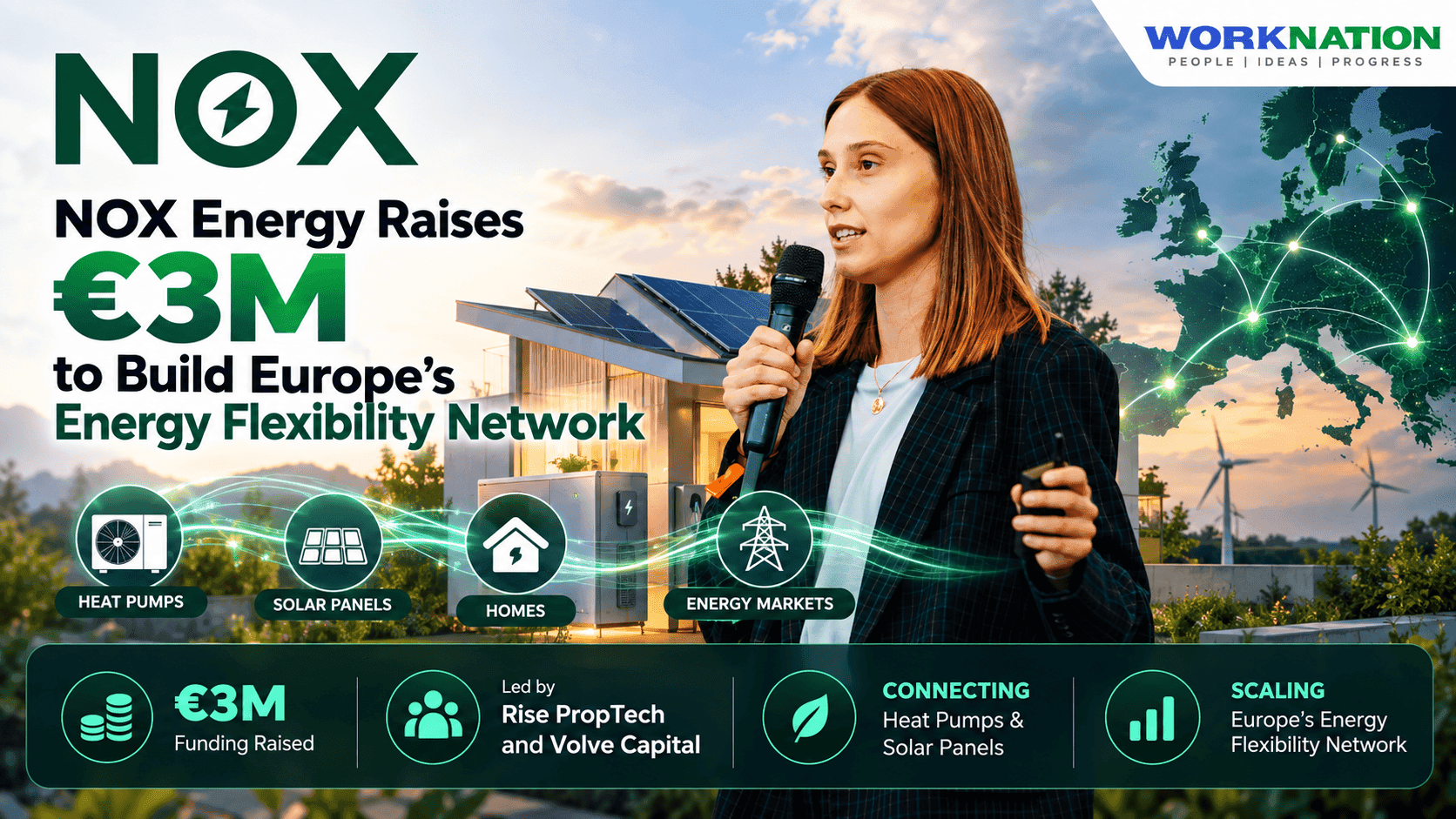
Belgian energy technology startup NOX Energy has raised €3 million in seed funding to build infrastructure connecting household energy devices such as heat pumps and solar panels with European electricity markets.
The round was co-led by Rise PropTech and Volve Capital, with participation from Seeder Fund, Uneti Ventures, Fair Capital Impact Fund and 100in.
Founded in 2024 by Axelle Moortgat, Louis Clermont and Martin Michaux, NOX is positioning itself as an infrastructure layer between energy suppliers, grid operators, device manufacturers and households.
The company's ambition is straightforward but large: make household energy flexibility easier to access across different manufacturers and European energy markets.
Building a "SWIFT for Energy Flexibility"
NOX Energy describes its ambition using an unusual comparison.
The company wants to become the "SWIFT" of energy flexibility.
SWIFT provides infrastructure that allows financial institutions to communicate and move information across different banking systems. NOX wants to play a similar connecting role for flexible energy assets in homes.
Millions of European households already have devices such as heat pumps, solar panels and batteries connected to manufacturer or energy-provider applications.
However, those devices and the markets they operate in do not necessarily use the same systems.
That creates a challenge for energy suppliers and grid operators looking to access the flexibility available in residential energy assets.
NOX aims to sit between these different parties.
Its software connects household devices through existing manufacturer or energy-supplier applications and determines when equipment should operate based on electricity prices and grid conditions.
The company says its goal is for every kilowatt-hour of flexibility in Europe to eventually be able to run through its infrastructure.
Turning Heat Pumps Into Flexible Energy Assets
Heat pumps are central to NOX's current strategy.
A heat pump does not necessarily need to operate at exactly the same intensity throughout the day. If electricity is inexpensive or more renewable power is available, the system can run more intensively and pre-heat a home.
When electricity becomes more expensive or scarce, the heat pump can reduce its activity.
For the household, the change can potentially happen without a noticeable impact on comfort.
For the electricity system, however, thousands or millions of flexible devices can collectively provide a significant amount of controllable demand.
NOX's software forecasts a heat pump's expected consumption for the following 24 hours and determines when the device should operate.
The company connects to devices through existing manufacturer or energy-supplier applications rather than requiring households to install additional hardware.
This is intended to make the system easier to deploy across existing residential energy infrastructure.
Sharing the Value of Flexibility
The flexibility generated by household devices has value to electricity markets and grid operators.
NOX's model is to help capture that value and share part of the resulting revenue with manufacturers and households.
The company says households can achieve savings of up to 28% and earn up to €200 per year through its platform, although these figures are company claims and can depend on individual circumstances and market conditions.
The company currently has live integrations covering heat pumps and solar panels.
These include integrations involving DeWarmte, NextEnergy, Frank Energie's smart heating and solar steering services, and NIBE Group brands through the myUplink platform.
More Renewable Power Creates More Flexibility Demand
The broader energy transition is creating the market opportunity NOX is targeting.
Wind and solar accounted for 30% of electricity generation in the European Union in 2025, according to figures cited from energy think tank Ember, exceeding fossil fuels at 29% for the first time.
Renewable generation can vary depending on weather conditions.
That means the electricity system increasingly needs ways to adjust demand alongside changes in supply.
Household devices can potentially provide part of that flexibility.
A heat pump, battery or electric vehicle can consume electricity at different times without necessarily changing the total amount of energy a household ultimately needs.
Aggregated across thousands of homes, those small adjustments can become a larger flexible resource.
This is the market NOX is attempting to build around.
From a Solar Marketplace Idea to Energy Infrastructure
NOX's origins came from an earlier idea developed by co-founder and CEO Axelle Moortgat.
Before starting the company, Moortgat tested a platform that allowed Belgian households to sell surplus solar power to their neighbours.
According to the source, energy suppliers were not enthusiastic about that approach because suppliers can face penalties when their electricity portfolios fall out of balance.
Moortgat subsequently shifted toward working with energy suppliers rather than operating around them.
That became the foundation for NOX Energy.
Moortgat founded the company with COO Louis Clermont and Martin Michaux in 2024.
The company initially operated as a Belgian-American startup and participated in the Entrepreneurs Roundtable Accelerator in New York.
It raised approximately $1 million in December 2024 from Volve Capital, Seeder and angel investors.
The latest financing brings NOX's disclosed funding to close to €4 million, according to the source's calculation.
Competition Is Already Building
NOX is entering a European market where several companies are attempting to aggregate flexible residential energy assets.
London-based Axle Energy is one of the larger players mentioned in the source. The company says it manages more than 300,000 devices representing more than two gigawatts of flexible capacity.
That is significantly larger than NOX's current network of more than 10,000 connected devices.
Germany's 1KOMMA5° has also invested heavily in energy software and operates its Heartbeat AI virtual power plant, which the source says reportedly controls more than 500 megawatts.
Berlin-based Nomos raised €20 million from Index Ventures in September 2026 to connect home batteries, electric vehicles and heat pumps to Germany's electricity market as a licensed supplier operating behind installers' brands.
NOX takes a different approach by remaining inside the applications operated by its partners.
Belgian company LIFEPOWR is another competitor in the broader market and has more than 22,000 connected assets after raising €5.65 million in November 2025.
These companies demonstrate both the opportunity and competitive pressure surrounding household energy flexibility.
A Focused Strategy
NOX's differentiation is primarily its focus.
Rather than attempting to cover every type of flexible energy asset and every market immediately, the company is concentrating on heat pumps and supplier applications, particularly in Belgium and the Netherlands.
That narrow focus could allow NOX to build deeper integrations with manufacturers and energy suppliers.
At the same time, the approach creates a scaling challenge.
The company's ambition requires manufacturers and energy suppliers to integrate with its infrastructure and continue using it as the market develops.
That means NOX has to build relationships across a fragmented ecosystem where individual companies could alternatively develop their own systems or choose competing platforms.
Where the €3M Will Go
The new €3 million will support NOX's expansion beyond Belgium and the Netherlands.
The company also plans to invest in integrating its optimisation technology more directly into manufacturers' and energy suppliers' existing applications.
The team currently consists of 13 people.
As NOX expands geographically and adds more integrations, its ability to connect a growing number of devices could become a key measure of its progress.
The company already counts Eneco and Frank Energie among its customers and says it has connected more than 10,000 devices.
The Road Ahead
NOX Energy is trying to solve a coordination problem created by the growing number of smart energy devices in European homes.
Heat pumps, solar panels and batteries can potentially provide flexibility to electricity markets, but accessing that flexibility requires connections between households, manufacturers, suppliers and grid operators.
NOX wants to provide that connecting layer.
The "SWIFT for energy" comparison captures the scale of the ambition, but it also highlights the challenge. SWIFT became powerful because financial institutions adopted common infrastructure and standards.
NOX faces a similarly fragmented energy ecosystem, with manufacturers, suppliers and markets using different systems and competing platforms offering alternative approaches.
With more than 10,000 devices connected, a 13-person team and close to €4 million in disclosed funding, the company is still at an early stage.
Its next challenge is to expand beyond its initial markets and turn its infrastructure into a widely adopted layer for European residential energy flexibility.
Have a Funding Round or Exciting Update to Share?
Submit your press release to get featured on WorkNation and reach founders, investors, and tech leaders.