Reco Raises $55M to Secure the Growing AI Agent Ecosystem
Top Picks
Submit PR
Stay Ahead of the Market
Get the latest startup funding, hiring trends and global opportunities delivered to your inbox every week.
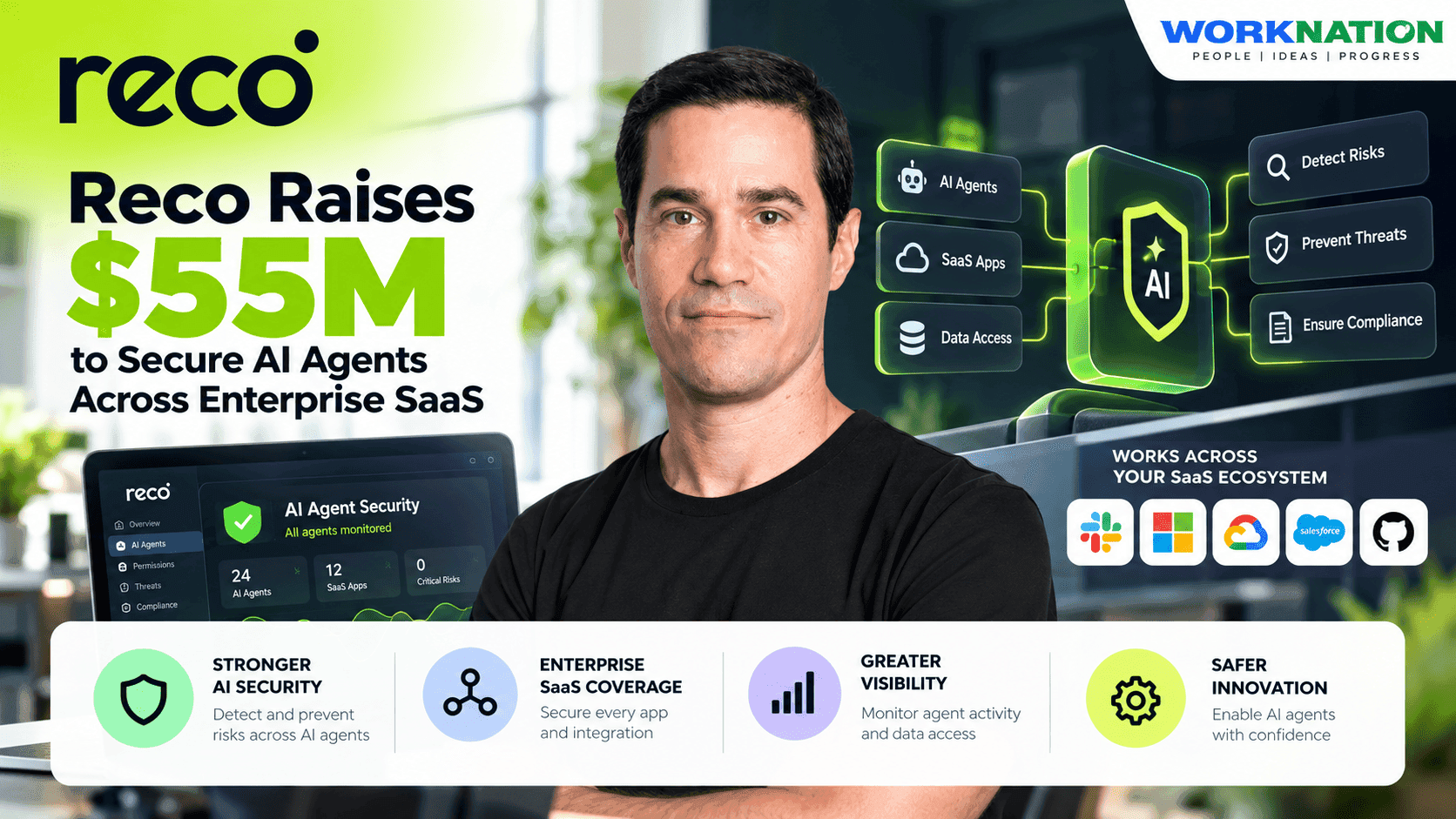
Reco, an AI security startup focused on helping enterprises discover and secure SaaS applications and AI agents, has raised $55 million in new funding as companies accelerate their adoption of autonomous AI systems.
The new financing follows Reco's $30 million Series B announced in February 2026 and brings the company's total capital raised to $140 million. AT&T, through its venture arm, participated in the latest financing alongside Forestay and Quadrille Capital.
Reco's latest round comes amid growing concerns around "AI sprawl" - the rapid proliferation of AI agents across enterprise networks, applications and workflows.
As companies deploy increasing numbers of agents, security teams face a new challenge: understanding which agents exist, what systems they can access, which permissions they hold and whether those permissions are appropriate.
Reco is expanding its platform to address that problem through a context graph that connects AI agents with applications, people, accounts and permissions.
The new AI agent security problem
Enterprise AI adoption is creating a rapidly expanding security environment.
Companies are deploying AI agents to perform tasks across software systems, retrieve information, interact with applications and execute workflows. While these capabilities can increase automation, they also create additional access points into corporate systems.
Security teams therefore need to understand not just the security of individual AI models, but the broader ecosystem surrounding them.
That includes the applications agents use, the accounts they operate through, the people who created them and the data they can access.
Reco says this broader view is becoming increasingly important as organizations deploy agents faster than security teams can inventory them.
According to Reco co-founder and CEO Ofer Klein, one Fortune 100 customer used the company's platform to identify 21,000 AI agents that the organization was previously unaware of.
At a large financial services customer, Reco said it identified an agent created by a former employee that could access Salesforce and share information with a domain the company could not see.
These examples illustrate the challenge enterprises face when AI agents can inherit or maintain access to systems beyond what security teams realize.
From SaaS security to AI agent security
Reco was originally focused primarily on mapping and securing SaaS and AI platforms.
The company's latest strategy expands that focus toward AI agents and the relationships between agents, applications and users.
Its platform uses a context graph to connect these different elements.
Security teams can use that information to understand what an agent can reach and identify access that may no longer be necessary.
The approach is designed to provide visibility across the enterprise rather than examining an AI agent in isolation.
Reco says its platform can also identify agents operating outside applications with which it directly integrates.
The company uses browser and network signals to find these agents and has controls that allow security teams to inspect prompts and tool calls.
That gives Reco a position between traditional SaaS security and the emerging category of AI agent security.
A crowded AI security market
Reco is entering a rapidly expanding market.
Dozens of companies are now developing products aimed at securing AI agents.
The products differ, but many focus on similar enterprise security challenges, including discovering agents, monitoring their activity, governing access and controlling which tools or data agents can reach.
Some companies focus on vetting the tools and skills agents use.
Others concentrate on controlling access to enterprise data, monitoring agents at runtime or detecting unauthorized AI deployments.
CrowdStrike, for example, has introduced controls focused on AI agent security on the devices where agents operate.
Other security companies are addressing unauthorized AI usage and governance.
This creates a competitive environment in which security vendors are attempting to establish themselves as the layer enterprises will use to manage increasingly complex AI deployments.
Reco's strategy is to differentiate through its existing coverage of SaaS applications and its ability to connect agents with the broader enterprise environment.
More than 280 application integrations
Reco currently integrates with more than 280 applications.
Klein said new integrations can be added within days, allowing the company to expand the range of software environments it can monitor.
The existing SaaS security footprint gives Reco a foundation for its AI agent strategy.
As SaaS applications increasingly introduce their own AI agents and agentic functionality, Reco can potentially extend its existing visibility into those systems.
The company is also attempting to identify agents that operate outside directly connected applications.
Browser and network signals can help discover activity that might otherwise remain invisible to security teams.
Reco also provides controls for inspecting prompts and tool calls, giving organizations additional information about how agents interact with systems.
Growing customer base and revenue
Reco currently has more than 100 customers.
Financial services companies represent approximately 40% of its business, making regulated organizations an important part of its customer base.
The company said its annual recurring revenue is currently in the double-digit millions of dollars and expects revenue to triple during 2026.
Klein also said Reco's valuation has more than doubled since the company's Series B was announced in February.
He described the valuation as being in the high hundreds of millions of dollars but did not provide a specific figure.
The company now has $140 million in total capital raised.
The latest financing gives Reco additional resources to expand its workforce, sales operations, partnerships and customer support.
Investors are betting on agent security
The financing reflects growing investor interest in security products built around enterprise AI adoption.
AT&T, a Reco customer, participated in the extension through its venture arm.
Forestay and Quadrille Capital also joined the round.
The investment follows Reco's $30 million Series B earlier in 2026.
For investors and enterprise customers, the rapid expansion of AI agents creates a new category of security requirements.
Traditional identity and access management systems can show which employees and applications have permissions, but AI agents can introduce another layer of identities and automated actions.
An agent may operate through an employee's account, interact with multiple applications and access data based on permissions inherited from connected systems.
That makes visibility into the relationships between people, accounts, applications and agents increasingly important.
AI agent sprawl creates a new security layer
Reco's expansion reflects a broader shift in enterprise cybersecurity.
The question for security teams is no longer only whether an organization has approved an AI model.
It is also whether the organization knows which AI agents are operating across its environment, what they can access and what actions they can perform.
The scale of the problem can be substantial.
Reco's discovery of 21,000 previously unknown agents at one Fortune 100 customer illustrates how quickly agent deployments can outpace traditional inventory processes.
Other companies are reporting similar concerns. Cymphony said it found around 85,000 files that had become accessible to AI tools and agents at one U.S. public company.
HiddenLayer has also highlighted the increasing number of enterprise customers deploying AI agents into production environments involving critical systems and sensitive assets.
These developments are creating demand for tools that can provide visibility and governance across agent ecosystems.
Reco's next phase
Reco plans to use its $55 million financing to expand hiring, sales, partnerships and customer support.
Its strategy is to build on the company's existing SaaS security capabilities while extending them into the rapidly emerging AI agent security market.
The company now has more than 100 customers, integrations with more than 280 applications and a platform designed to map relationships between agents, applications, people, accounts and permissions.
As enterprise AI adoption accelerates, security teams will have to manage not only traditional software and human identities, but also growing networks of autonomous agents.
Reco is betting that its existing visibility across SaaS environments can provide a foundation for that new security layer.
Have a Funding Round or Exciting Update to Share?
Submit your press release to get featured on WorkNation and reach founders, investors, and tech leaders.