Atomic Raises $12.5M Series A to Let AI Execute Company Purchasing
Top Picks
Submit PR
Stay Ahead of the Market
Get the latest startup funding, hiring trends and global opportunities delivered to your inbox every week.
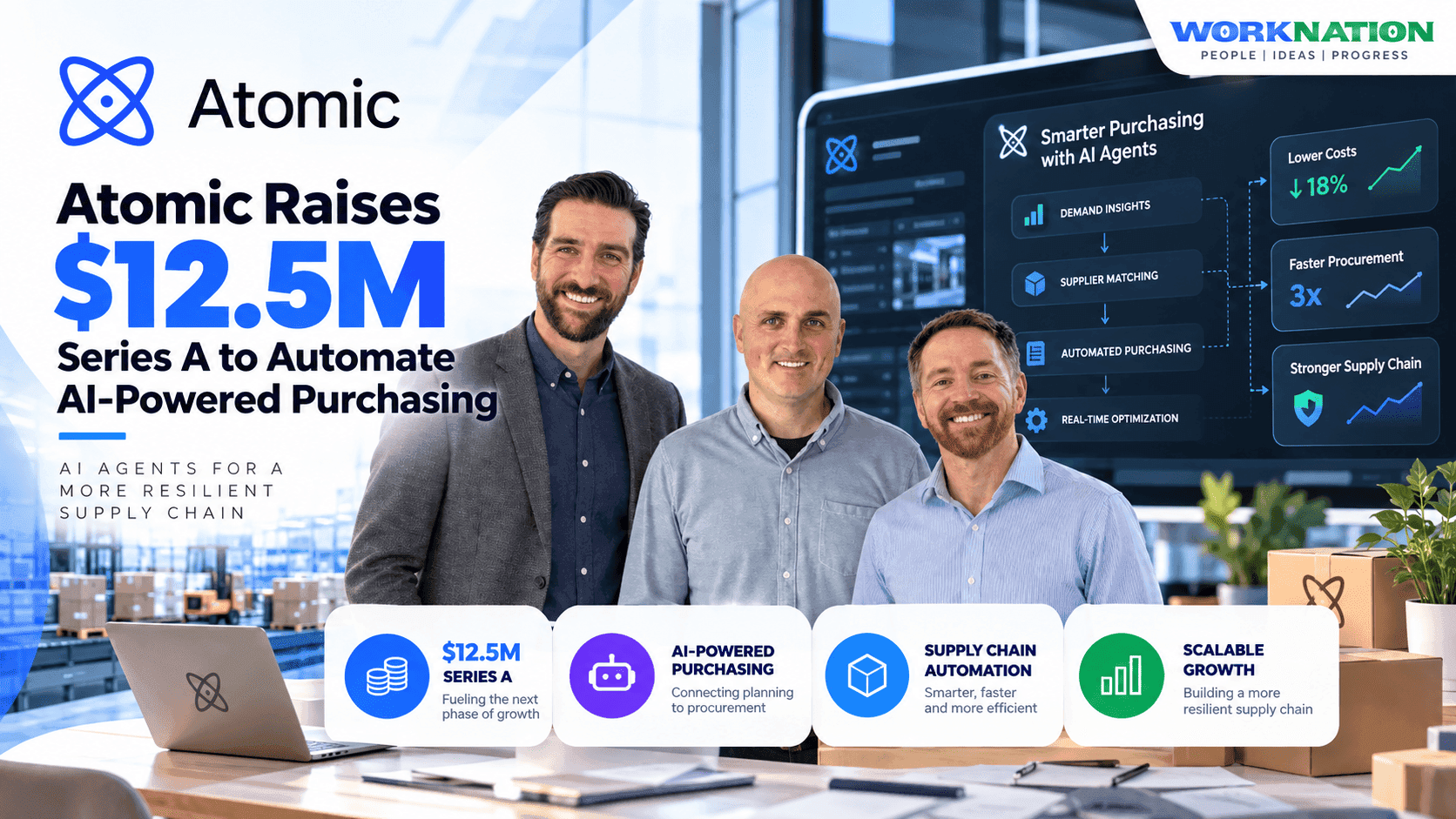
Boston-based supply chain software company Atomic has raised $12.5 million in Series A funding to expand its AI-powered platform from planning and decision support into automated purchasing.
The round was led by Klass Capital and Madrona Venture Group, with Adrian Schauer of Klass Capital and Matt McIlwain of Madrona joining Atomic's board. Alumni Ventures, Sandberg Bernthal Venture Partners and DVx Ventures are also investors in the company.
Atomic was founded by Michael Rossiter, Neal Suidan and Jeff Goodrich, three former Tesla planning leaders who worked on sales and operations planning during the company's Model 3 ramp-up.
The founders are applying lessons from Tesla's internal planning infrastructure to companies that do not have the resources to build large planning engineering teams themselves.
Atomic says its AI is already automating 90% of purchasing across hundreds of DoorDash DashMart locations.
From Tesla planning to an AI purchasing system
Atomic's founders bring experience from one of the world's most complex manufacturing and supply chain environments.
Michael Rossiter, Neal Suidan and Jeff Goodrich previously led sales and operations planning at Tesla during the Model 3 production ramp.
The team built a 50-person planning engineering organization at Tesla, developing systems that connected operational planning with the company's broader business objectives.
After leaving Tesla, the founders saw an opportunity to package similar capabilities for other businesses.
Atomic was incubated at DVx Ventures, the venture firm founded by former Tesla President Jon McNeill, who had worked alongside the team at Tesla.
The company's premise is that most physical goods businesses cannot justify building the kind of specialized planning organization Tesla developed internally.
Instead, many companies continue to operate critical supply chain processes through legacy software, spreadsheets and manual decision-making.
Atomic is attempting to turn those planning capabilities into software.
Moving from planning to execution
Atomic's platform provides planning teams with a product-level model of their business.
The system can generate recommendations and explain the reasoning behind those recommendations. As customers become more comfortable with the system, AI agents can take on additional tasks.
The company's latest direction is to move beyond recommendations toward what it describes as a "control system."
The idea is to connect a company's business objectives directly to the purchasing decisions it makes every day.
That means the software is not simply telling a planner what should happen. It can increasingly execute the resulting decisions by placing orders.
For example, a company can improve the logic it uses to select suppliers and then apply that updated logic directly to daily purchasing activity.
This creates a feedback loop between planning and execution.
Instead of a planner receiving a recommendation, manually translating it into an order and then entering that order into an ERP system, Atomic is working toward automating more of the process.
AI agents for supply chain operations
Atomic's AI agent platform, Nucleus, is already being used for sales and operations planning preparation, inventory questions and supply-risk checks.
The company says customers can deploy its S&OP layer in approximately 30 days using data they already have.
The software operates alongside an existing enterprise resource planning system rather than requiring customers to replace their existing ERP infrastructure.
This is important for large businesses where replacing core enterprise software can take years and involve significant operational disruption.
Atomic instead aims to sit on top of existing systems and provide an intelligent layer for planning and execution.
The company says its agents can increasingly handle the operational work that follows from a planning decision.
90% of DashMart purchasing automated
One of Atomic's most significant disclosed customer deployments is with DoorDash's DashMart business.
Atomic says its AI now automates 90% of purchasing across hundreds of DashMart sites.
The company said DashMart moved from a legacy software-as-a-service vendor to Atomic in approximately three months.
Atomic also described an example where its team used the platform's AI to develop new logic for selecting primary and backup suppliers.
According to the company, the new logic was created in roughly one hour and then applied across daily purchases.
The change shifted more purchasing volume toward primary suppliers and improved gross margins, according to Atomic.
The company did not disclose the customer-specific financial improvement.
Good Chop reduced inventory
Atomic also highlighted results from Good Chop, the meat-box subscription business operated by HelloFresh.
According to Atomic, Good Chop reduced inventory on hand from eight or nine weeks to approximately four weeks.
At the same time, the business more than doubled revenue while expanding its distribution network and product range.
The example illustrates the type of problem Atomic is targeting.
Holding excessive inventory ties up capital and increases storage requirements, while holding too little can result in stockouts and lost sales.
Planning systems attempt to balance those competing requirements.
Atomic's approach is to allow AI agents to participate more directly in those decisions.
A crowded supply chain AI market
Atomic is entering a rapidly developing market for AI-powered supply chain and procurement software.
Several other startups are attempting to automate different parts of supply chain decision-making.
Lyric has raised $43.5 million for AI decision products across supply chains, while Freehand has raised $75 million to develop agents for supply chain spending at companies including Meta and Unilever.
In procurement specifically, Didero has raised $30 million and Magentic has raised $18 million for AI agent-based purchasing workflows.
Pelico has raised $40 million for technology focused on reducing factory delays.
Traditional enterprise software companies are also expanding their capabilities. Kinaxis acquired MPO in a $45 million deal aimed at real-time order execution, while Doss raised $55 million for AI-powered inventory management designed to connect with ERP systems.
The broader market therefore includes both startups and established enterprise software providers.
Atomic's position in the market
Atomic's differentiation is its attempt to connect planning logic directly to purchasing execution.
Many supply chain systems provide recommendations that still require a human to translate the recommendation into an operational action.
Other procurement systems focus primarily on the purchasing process itself.
Atomic is attempting to connect the two.
The company's platform begins with the business objectives and planning decisions, then increasingly allows AI agents to execute those decisions.
This could create a more autonomous supply chain workflow in which humans define objectives and oversee decisions while AI handles repetitive operational execution.
The company says this progression is based on building trust with customers. As teams become comfortable with the system's recommendations, agents can be given responsibility for additional decisions.
$12.5M Series A and a larger filing
The announced Series A totals $12.5 million and was led by Klass Capital and Madrona Venture Group.
Adrian Schauer of Klass Capital and Matt McIlwain of Madrona joined Atomic's board.
Jon McNeill, who founded DVx Ventures and previously worked with the Atomic founders at Tesla, is also involved with the company.
An SEC filing referenced in the source indicates that $18.5 million in securities were sold, approximately $6 million more than the Series A amount publicly announced by Atomic.
The difference between the announced round and the regulatory filing is therefore a point investors may continue to examine.
A large supply chain opportunity
The opportunity Atomic is targeting extends across companies that manufacture, distribute or sell physical goods.
Supply chain planning involves forecasting demand, managing inventory, selecting suppliers and determining when and how much to purchase.
The software market supporting these activities is already substantial.
Technavio expects the broader supply chain management software market to grow by $29.6 billion between 2025 and 2030, representing a 15.2% compound annual growth rate. The planning segment was valued at $9.26 billion in 2024, according to the market data cited in the source.
For Atomic, the opportunity is to capture part of this market by making planning systems increasingly autonomous.
From recommendations to autonomous purchasing
Atomic's Series A gives the company additional resources to develop its AI agents and expand its customer base.
The company's current focus is moving from planning and decision support toward direct execution.
Its deployments at DoorDash's DashMart and Good Chop provide early examples of how the platform is being applied to real-world purchasing and inventory decisions.
The next stage will involve determining how much responsibility companies are willing to give AI agents over increasingly important supply chain decisions.
For Atomic, the core proposition is that AI can take the planning infrastructure once built internally by companies such as Tesla and turn it into a product that other businesses can deploy alongside their existing systems.
Have a Funding Round or Exciting Update to Share?
Submit your press release to get featured on WorkNation and reach founders, investors, and tech leaders.