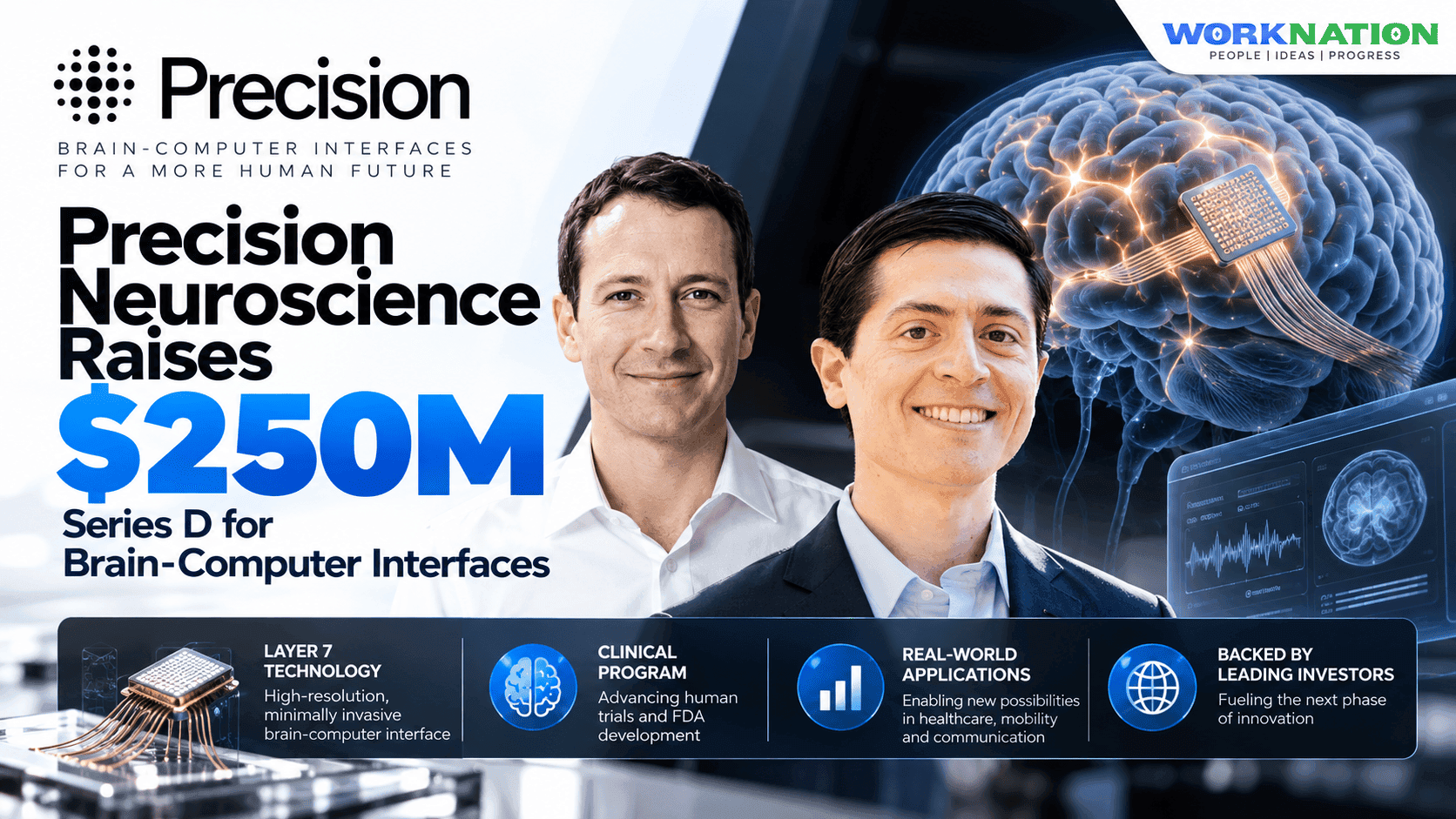
Precision Neuroscience Raises $250M Series D to Advance Brain-Computer Interfaces
Top Picks
Submit PR
Stay Ahead of the Market
Get the latest startup funding, hiring trends and global opportunities delivered to your inbox every week.
Precision Neuroscience, a New York-based medical device company developing brain-computer interfaces (BCIs), has raised $250 million in an oversubscribed Series D round to advance its brain-interface technology, expand clinical development and build out commercial infrastructure.
The round was co-led by Pershing Square Inc., founded by investor Bill Ackman, the Ackman Oxman Institute, and an undisclosed life sciences fund. The financing brings Precision's total funding since its launch in 2021 to $430 million.
The latest investment values the company at just over $1 billion, according to the source.
Precision is developing a brain-computer interface designed to record neural signals without penetrating brain tissue. Its flagship Layer 7 Cortical Interface sits on the surface of the brain, offering the company a different approach from implants that place electrodes directly into the cortex.
A less invasive approach to brain-computer interfaces
Precision Neuroscience was founded in 2021 by Michael Mager and Benjamin Rapoport.
Mager is the company's co-founder and CEO, while Rapoport is a neurosurgeon who previously spent a year on Neuralink's founding team before leaving to develop a different approach to brain-computer interfaces.
The company's core technology is the Layer 7 Cortical Interface.
Rather than inserting electrodes into brain tissue, Layer 7 is designed as an extremely thin film that rests on the brain's surface.
The device is inserted through a slit in the skull that is less than one millimetre wide, according to the source.
This design is intended to reduce the invasiveness associated with traditional intracortical brain implants while still allowing the system to capture neural signals.
Precision describes the implant as reversible, and the device currently has FDA clearance for use for up to 30 days.
The company says it has now conducted more than 100 procedures across 18 medical institutions.
Those institutions include Mount Sinai and Penn Medicine.
From research to clinical development
The latest funding marks another step in Precision's transition from a medical-device startup developing experimental technology toward a company building a broader clinical and commercial infrastructure.
CEO Michael Mager said the next phase of BCI development would require more than the underlying technology, pointing to the company's clinical network, regulatory position and manufacturing capabilities.
The company has already established a clinical footprint through more than 100 procedures.
The experience generated through these procedures can help Precision continue evaluating its interface and advancing its regulatory program.
The new capital will support that work, including additional clinical programs and further FDA review of Layer 7.
Competing approaches to reading the brain
Precision operates in a rapidly developing BCI market where companies are pursuing different approaches to connecting computers with neural activity.
Neuralink, founded by Elon Musk, uses electrodes implanted directly into brain tissue.
Synchron has taken another route with its Stentrode system, which is inserted through a blood vessel rather than requiring an incision directly into the skull.
Science Corporation, another company founded by a former Neuralink employee, is developing a retinal implant designed to restore vision rather than directly targeting the same brain-interface application.
Precision positions its technology between these approaches.
Its surface-based interface is designed to be less invasive than an implant that penetrates brain tissue while providing higher-resolution access to neural signals than some approaches that reach the brain through blood vessels.
The company is also developing its manufacturing capabilities as it works toward broader commercial applications.
Medtronic partnership and Texas manufacturing
Precision has partnered with Medtronic as it develops its technology toward commercial applications.
The company also operates its own microelectronics manufacturing facility in Texas.
That infrastructure could become important as Precision moves from individual clinical procedures toward larger-scale production.
Medical devices that require implantation must meet demanding manufacturing and regulatory requirements, meaning the transition from a successful prototype to a commercial product involves considerably more than demonstrating that the technology works.
Precision's latest funding gives the company capital to continue building those capabilities while advancing its clinical and regulatory programs.
$250M round backed by major investors
The Series D attracted a broad group of investors.
In addition to Pershing Square and the Ackman Oxman Institute, the round included Duquesne Family Office, ARK Invest, B Capital, Invus, Mubadala Capital, Mirae Asset Capital, Korea Investment Partners, Hitachi Ventures and JSL Health Capital.
The Ackman Oxman Institute is making its first investment in Precision through the round.
Pershing Square and the Institute together contributed $42.5 million to the financing, according to the source.
The investment brings Precision's total capital raised to $430 million since the company was launched in 2021.
Funding clinical and commercial expansion
Precision plans to use the new capital to expand its clinical program, continue advancing Layer 7 through the FDA process and build out commercial infrastructure.
The company is also working toward broader applications for brain-computer interfaces.
BCIs have historically been associated with research into restoring communication or movement for people with neurological injuries and other conditions affecting the nervous system.
Precision's technology is being developed within that broader effort to translate neural signals into useful digital commands.
The company's approach depends on finding a balance between signal quality, invasiveness, reliability, regulatory requirements and long-term usability.
The long-term BCI challenge
The latest funding does not resolve the biggest long-term questions facing the BCI industry.
Precision's current FDA clearance permits Layer 7 to be used for up to 30 days. Moving from temporary clinical use toward a permanent, fully implantable device would require additional regulatory and technical development.
The source notes that Mager has said such a development could take years.
That makes the current stage of Precision's development significant: the company is building clinical evidence, regulatory experience and manufacturing capacity while continuing to develop its core brain-interface technology.
With $250 million in new capital and $430 million raised in total, Precision now has additional resources to advance those efforts.
The broader BCI industry is also attracting substantial investment as companies pursue different methods of connecting computing systems with the human nervous system.
For Precision, the central proposition remains its surface-based Layer 7 interface - an attempt to capture neural signals while avoiding direct penetration of brain tissue.
The next phase will depend on clinical results, regulatory progress, manufacturing scale and the company's ability to turn its technology into a practical medical device.
Have a Funding Round or Exciting Update to Share?
Submit your press release to get featured on WorkNation and reach founders, investors, and tech leaders.