Rayon Raises €10M Series A to Bring AI and 3D to Interior Design
Top Picks
Submit PR
Stay Ahead of the Market
Get the latest startup funding, hiring trends and global opportunities delivered to your inbox every week.
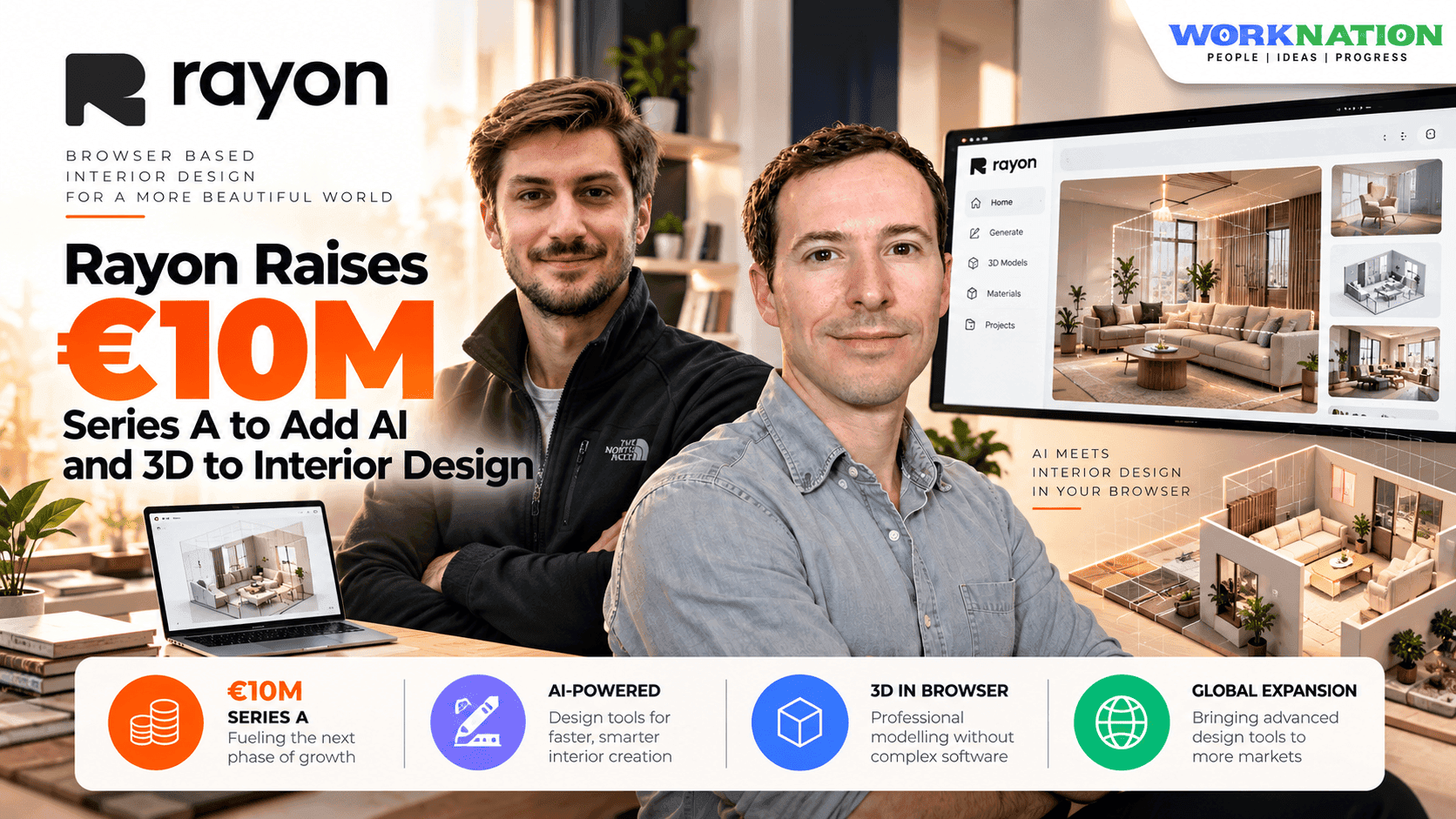
Paris-based design software company Rayon has raised €10 million in Series A funding to expand its browser-based platform for interior and experiential design with artificial intelligence and 3D modelling capabilities.
The Series A was led by Partech, with continued participation from Northzone, Foundamental and Seedcamp. The latest financing brings Rayon's total funding to nearly €16 million.
Founded in Paris in 2021 by Stanislas Chaillou and Bastien Dolla, Rayon is building a browser-based alternative to traditional architecture and design software. The company focuses specifically on interior fit-outs, retail build-outs and home renovations, areas that the founders believe have historically received less attention from major computer-aided design software providers.
Rayon says its platform has been used to create more than four million drawings since launch.
The new capital will be used to develop 3D capabilities, integrate additional AI features into the drawing workflow and expand the company's sales team.
Building software for the "architecture of the 90%"
Rayon's founders believe a large part of the built environment is underserved by conventional architecture and building information modelling software.
Stanislas Chaillou, Rayon's co-founder, previously worked as an architect and senior data scientist at Spacemaker, an AI design company based in Oslo. Autodesk acquired Spacemaker for $240 million in 2020 and subsequently incorporated its technology into Autodesk Forma.
Bastien Dolla, Rayon's other co-founder, previously co-founded French housing marketplace Habx and worked as an adviser to the French secretary of state for housing before moving into software.
Together, they established Rayon around a specific segment of the design market.
Chaillou describes the target market as the "architecture of the 90%" - interior fit-outs, retail build-outs and home renovations that make up a large portion of construction and design activity.
Rather than attempting to build another general-purpose architectural platform, Rayon is concentrating on the workflows used by interior and experiential design teams.
A browser-based design platform
Rayon operates entirely through a web browser.
The company positions the platform as a lighter and faster alternative to traditional BIM and CAD tools.
Its software brings multiple aspects of an interior design project into one file, including floor plans, mood boards, specifications and furniture schedules.
Designers can import existing DWG or PDF plans into Rayon, where the files can be converted into editable drawings.
The platform's "Generate Plan" feature can also work with scanned or photographed floor plans.
Another feature automatically updates specification sheets when design changes are made.
This can eliminate some of the manual work involved in keeping project documentation synchronized as a design evolves.
For interior design teams, where layouts and specifications can change repeatedly throughout a project, keeping drawings and supporting documents aligned can become a significant administrative task.
Rayon's approach is to place those workflows within the same browser-based environment.
AI built directly into the drawing workflow
Artificial intelligence is becoming a central part of Rayon's product strategy.
Rather than treating AI as a separate tool that designers have to use alongside their design software, Rayon plans to integrate AI directly into the drawing experience.
The company's fourth major version, expected by the end of 2026, is planned to combine advanced AI tools and 3D modelling within a single browser tab.
That would bring several previously separate stages of the design workflow into one environment.
Rayon says the goal is to create an AI approach specifically designed around interior design rather than simply adapting general-purpose AI tools to architectural workflows.
Chaillou has emphasized that interior design requires its own approach to AI, with the technology integrated directly into the drawing process while remaining compatible with the AI tools designers already use.
Competing with established CAD and BIM software
Rayon operates in a market dominated by established software providers.
The company identifies Autodesk, Trimble and Nemetschek as major competitors. According to the market data cited in the source, those companies collectively control around 42% of the interior design software market.
Rayon says some customers are moving away from traditional programs such as AutoCAD, SketchUp and ArchiCAD.
One example cited is design studio Nolt Mathis, which ended a 15-year CAD subscription to move to Rayon.
The company is not alone in pursuing browser-based design software.
Snaptrude and Arcol are also targeting architecture and BIM workflows with browser-based tools. London-based Gendo is focused on AI-powered architectural visualization.
Rayon's positioning is more specifically centered on interior and experiential design.
That focus could allow the company to develop workflows tailored to interior designers rather than adapting software primarily designed for architects.
Customer adoption and measurable savings
Rayon has already attracted customers across interior design, hospitality and other experiential environments.
Virgin Atlantic uses Rayon in the design of its airport lounges.
The company also highlights examples where customers have used the software to bring more feasibility work in-house.
Hostel operator CityHub reportedly saves €10,000 per month by conducting feasibility studies internally using Rayon.
Interior firm Coloc Housing has reduced its feasibility costs by €11,000 per month by testing layouts before involving architects.
These examples point to one of Rayon's broader propositions: giving teams the ability to explore layouts and design options earlier in the process without immediately relying on external architectural resources.
For businesses operating multiple properties or frequently evaluating new spaces, those savings can potentially accumulate across projects.
€16M raised to date
Rayon's latest Series A follows two earlier financing rounds.
The company raised €1.7 million in pre-seed funding in 2022, led by Seedcamp.
In September 2023, Rayon raised a further €4 million seed round jointly led by Northzone and Foundamental.
Following that financing, the company expanded its team to approximately 40 people.
The latest €10 million Series A brings total funding to nearly €16 million.
Partech led the new round, while Northzone, Foundamental and Seedcamp continued their support.
Réza Malekzadeh, general partner at Partech, said the firm was attracted to the opportunity to build software specifically for an interior design market that has historically been underserved by specialized technology.
The investment gives Rayon additional resources to develop its product and expand its commercial organization.
A growing interior design software market
The market opportunity is significant.
The source cites estimates placing the global interior design software market at approximately $6.5 billion in 2026, with the market expected to reach $9.7 billion by 2030 at an annual growth rate of around 10%.
The sector is also being reshaped by AI and browser-based collaboration.
Designers increasingly have access to tools that can automate portions of drawing, visualization and documentation workflows.
For Rayon, the opportunity is to combine those capabilities with a platform specifically designed around interior and experiential design.
That means the company is competing not only on AI capabilities, but also on workflow design and ease of use.
Version 4 will bring 3D and AI together
The company's next major product milestone is Version 4, which is expected by the end of 2026.
The release is planned to combine 3D modelling with a broader set of AI capabilities inside a single browser tab.
This would represent a significant expansion from Rayon's current 2D-oriented design workflow.
The company will need to demonstrate that the new capabilities can provide meaningful advantages to designers who have spent years working with established tools.
At the same time, its existing customer base gives Rayon an opportunity to test these features with professionals already using its platform.
Building the next generation of interior design software
Rayon is taking a focused approach to a large and established software category.
Rather than attempting to replace every architectural workflow, the company is targeting interior design, retail build-outs, home renovations and experiential spaces.
Its browser-based platform combines drawings, specifications, mood boards and furniture schedules, while its next generation of software will add deeper AI capabilities and 3D modelling.
With nearly €16 million raised and more than four million drawings created since launch, Rayon now has capital to expand its product and commercial operations.
The company's next challenge is turning its specialized approach into a platform that can compete for a larger share of workflows traditionally dominated by established CAD and BIM providers.
Have a Funding Round or Exciting Update to Share?
Submit your press release to get featured on WorkNation and reach founders, investors, and tech leaders.